





Moffitt Cancer Center shared on LinkedIn:
“Understanding T-cell engagers and where they’re headed.
Ken Shain of Moffitt Cancer Center breaks down this approach and discusses emerging directions in cancer treatment at Cell Coast 2026.
Key takeaways:
- Bispecific antibodies targeting BCMA are reshaping treatment expectations in relapsed/refractory multiple myeloma, with impressive progression-free survival and MRD negativity rates raising questions about their potential role in newly diagnosed disease.
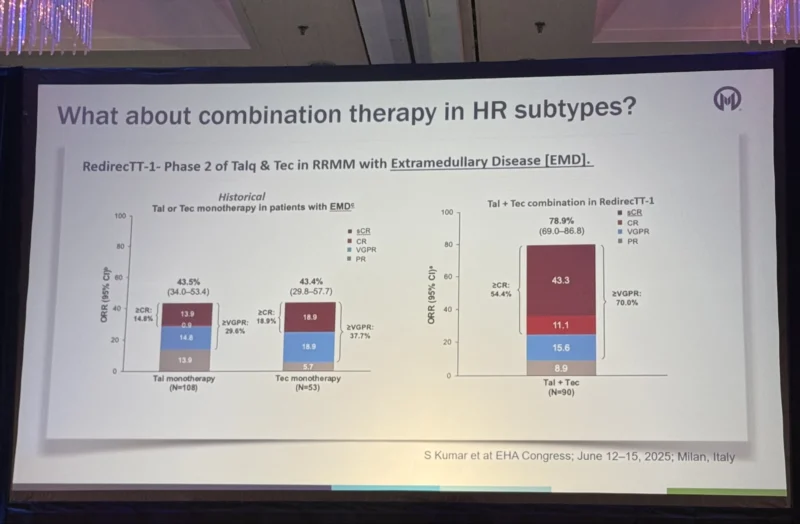
- Combination therapies are showing encouraging activity in high-risk patients. The talquetamab + teclistamab combination demonstrated a 78.9% overall response rate in patients with extramedullary disease in the phase 2 RedirecTT-1 study.
- Despite remarkable efficacy, optimizing treatment safety remains essential. Infection prevention, CRS/ICANS management and understanding resistance mechanisms will be critical to improving outcomes and guiding future treatment strategies.
Summary
- The treatment goals for relapsed MM continue to evolve at a fast pace
- Impressive PFS and MRD negativity rate can be achieved by incorporating BCMA targeting therapy with bi-specifics in RRMM.
- The unprecedented efficacy of BCMA targeting with bispecific begs the question: who will they affect treatment of NDMM?
- The effectiveness is unprecedented, but we have to highly attentive to infection mitigation strategies.
- We are in the midst of a change in the goals of therapy (at least for some)․”
Other articles about multiple myeloma on OncoDaily.