Mira Turgun, Business Development Lead at BioMira Health, shared on LinkedIn:
“Every approved Bispecific T-cell engager carries a boxed warning for cytokine release syndrome.
The 2026 deals in this space are all trying to build one that doesn’t.
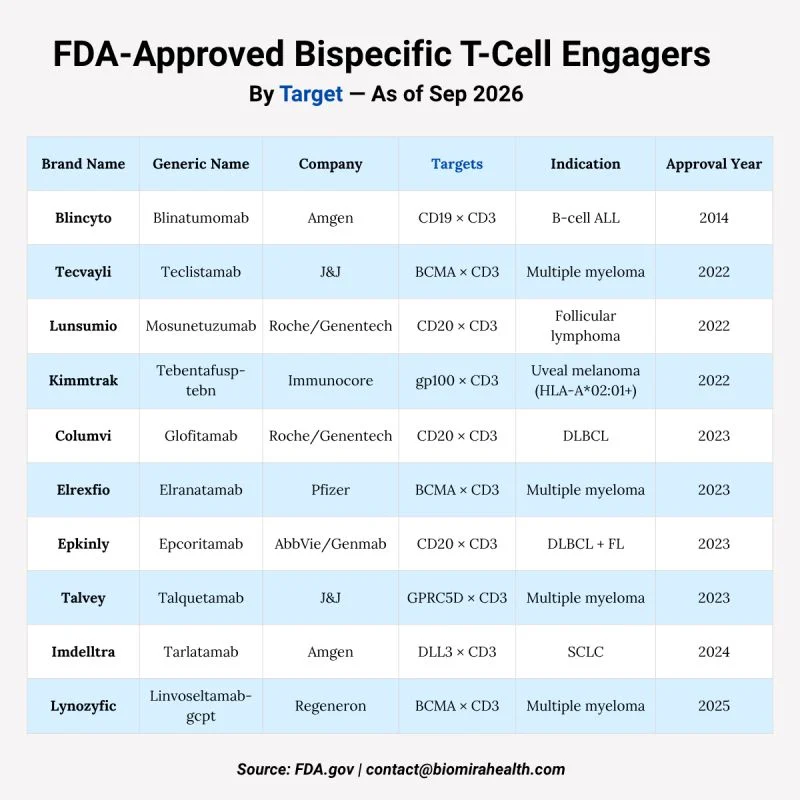
Ten FDA approvals to date:
- CD20 x CD3: 3 (most crowded)
- BCMA x CD3: 3 (myeloma dominant)
- CD19 x CD3: 1 (the pioneer)
- GPRC5D x CD3: 1 (multiple myeloma)
- DLL3 x CD3: 1 (SCLC)
- gp100 x CD3: 1 (uveal melanoma, HLA-restricted)
8 of 10 are in blood cancers.
Hematologic BiTEs are proven and increasingly commoditized.
Solid tumors face a different set of challenges: CRS, the harsh tumor microenvironment, on-target/off-tumor toxicity, and more.
However, 2026’s deals are increasingly trying to solve those challenges:
Astellas + Vir Biotechnology (Feb 2026): up to $1.7B, VIR-5500, a dual-masked PSMA × CD3 T-cell engager; Phase 1 in prostate cancer, designed to activate preferentially in the tumor microenvironment.
Antengene + K2 Therapeutics (Jun 2026): ~$1.92B in potential milestones across two TCE programs, including ATG-106 (CDH6 × CD3) for solid tumors plus an option on a second undisclosed bispecific TCE.
Amberstone Biosciences + Henlius (Sep 2026): up to $440M per target for up to two targets; pH-gated T-cell engagers designed to reduce activity in blood/healthy tissue and preferentially activate under acidic tumor-microenvironment conditions.
So what will unlock the next generation of BiTEs?
New targets or solving the problems that limit existing ones?”
Other articles about multiple myeloma on OncoDaily.