






Miguel Bronchud, Veteran Cancer Clinician and Researcher, shared on LinkedIn:
“Meningiomas account for approximately 25–33% of primary brain tumours in adults, with an incidence of 6–8 per 100000 person – years and a peak incidence between ages 40 years and 60 years.
According to WHO classification, meningiomas are broadly categorised as grade 1 (benign), grade 2 (atypical), or grade 3 (anaplastic).
Atypical meningiomas account for 25–30% of all meningiomas and are associated with significantly higher rates of recurrence.
Meningiomas are relatively frequent and often incidental findings on CT scans of the brain or MRI and account for approximately 25 – 33% of primary brain tumours in adults, with an incidence of 6 – 8 per 100 000 person – years and a peak incidence between ages 40 years and 60 years.
According to WHO classification, meningiomas are broadly categorised as grade 1 (benign), grade 2 (atypical), or grade 3 (anaplastic).
Atypical meningiomas account for 25–30% of all meningiomas and are associated with higher rates of recurrence.
WHO grade 2 atypical meningioma is a primary brain tumour with a high risk of recurrence even after complete surgical resection. The role of adjuvant radiotherapy remains uncertain.
This international research collaboration aimed to assess whether adjuvant radiotherapy reduces recurrence compared with observation in patients with a newly diagnosed atypical meningioma who have undergone complete surgical resection.
NIH EORTC other
ROAM EORTC-1308 was an international, multicentre, open – label, phase 3, randomised controlled trial, conducted at 58 hospitals & academic centres in 11 countries.
Participants assigned to the radiotherapy group received fractionated external – beam intensity – modulated radiotherapy at a total dose of 60 Gy in 30 fractions over 6 weeks. Participants were followed up for a minimum of 4 years.
The primary outcome was disease – free survival, defined as time from surgery to MRI – confirmed recurrence or death due to any cause, analysed in all randomly assigned participants in their assigned treatment group. Harms analysis was done in the as – treated population.
Between April 28, 2016, and May 21, 2021, 990 patients were assessed for eligibility, 157 of whom were randomly assigned to radiotherapy (n=78) or observation (n=79).
Median age was 57·40 years (IQR 49·09–66·93); 84 (54%) participants were female and 73 (46%) were male.
At a median follow-up of 64 months (IQR 50–75), meningioma recurrence occurred in 11 (14%) of 78 participants in the radiotherapy group and 24 (30%) of 79 in the observation group. 5-year disease – free survival was 79·9% (95% CI 67·6–87·9) in the radiotherapy group and 64·3% (51·9–74·2) in the observation group (absolute difference 15·6% percentage points [95% CI 0·6–30·5]).
Disease-free survival was improved in the radiotherapy group compared with the observation group (hazard ratio 0·51 [95% CI 0·27–0·97]; p=0·0396).”
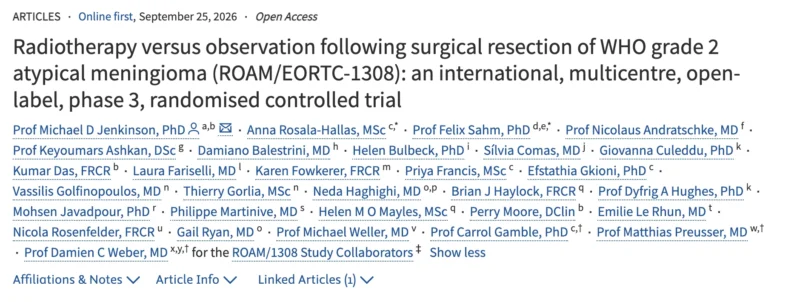
Title: Radiotherapy versus observation following surgical resection of WHO grade 2 atypical meningioma (ROAM/EORTC-1308): an international, multicentre, open-label, phase 3, randomised controlled trial
Authors: Michael D Jenkinson, Anna Rosala-Hallas, Felix Sahm, Nicolaus Andratschke, Keyoumars Ashkan, Damiano Balestrini, Helen Bulbeck, Sílvia Comas, Giovanna Culeddu, Kumar Das, Laura Fariselli, Karen Fowkerer, Priya Francis, Efstathia Gkioni, Vassilis Golfinopoulos, Thierry Gorlia, Neda Haghighi, Brian J Haylock, Dyfrig A Hughes, Mohsen Javadpour, Philippe Martinive, Helen M O Mayles, Perry Moore, Emilie Le Rhun, Nicola Rosenfelder, Gail Ryan, Michael Weller, Carrol Gamble, Matthias Preusser, Damien C Weber
Other articles featuring Miguel Bronchud on OncoDaily.