






Miguel Bronchud, Veteran Cancer Clinician, Researcher, Co-Founder and ex Advisory Board at Regenerative Medicine Solutions, shared on LinkedIn:
“‘How a cancer is found carries information about a patient’s outlook that goes beyond the tumor itself’? Better to avoid being diagnosed cancer in an emergency care unit?
Diagnosis of a cancer upon emergency department presentation was associated with an elevated mortality rate, which was consistent across 16 analyzed cancer types, according to new research findings published in the Journal of the National Cancer Institute.
These conclusions held up even after we accounted for age, cancer stage, other illnesses, and frailty.
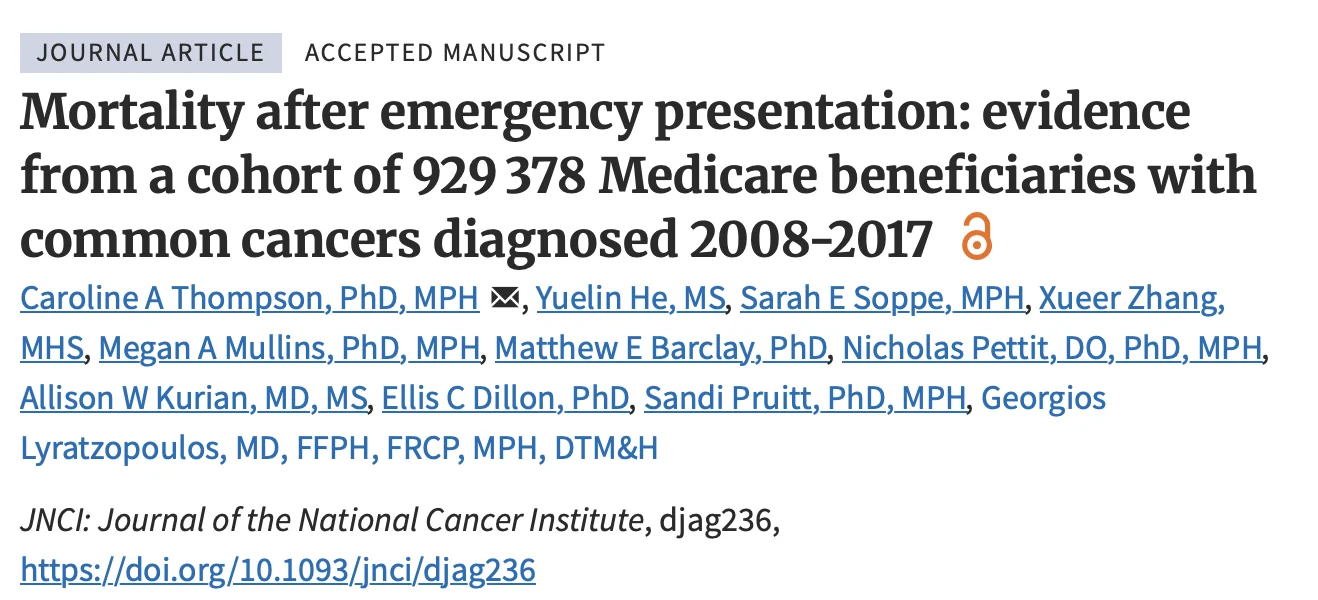
‘Mortality after emergency presentation: evidence from a cohort of 929 378 Medicare beneficiaries …’
The lead author Caroline Thompson, Associate Professor of Epidemiology at the University of North Carolina (UNC) Gillings School of Global Public Health and member of the UNC Lineberger Comprehensive Cancer Center adds ‘How a cancer is found carries information about a patient’s outlook that goes beyond the tumor itself.’
Researchers analyzed individuals diagnosed with cancer in the emergency department and associated mortality after their emergency presentation across 16 cancers in a national Medicare cohort. They identified patients with high-burden cancers who were diagnosed between 2008 and 2017 (n = 929,378), based on SEER-Medicare data.
An emergency presentation was defined by an emergency department claim 30 days before the cancer claim. These presentations were classified as either inpatient or outpatient.
Survival probabilities and mortality risk ratios were estimated, and were also adjusted for demographics, tumor characteristics, comorbidity, frailty, and health-care utilization.
In summary: Twenty-eight percent of the patients diagnosed with high-burden cancers in the study period had an emergency presentation, including 22% inpatient and 6% outpatient.
The most common cancers with an emergency presentation (> 40%) were liver, lung, stomach, colon, ovarian, and pancreatic cancers; cancers less likely (< 10%) to be diagnosed through an emergency presentation included breast and prostate cancer.
At 1 year, the survival rate was 81% for non–emergency presentations, 60% for outpatient presentation, and 36% for inpatient presentation.
Inpatient emergency presentations had a nearly four-fold greater 30-day adjusted mortality than non–emergency presentations (risk ratio [RR] = 3.88; 95% confidence interval [CI] = 3.81–3.96). The risk ratios ranged from 2.1 for pancreatic cancer to 6.3 for lymphoma.
In patients who survived 90 days, inpatient emergency presentation was associated with a 51% higher mortality at 1 year (RR = 1.51; 95% CI = 1.49–1.52), ranging from a risk ratio of 1.1 for pancreatic cancer to 2.1 for lymphoma.
At 1 year, the mortality risk ratio for outpatient emergency presentations was 1.28 (95% CI = 1.26–1.30).”
Title: Mortality after emergency presentation: evidence from a cohort of 929 378 Medicare beneficiaries with common cancers diagnosed 2008-2017
Authors: Caroline Thompson, Yuelin He, Sarah Soppe, Xueer Zhang, Megan Mullins, Matthew Barclay, Nicholas Pettit, Allison Kurian, Ellis Dillon, Sandi Pruitt, Georgios Lyratzopoulos
Read the Full Article on Journal of the National Cancer Institute
Other posts featuring Miguel Bronchud on OncoDaily.