






Miguel Bronchud, Co-Founder at Regenerative Medicine Solutions, shared a post on LinkedIn:
“The oncologist and patient’s “dream of not needing cytotoxic chemotherapy” – to effectively treat cancer – has already been achieved in many malignant diseases (Chronic Myeloid Leukemia with +Phi, since 2001 for example, with oral Gleevec) but it has not yet been achieved in metastatic colorectal patients with a K-RAS mutated Onco driver?
Tabernero J, et al. Second-line adagrasib plus cetuximab vs chemotherapy in patients with KRASG12C-mutated metastatic colorectal cancer: Results from the KRYSTAL-10 trial. ESMO Gastrointestinal Cancers Congress 2026 – LBA1
The chemotherapy-free regimen of the selective KRAS G12C inhibitor, adagrasib, plus cetuximab, a chimeric IgG1 monoclonal antibody targeting EGFR, is not superior to standard treatment in previously treated KRAS G12C-mutated metastatic colorectal cancer (mCRC), according to final data from the phase III KRYSTAL-10 trial(LBA1).
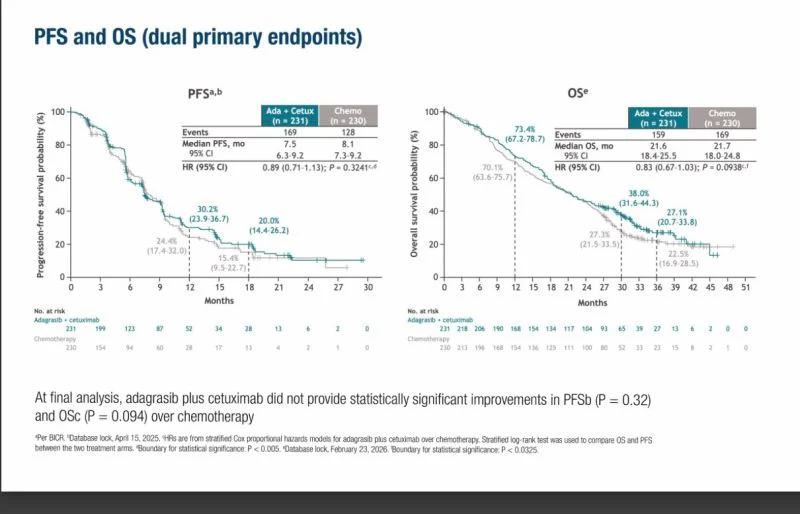
While a numerically higher overall response rate (ORR) was reported for second-line adagrasib combined with cetuximab (47%) compared with chemotherapy (16%), the study did not meet its dual primary endpoints of progression-free survival (PFS) and overall survival (OS), as presented at the ESMO Gastrointestinal Cancers Congress 2026 (Munich, 1–4 July).
High expectations for the combination therapy have arisen owing to the phase I/II efficacy and safety findings of the trial KRYSTAL-1 trial in heavily pre-treated patients with KRAS G12C-mutated mCRC, reporting a response rate of 46%, median response duration of 7.6 months, and median PFS of 6.9 months, with 16% of patients having grade 3–4 adverse events (N Engl J Med. 2023;388:44–54)
But, that level of benefit was not confirmed in the phase III trial, and was not superior to standard care chemotherapy, so the data are disappointing- says Prof. Per Pfeifferfrom the University of Southern Denmark, and Odense University Hospital, Denmark. The reasons why cytotoxic chemotherapy is not worst are largely unknown, but might be related to apoptosis mechanisms. Chemotherapy is (at present) also cheaper.
KRYSTAL-10 is a global, open-label, randomised trial of 461 patients with mCRC who had progressed on first-line fluoropyrimidine-based doublet chemotherapy and were randomised 1:1 to adagrasib plus cetuximab (n=231) or chemotherapy with or without vascular endothelial growth factor (VEGF)/VEGF receptor (VEGFR) inhibitor (n=230).
Median PFS per blinded independent central review was 7.5 months with the adagrasib combination versus 8.1 months with chemotherapy (hazard ratio [HR] 0.89; 95% confidence interval [CI] 0.71–1.13; p=0.3241), and median OS (at a minimum follow-up of 35.3 months for OS) was 21.6 months versus 21.7 months, respectively (HR 0.83; 95% CI 0.67–1.03; p=0.0938). No new safety signals were observed.”
Other articles about Colon Cancer on OncoDaily.