






Maya Fehr, Junior Advisor / Permanent Mission of Switzerland to the OSCE at Federal Department of Foreign Affairs FDFA, shared on LinkedIn:
“I’m incredibly pleased to share my first published research paper, which builds on my MA research and was completed under the invaluable guidance of Professor Martin Bricknell CB OStJ.
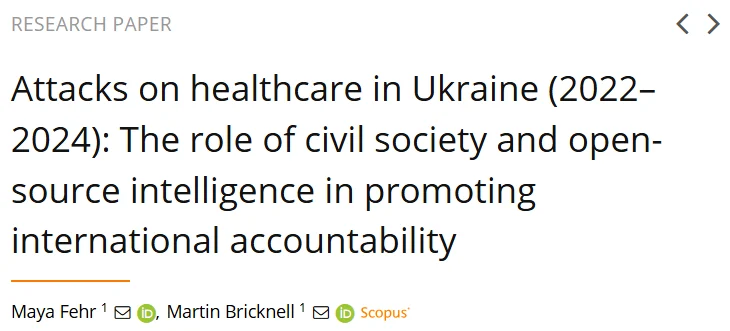
The article ‘Attacks on healthcare in Ukraine (2022–2024): The role of civil society and open-source intelligence in promoting international accountability’ explores how civil society organisations and international institutions are using open-source intelligence (OSINT) and digital verification to document attacks on healthcare (AHC) in Ukraine. By comparing different documentation approaches, the study highlights how networked, multi-stakeholder efforts can strengthen evidence collection, support accountability mechanisms, and help protect healthcare as a legally protected civilian service during armed conflict.
The findings point to an important shift towards collaborative, technology-enabled accountability and underscore the need for stronger partnerships to safeguard healthcare in conflict settings. I hope the research contributes to ongoing discussions on the protection of healthcare, international humanitarian law, and the role of digital evidence in advancing accountability.”
Title: Attacks on healthcare in Ukraine (2022–2024): The role of civil society and open-source intelligence in promoting international accountability
Authors: Maya Fehr, Martin Bricknell
The Institute of Cancer and Crisis (ICC) shared Maya Fehr’s post:
“Sharing a new interesting study that deserves your attention.
Co-authored by Maya F. and Professor Martin Bricknell, the paper ‘Attacks on healthcare in Ukraine (2022–2024): The role of civil society and open-source intelligence in promoting international accountability’ addresses a critical frontier in global health security and humanitarian law.
The article explores how civil society organizations and international institutions are leveraging open-source intelligence (OSINT) and digital verification to document attacks on healthcare (AHC) in Ukraine. By analyzing and comparing different documentation approaches, the study highlights how collaborative, networked, and multi-stakeholder efforts can:
- Strengthen digital evidence collection;
- Support international accountability mechanisms;
- Help safeguard healthcare as a legally protected civilian service during armed conflict.
This timely research underscores an important shift toward technology-enabled accountability and emphasizes the urgent need for stronger global partnerships to protect healthcare in conflict settings.
This is a crucial contribution to the fields of global health, international humanitarian law and conflict studies. We highly recommend diving into their findings to understand the evolving role of digital evidence in protecting vital healthcare infrastructure during crises.”
Other articles about cancer types on OncoDaily.