
Matt Jones, Assistant Professor at MIT Biology, shared on X:
“New paper from my group at Koch Institute at MIT, MIT IMES, MIT Biology!
I am thrilled to share that our paper describing c, a new method for analyzing extrachromosomal DNA amplifications at single-cell resolution, has been published in Nature Communications. Thread below.
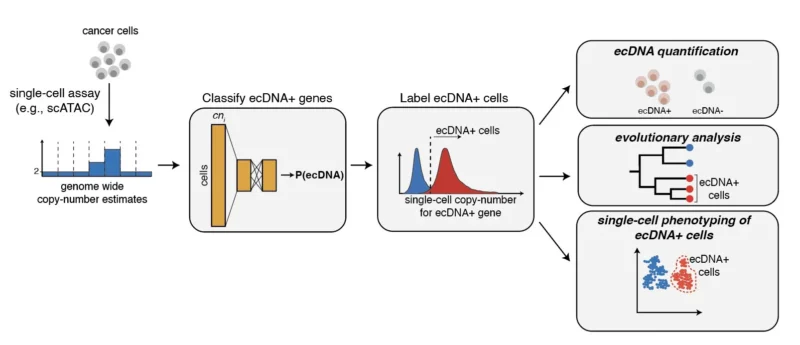
ecDNA is increasingly seen as a hallmark of aggressive cancers, and are mostly studied with bulk assays. But bulk assays often miss subtle copy-number changes or rare ecDNA subclones, and cannot link cell states to ecDNA status. Thus, we introduce scAmp:
scAmp’s algorithm is based on a key feature of ecDNA copy-number distributions: namely that they are over-dispersed compared to chromosomal amplifications. Based on this observation, we trained models to predict ecDNA status directly from single-cell copy-number distributions.
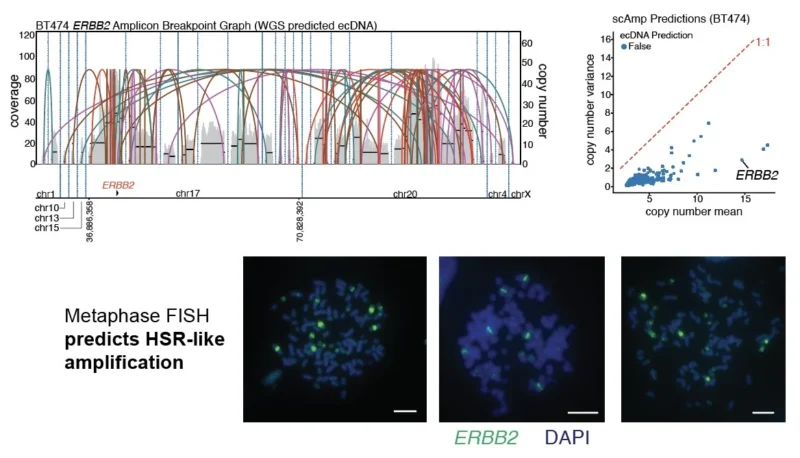
scAmp is accurate on both simulated and cell line data, and also revealed new ecDNA biology: e.g., a class of chromosomal amps that likely derived from ecDNA (e.g., BT474 below). While scAmp accurately classifies these, bulk assays cannot because their sequences resemble ecDNA.
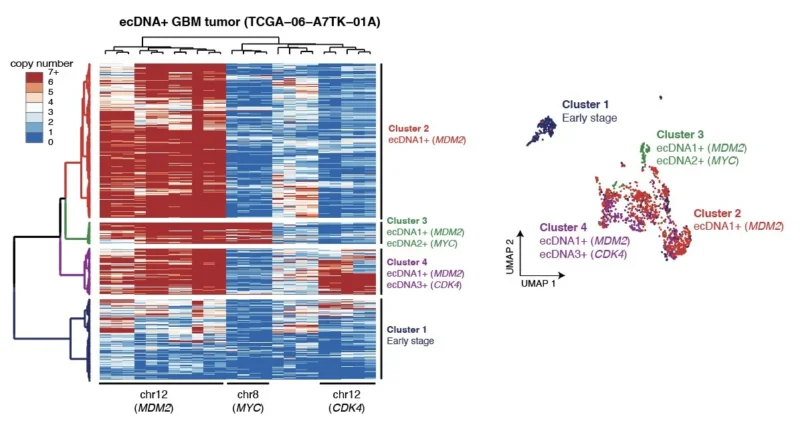
Importantly, scAmp enables retrospective single-cell analyses of ecDNA in patient datasets. We analyzed 73 patient tumors from TCGA, including one GBM sample that showed subclonal evolution of ecDNA, with each subclone showing distinct chromatin accessibility states.
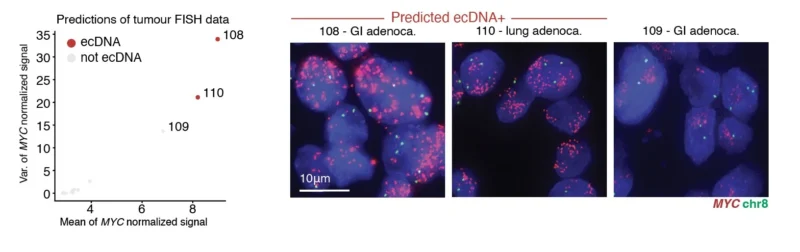
We end our study by speculating that the same principles – over-dispersion being predictive of ecDNA – may extend beyond genomics assays. We show that scAmp can accurately detect ecDNA from DNA FISH on fixed patient samples, a routine clinical assays to detect amplifications.
Together, we envision scAmp opening new avenues in understanding the single-cell dynamics of ecDNA and enabling new diagnostic assays based on readily available fixed patient samples. If you find these directions exciting too, we’re recruiting postdocs so get in touch!
Of course, this was a major team effort that would not have been possible without Howard Chang, Mischel Lab, and my co-first author Natasha Weiser. Thank you also to the terrific reviewers we worked with and editorial staff at Nature Communications!
Also please check out excellent work that details the single-cell genomic evolution of focal amplifications from Jake June-Koo Lee and Sohrab Shah.
We’re thankful for the terrific discussions about these projects these past few years.”
Title: scAmp enables focal gene amplification analysis from single-cell data
Authors: Matthew G. Jones, Natasha E. Weiser, King L. Hung, Xiaowei Yan, Sangya Agarwal, Jens Luebeck, Aditi Gnanasekar, Shu Zhang, Ivy Tsz-Lo Wong, Jun Tang, Brooke E. Howitt, Ellis J. Curtis, Kevin Yu, John C. Rose, Katerina Kraft, Valeh Valiollah Pour Amiri, Leena Satpathy, Vineet Bafna, Paul S. Mischel, Howard Y. Chang
You can also read:
Paul Mischel’s Work on ecDNA is Changing How We Understand Treatment Resistance – CancerWorld