






Massimo Cristofanilli, Professor of Medicine & Associate Director of Precision Medicine at Weill Cornell Medicine, shared a post on LinkedIn:
“An important paper to confirm the prognostic value of MRD detection. The issue is the perceived impact of the information.
We should consider treatment of ‘early’ and asymptomatic metastatic disease the primary endpoint with potential impact on long term outcome. Randomization to observation or no monitoring will not advance clinical application of this sensitive technology.”
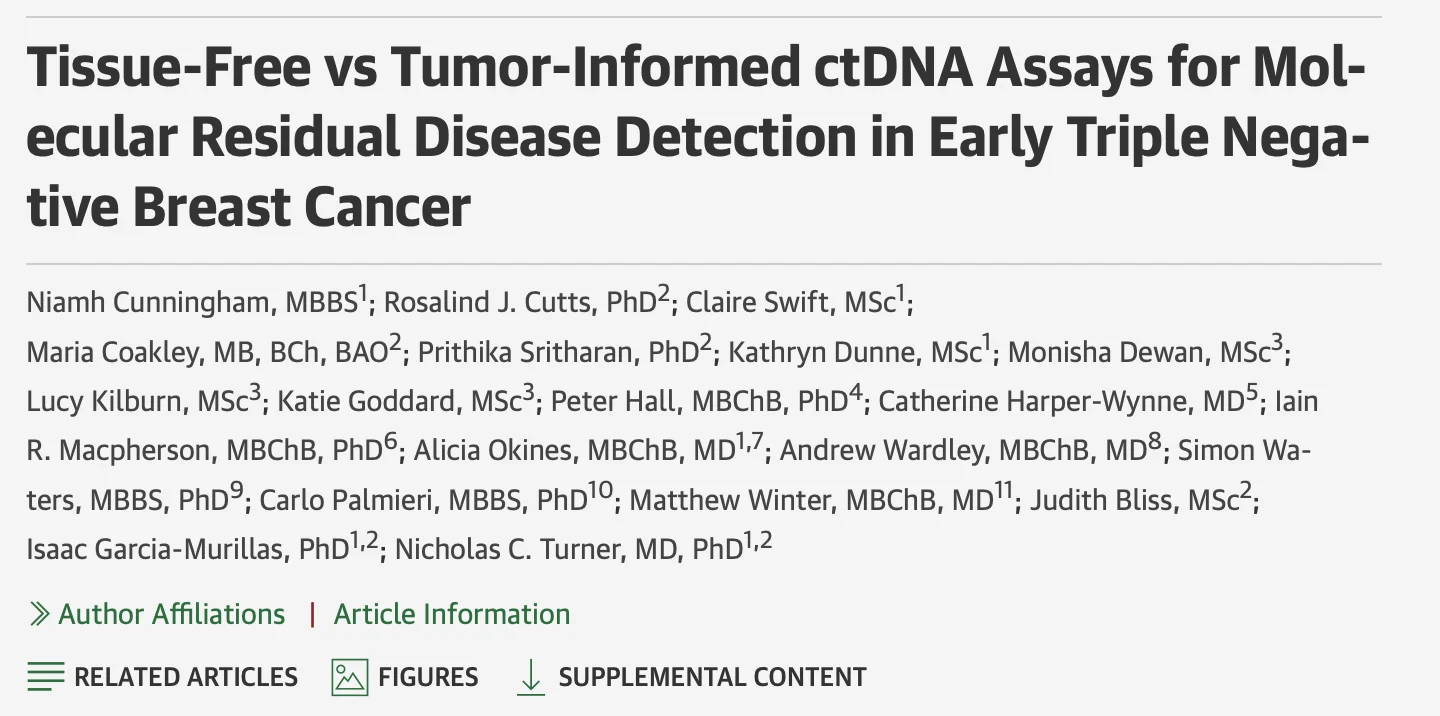
Title: Tissue-Free vs Tumor-Informed ctDNA Assays for Molecular Residual Disease Detection in Early Triple Negative Breast Cancer
Authors: Niamh Cunningham, Rosalind J. Cutts, Claire Swift, Maria Coakley, Prithika Sritharan, Kathryn Dunne, Monisha Dewan, Lucy Kilburn, Katie Goddard, Peter Hall, Catherine Harper-Wynne, Iain R. Macpherson, Alicia Okines, Andrew Wardley, Simon Waters, Carlo Palmieri, Matthew Winter, Judith Bliss, Isaac Garcia-Murillas, Nicholas C. Turner
Read the Full Article on JAMA Oncology
Sarah Sammons, Co-Leader of Breast Oncology at UMGCCC and former Senior Physician at Dana-Farber, shared this post, adding:
“Agree. This technology is here and prognostic albeit not actionable in terms of systemic therapy decision making.
Patients may perceive this information actionable in terms of decision making for their life goals and plans. With optimal counseling, I don’t understand the hesitancy to use it.”