






Marianna Cavazza, Associate Professor of Practice and Cergas Research Fellow at SDA Bocconi, shared on LinkedIn:
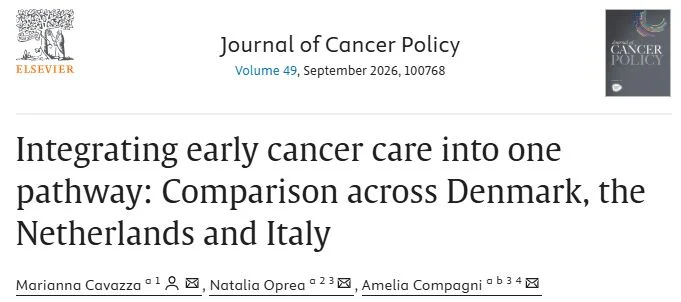
“I am pleased to share the publication of our article ‘Integrating early cancer care into one pathway: Comparison across Denmark, the Netherlands and Italy’, published in the Journal of Cancer Policy.
The article, co-authored with Natalia Oprea and Amelia Compagni, introduces and discusses the notion of early cancer care as a single integrated process: a pathway that starts with education and cancer health literacy, continues through early detection and early diagnosis, and ultimately leads to timely access to early treatment.
This perspective is important because these phases are often addressed separately, through distinct policies, organisations, professional communities and accountability mechanisms. Yet, for early cancer care to be effective, they need to be internally coherent and connected through continuous interaction – and, ideally, integration – among all actors involved along the pathway.
This condition does not yet exist in a fully developed form. We investigate which policy and organisational conditions can support the construction of such an integrated pathway across healthcare systems.
By comparing Denmark, the Netherlands and Italy, we analyse how different countries connect health literacy, early detection, early diagnosis and early treatment, and how integration is shaped by governance arrangements, organisational infrastructures, professional collaboration, information systems, cancer networks and patient pathways.
Our findings show that integration in early cancer care is not achieved through a single instrument. It requires a combination of structural, functional, interpersonal and process integration. Centralised infrastructures, shared standards, multidisciplinary collaboration, cancer networks, stakeholder engagement and patient-centred pathways all play a role – but their relevance and feasibility depend on each country’s institutional context.
The study also highlights that there is no one-size-fits-all model. Rather, policymakers and managers need to identify context-sensitive combinations of policy and organisational tools capable of reducing fragmentation, improving timeliness and ensuring continuity from education to early treatment.
This publication is the scientific output of the research project ‘A ‘Lavender’ Policy Environment for Early Cancer Care’, supported by an unconditional grant from Brunswick Brussels, within the global policy initiative “Mission Early” with the support of Sanofi and MSD.
We would like to thank all the scholars, policymakers, healthcare professionals and operators interviewed for their valuable contribution, insights and availability throughout the research process.
We hope this work can contribute to the debate on how health systems can better govern the growing complexity of cancer care and move towards more integrated, timely and equitable early cancer care pathways.”
Title: Integrating early cancer care into one pathway: Comparison across Denmark, the Netherlands and Italy
Autors: Marianna Cavazza, Natalia Oprea, Amelia Compagni
Other articles about Cancer Types on OncoDaily.