





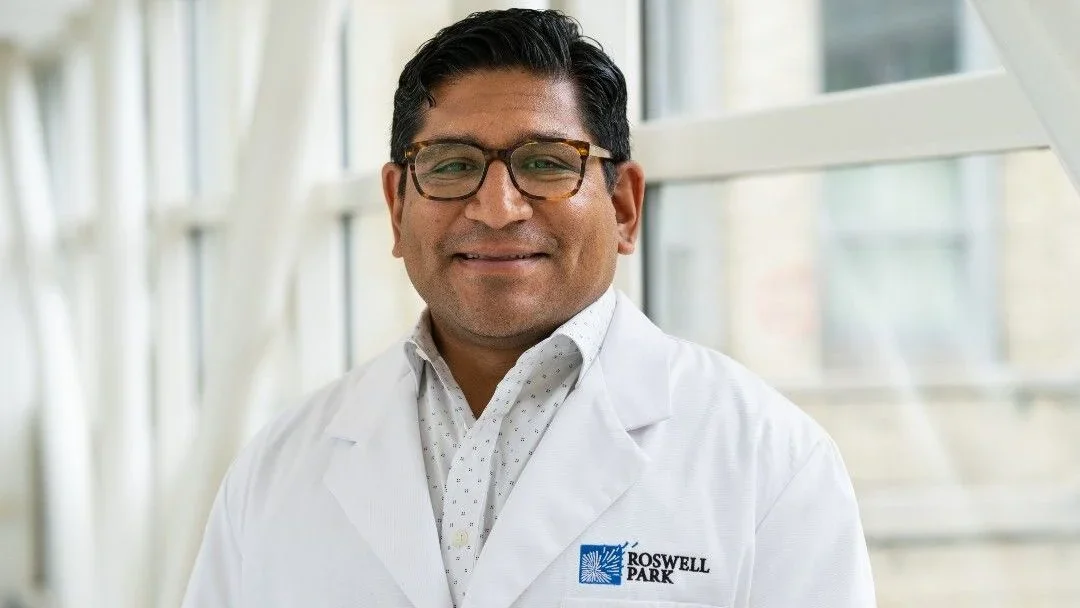
Marco Davila, Senior Vice President, Translational Research at Roswell Park Comprehensive Cancer Center, shared on LinkedIn:
“What if CRP and ferritin are more than CAR T risk markers – what if they point to macrophage biology driving both toxicity and resistance?
Our new Nature Communications paper connects these dots.
This work began at Moffitt Cancer Center and continued at Roswell Park Comprehensive Cancer Center.
I have been fortunate to work with remarkable trainees. Rawan Faramand was a clinical fellow when this work began; Sae Bom Lee and Payal Goala, PhD were graduate students and are now PhDs.
Mike Jain and Frederick Locke started this research project with me and we each pursued different parts of the same problem.
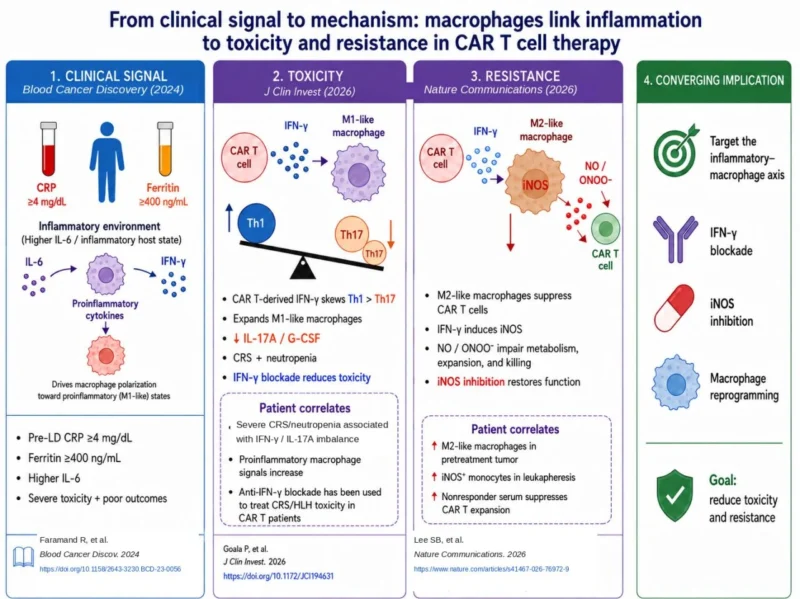
Clinical Signal – In a Blood Cancer Discovery paper Rawan and our colleagues showed that pre-lymphodepletion CRP and ferritin identified patients at risk for severe toxicity and poor outcomes. CRP ≥4 mg/dL plus ferritin ≥400 ng/mL tracked with higher IL-6, suggesting an inflammatory host state before infusion.
Toxicity – In JCI, Payal and our colleagues found that CAR T-derived IFN-γ skewed Th1 over Th17, expanded M1-like macrophages, lowered IL-17A/G-CSF, and disrupted neutrophil homeostasis.
IFN-γ blockade reduced CRS and neutropenia without compromising antitumor activity.
Resistance – Sae Bom’s newly published paper takes the next step.
Non-durable responders had more M2-like macrophages in pretreatment tumors.
CAR T-derived IFN-γ induced macrophage iNOS; nitric oxide/peroxynitrite activated p53 stress, suppressed MYC-dependent protein synthesis, and rewired CAR T metabolism.
iNOS inhibition restored function and improved tumor control.
Patient data helped close the loop: iNOS+ monocytes were increased before lymphodepletion in patients with non-durable responses, while nonresponder serum conditioned macrophages to suppress human CAR T expansion.
Our studies support a coherent, testable model: Elevated CRP/ferritin may mark an inflammatory host state and that state shapes macrophage phenotype macrophages drive systemic toxicity, local CAR T resistance, or both.
The lesson: CAR T outcomes depend not only on the engineered T cell and tumor, but also on the host inflammatory state and macrophage response. I’m grateful to all our co-authors and many collaborators.
Alex Niu and I are now asking whether CRP/ferritin can identify patients most likely to benefit from macrophage-directed or IFN-γ/iNOS-modulating strategies. Which patients, target, and timing would you test first?”
Papers:
IFN-γ-driven iNOS induction in macrophages mediates CAR T cell resistance in B cell lymphoma
Baseline Serum Inflammatory Proteins Predict Poor CAR T Outcomes in Diffuse Large B-cell Lymphoma
Other articles about CAR T on OncoDaily.