






Luca Arecco, Clinical Research Fellow at ESMO, shared a post on X:
“Although formally negative, Neo-CheckRay trial shows intriguing results, and I truly believe this strategy may help reshape clinical practice in the future.
Proud to see primary results just published in Nature Medicine.
Can radiotherapy make “cold” ER+/HER2- breast cancers more sensitive to immunotherapy?
Neo-CheckRay asked exactly this.
A randomized phase II trial testing neoadjuvant chemo + immune-modulating SBRT, with or without durvalumab ± oleclumab.
Study design: 147 patients with high-risk ER+/HER2- early breast cancer were randomized 1:1:1 to:
- chemo + iSBRT
- chemo + iSBRT + durvalumab
- chemo + iSBRT + durvalumab + oleclumab
iSBRT (3x8Gy) was delivered to the primary tumor only.
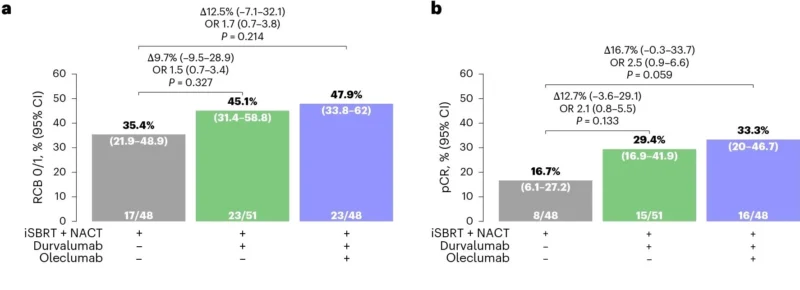
In the ITT population, the primary endpoint was not met.
RCB 0/1 rates:
- 35.4% with chemo + iSBRT
- 45.1% with + durvalumab
- 47.9% with + durvalumab + oleclumab
Numerically higher, but not statistically significant.
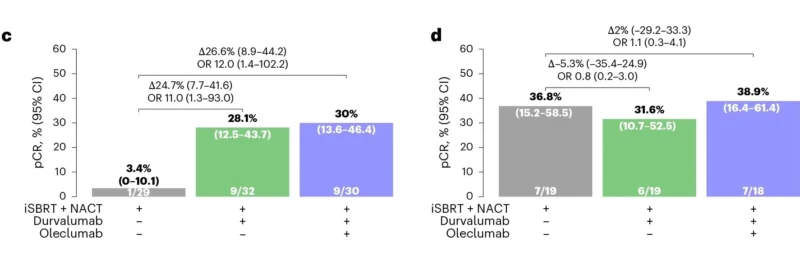
However, important finding in PD-L1-negative tumors.
pCR rates:
- 3.4% with chemo + iSBRT
- 28.1% with + durvalumab
- 30.0% with + durvalumab + oleclumab
This is one of the key biological signal of the study!
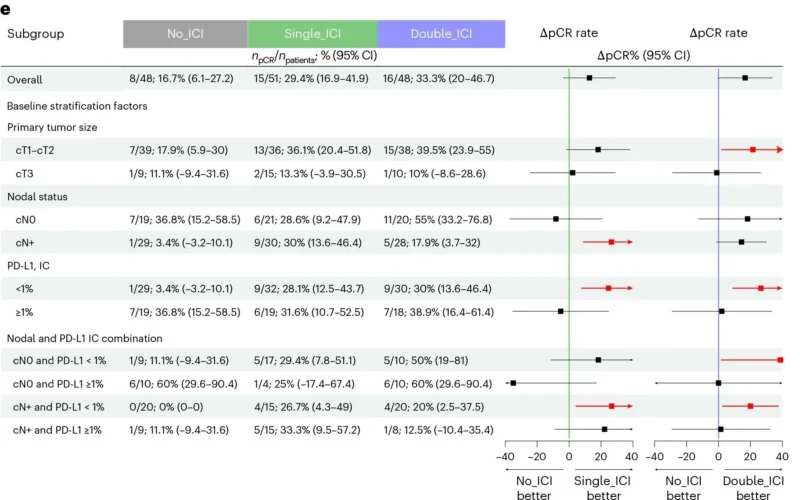
The node-positive subgroup is also worth noting.
Patients with baseline cN+ disease appeared to benefit more from adding ICI. The clearest signal was in patients with both:
- cN+ disease
- PD-L1-negative tumors.
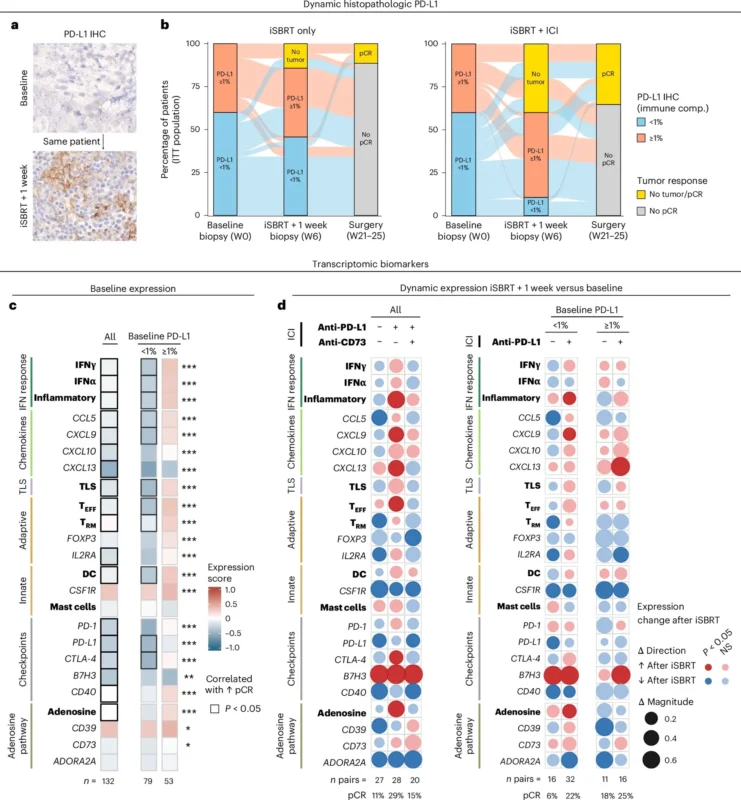
Another important point: iSBRT was directed to the primary tumor, while trying to spare the axilla. Patients receiving <1 Gy to axilla level 1 had a larger pCR benefit from ICI. This supports the idea that preserving nodal immune priming may matter.
Oleclumab did not clearly add much over durvalumab. The double-ICI arm was numerically higher, but the incremental benefit was small.
The main signal seems to be: iSBRT + anti-PD-L1 might be enough.
Safety was consistent with expectations. Grade ≥3 toxicities were higher with ICI, but there were no new safety signals, and no grade ≥3 adverse events related to iSBRT.
Take-home message: Neo-CheckRay suggests that in high-risk ER+/HER2- early breast cancer, RT may be more than local treatment, enhance immune activation and response to neoadj treatments!
A huge thanks to Alex De Caluwe and Buisseret Laurence for the opportunity to contribute to this study, to Institut Jules Bordet Instituut, to all the investigators and to all patients included in the trial.
Title: Neoadjuvant stereotactic body radiation therapy with durvalumab and oleclumab in ER+HER2− breast cancer: a randomized phase 2 trial
Authors: Alex De Caluwé, Isabelle Desmoulins, Kim Cao, Vincent Remouchamps, Adinda Baten, Eleonore Longton, Karine Peignaux, Andrea Joaquin Garcia, David Venet, Luca Arecco, Elisa Agostinetto, Guilherme Nader-Marta, Zoë Denis, Jennifer Dhont, Paulus Kristanto, Xavier Catteau, Denis Larsimont, Roberto Salgado, Philip Poortmans, John Stagg, Christos Sotiriou, Martine Piccart, Michail Ignatiadis, Emanuela Romano, Laurence Buisseret
Read the Full Article.
Other articles about breast cancer on OncoDaily.