


Liam Ghiam, Clinical Associate at the UCI Health, Integrative and Functional Medicine Fellow at the Susan Samueli Integrative Health Institute, shared on LinkedIn:
“The Care-to-Code Loop | 01
A new study in NEJM AI highlights an important point in clinical AI: Clinical completeness is not the same as clinical appropriateness.
Title: Comparative Cost of Care Recommended by Large Language Models versus Treating Physicians
Authors: Dvir Aran, Jeremy D. Goldhaber-Fiebert, Ittai Many, Anthony Nguyen, Daniel Yang, Shahar Shelly
Read the Full Article on NEJM AI
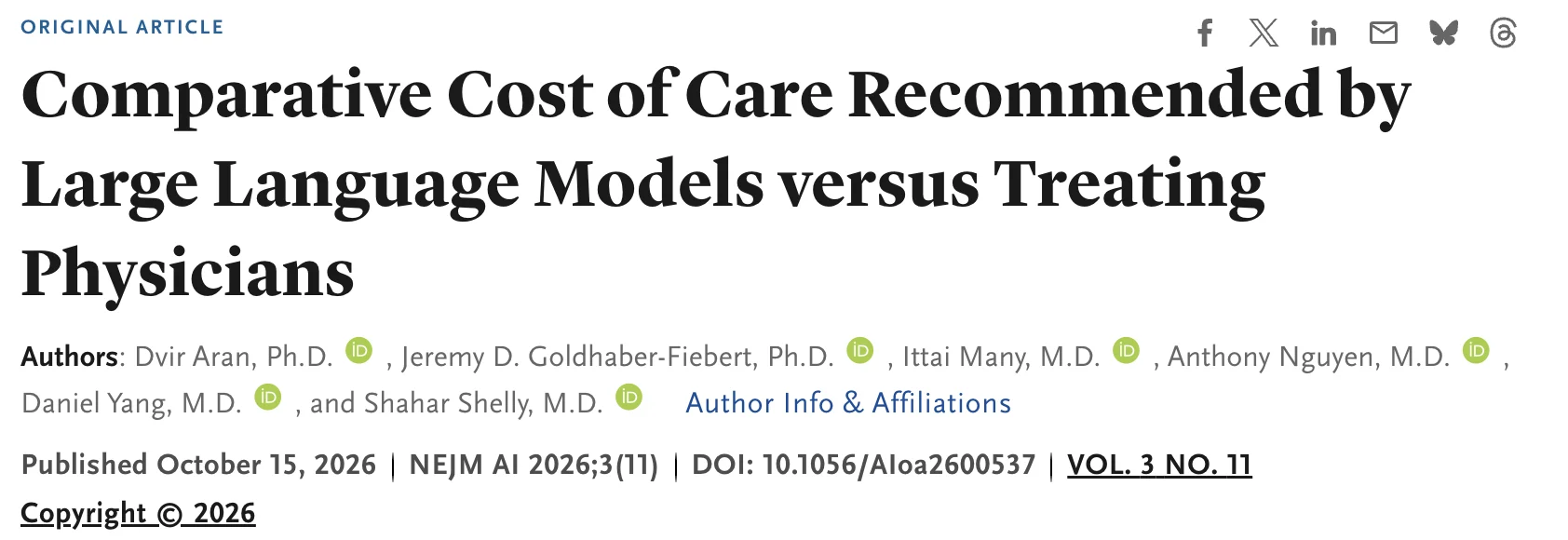
Researchers compared care recommendations from 24 AI systems with physicians’ documented plans across 200 encounters. AI generally recommended more testing and referrals, resulting in higher estimated costs.
These findings do not mean physicians made better decisions or that all additional testing was unnecessary. The study compared recommendations, so we do not know whether those additional tests would have improved patient care.
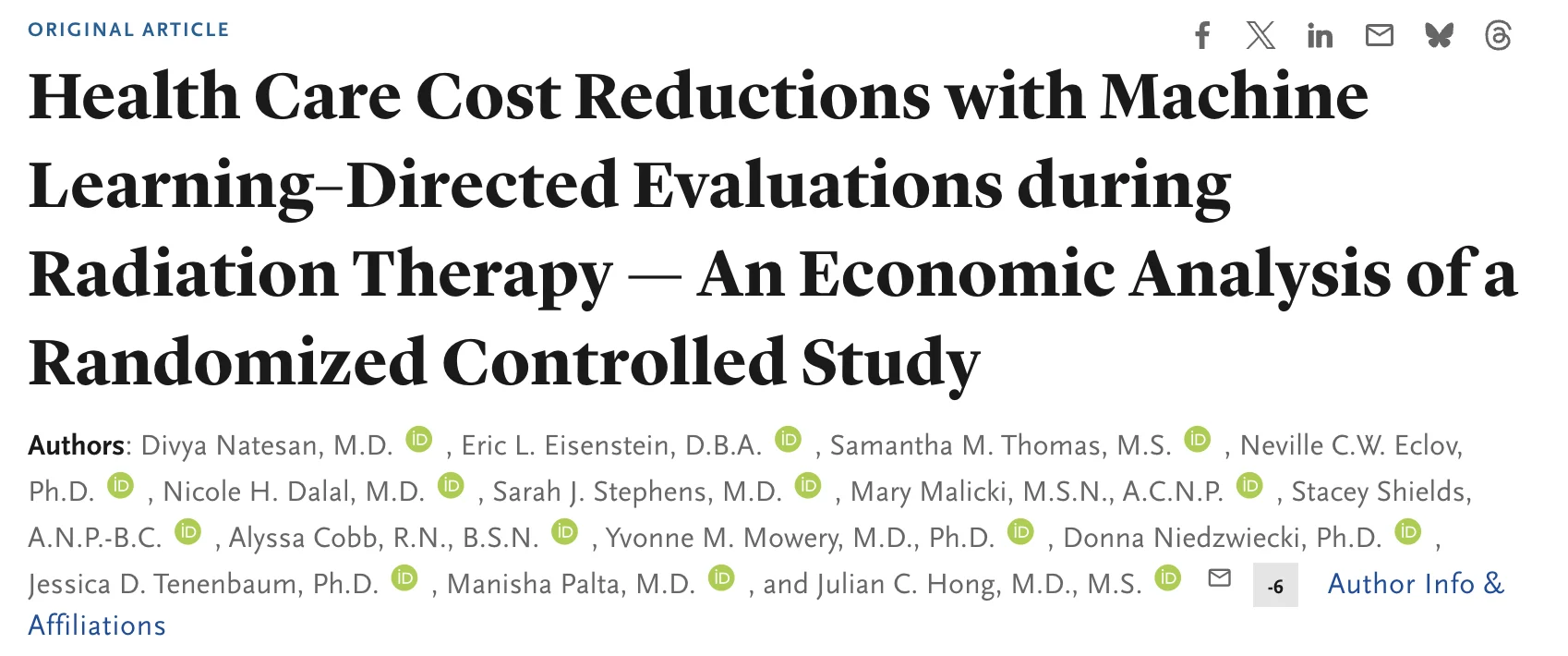
In a related study, the SHIELD-RT randomized trial in radiation oncology showed a contrasting perspective. ML-guided risk stratification helped identify high-risk patients who benefited from more frequent clinical evaluations during radiotherapy, reducing acute care visits and overall medical costs.
Title: Health Care Cost Reductions with Machine Learning–Directed Evaluations during Radiation Therapy — An Economic Analysis of a Randomized Controlled Study
Authors: Divya Natesan, Eric L. Eisenstein, Samantha M. Thomas, Neville C.W. Eclov, Nicole H. Dalal, Sarah J. Stephens, Mary Malicki, Stacey Shields, Alyssa Cobb, Yvonne M. Mowery, Donna Niedzwiecki, Jessica D. Tenenbaum, Manisha Palta, Julian C. Hong
Read the Full Article on NEJM AI
Diagnostic accuracy alone is not enough to evaluate AI in clinical practice. We also need to assess the appropriateness of its recommendations for individual patients, considering clinical context, competing risks, treatment burden, financial & time toxicity, and the value of intervention versus no intervention.
In clinical practice, sometimes less is more. As SHIELD-RT reminds us, sometimes doing more for the right patients leads to better care.
What are the best ways to evaluate clinical appropriateness in AI? Which metrics would be most meaningful?”
Other posts featuring Liam Ghiam on OncoDaily.