Kyle Strickland, Assistant CLIA Laboratory Director, Labcorp Oncology (PGDx) at Labcorp, shared a post on LinkedIn:
“We just published in JCO Clinical Cancer Informatics – and this work illustrates something important about where molecular diagnostics is headed.
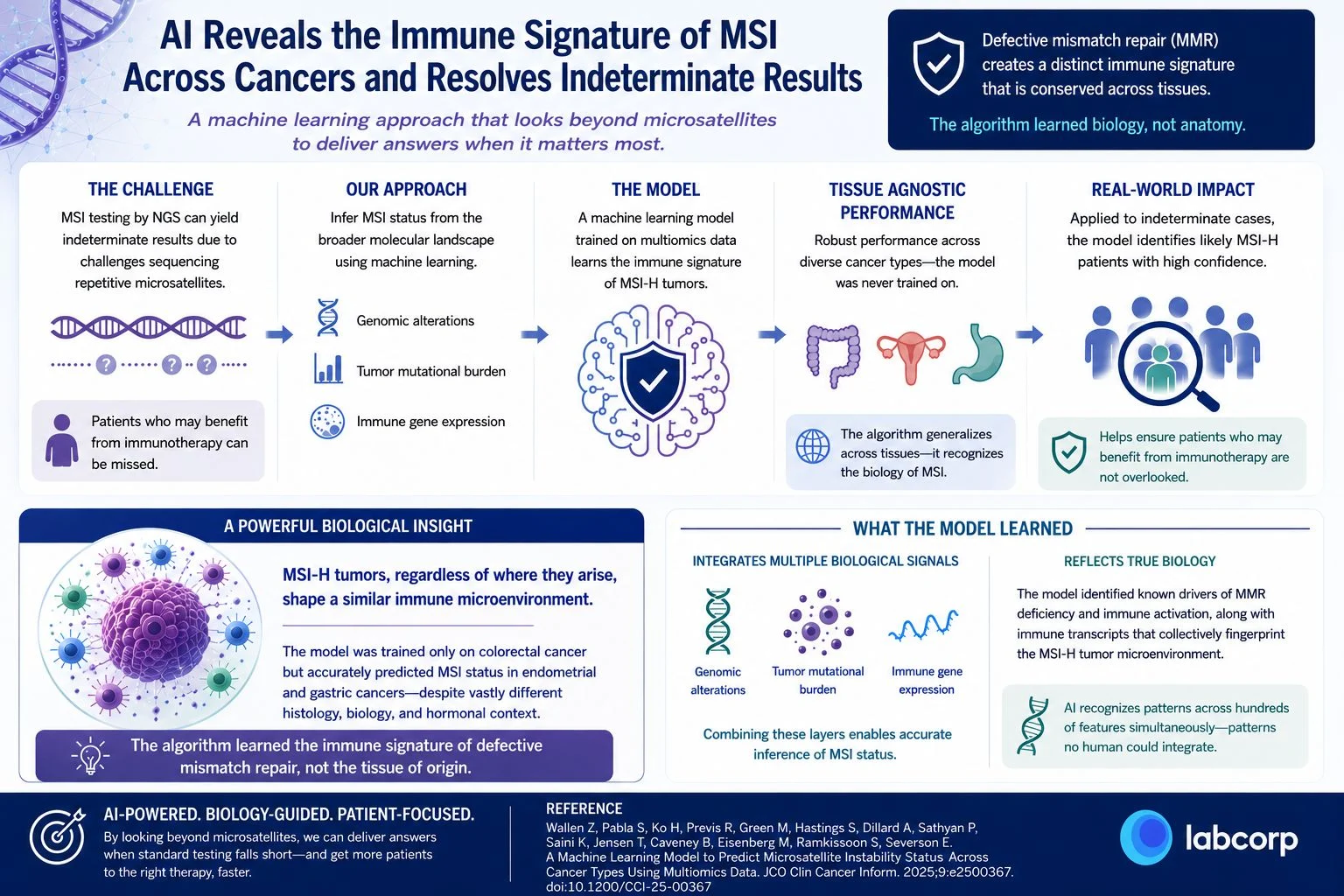
The problem: microsatellite instability (MSI) detection via NGS occasionally yields indeterminate results due to the inherent challenges of sequencing repetitive regions. When that happens, patients who might benefit from immunotherapy can fall through the cracks.
Our approach: we asked whether MSI status could be inferred from the broader molecular landscape – genomic alterations, TMB, and immune gene expression – using machine learning. We trained a CART model on multiomics data from 2,756 colorectal cancers tested via OmniSeq INSIGHT at Labcorp and validated across CRC, TCGA, uterine, and gastric cohorts.
The results were strong (ROC-AUC 0.86–0.97 across cohorts), but here’s what I find most compelling from a biological standpoint:
The model was trained exclusively on colorectal cancer. It had never seen a uterine tumor. Yet it predicted MSI status in endometrial cancers with meaningful accuracy.
Think about what that means – colorectal and endometrial cancers look nothing alike under the microscope. They express different lineage-specific transcription factors, arise in entirely different anatomic and hormonal contexts, and have distinct morphologic spectra. But the immune microenvironment sculpted by defective mismatch repair is conserved across both. The algorithm learned the immune signature of MSI, not the tissue of origin. That’s a powerful biological finding embedded in a computational result.
This is where AI genuinely changes molecular pathology. Not by replacing pathologists, but by recognizing patterns across hundreds of features simultaneously – patterns that no human could integrate at the bedside or the microscope. The algorithm identified 107 features, including expected players like RNF43, ARID1A, and MMR genes, but also immune transcripts that collectively fingerprint the MSI-H tumor microenvironment.
Critically, we applied the model to 53 cases with indeterminate microsatellite sequencing. Of 6 cases flagged as likely MSI-H, 100% showed ≥40% unstable loci on partial sequencing, and the majority demonstrated MLH1/PMS2 loss by IHC. These are real patients who might otherwise have been sent for repeat testing or missed entirely.”