






Krupa Naran, Freelance Medical Writer and Scientific Visual Communicator at The Erudite Communications, shared on LinkedIn:
“The Access Gap: Why a Preventable Cancer Still Kills
Every two minutes, a woman dies of cervical cancer. It is one of the most preventable cancers there is, caused almost entirely by a single virus we already vaccinate against.
That contradiction sits at the centre of women’s health. The tools to stop cervical cancer at its source already exist, yet it is still the fourth leading cause of cancer death in women, and 94% of those deaths fall in lower- and middle-income countries.
The paradox is stark:
- Almost entirely preventable: around 99% of cases are caused by HPV
- Still around 350,000 deaths a year
- Global first-dose HPV vaccination: roughly one in five girls
For years the barrier was supply and cost. That is changing. Gavi, the Vaccine Alliance and partners have now protected an estimated 86 million girls and helped prevent more than a million future deaths, with coverage in Africa overtaking Europe. Supply is no longer the main constraint. Delivery, screening and eroding vaccine confidence are, even in wealthy countries: in Canada, cervical cancer is now the fastest-rising cancer.
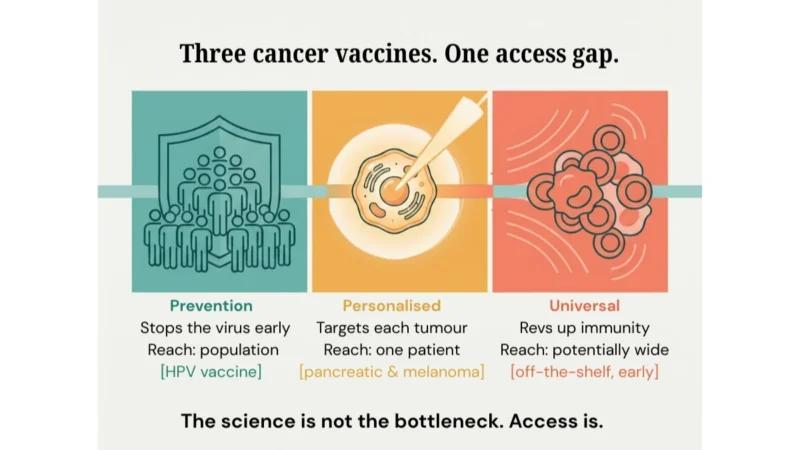
And the same gap is spreading across oncology. ‘Vaccine’ now means three things in cancer care:
- prevention through the HPV vaccine,
- personalised mRNA vaccines built for a single patient,
- and the first universal, off-the-shelf candidates.
The science is moving faster than access to it. The money follows the dazzling and the personalised. The largest number of lives sits with the cheap and the preventable.
Read the full analysis of why this gap persists and what it would take to close it, from the prevention gap to the newest cancer vaccines.
Cervical Cancer Could Be the First Cancer Eliminated. So Who Gets the Vaccine?
This article explores:
- Why cervical cancer is poised to become the first cancer humanity eliminates, and what “elimination” actually means.
- How a single virus writes a cancer at the molecular level, and how the vaccine interrupts the story before it starts.
- Why a preventable cancer still kills hundreds of thousands of women a year, and why even wealthy countries are now sliding backwards.
- How the new mRNA neoantigen vaccines fight cancer by a completely different logic, and why their bespoke design makes them powerful but hard to scale.
- Whether universal, off-the-shelf cancer vaccines could close the access gap the field is opening, or simply widen it.
- What researchers, communicators, industry and funders would each need to do to make cancer vaccines reach the people who need them most.
Introduction
In a handful of countries, something historic is quietly happening. The first generation of girls offered the HPV vaccine has reached adulthood, and in that generation cervical cancer is starting to disappear. Norway has recorded no HPV-caused cervical cancer among the under-25s who were first to be vaccinated. Sweden is on course to be the first country to cross the elimination threshold. For the first time in the history of oncology, we are watching a cancer being stopped at its source.
The World Health Organization has recognized that cervical cancer could be the first cancer ever to be eliminated. Nearly all of it is caused by one virus, and we have a vaccine that stops that virus.
And yet, in 2022, only about one in five girls worldwide had received a first dose. A cancer we know how to prevent still kills around 350,000 women a year, one roughly every two minutes, and 94% of those deaths fall in low- and middle-income countries. The science is not the bottleneck. The science already exists. The bottleneck is who it reaches.
That gap is the real story, because cervical cancer is no longer the only place the word “vaccine” appears in oncology. There are now three kinds of cancer vaccines at very different stages of maturity, and the same underlying question, the distance between what is possible and who benefits, applies to all three.
Prevention: a vaccine that works, and does not reach everyone
Cervical cancer is the rare cancer with one clear cause. Around 99% of cases trace back to persistent infection with high-risk HPV, chiefly types 16 and 18. Block the virus and you block the cancer years before it could begin, and you protect even the unvaccinated by starving the virus of hosts. That is why the WHO set its 90-70-90 targets for 2030: 90% of girls vaccinated, 70% of women screened, 90% of those with disease treated. Australia is on track for the early 2030s. Bhutan became the first low- or middle-income country to hit all three targets, in 2023.
The problem is coverage. In many low- and middle-income countries, fewer than 5% of women are ever screened, and global first-dose vaccination sits at roughly one in five.
Some of that gap is now closing. Gavi, the Vaccine Alliance which supplies HPV vaccines to many of the world’s lowest-income countries, has in the past few years reached more girls than in the whole of the preceding decade, and reports that vaccine supply is, for the first time, no longer the barrier. What remains is delivery: getting doses, screening and treatment to the women who need them.
‘Equity must be at the heart of our elimination strategy’, the WHO’s Director-General, Dr Tedros Adhanom Ghebreyesus, told health ministers in 2025. ‘Together, we can consign cervical cancer to the history books.’
And progress can reverse. In Canada, a wealthy country, cervical cancer is now the fastest-increasing cancer, rising 3.7% a year since 2015 as vaccination and screening slip. Elimination is not achieved once and then kept automatically. It depends on sustained coverage, and that coverage can fall.
Personalised treatment: precision that is hard to scale
While the HPV vaccine stops cancer starting, a newer class of vaccine treats cancers that already exist, by a completely different logic. When a tumour is removed, it is sequenced, its unique mutations identified, and an mRNA vaccine is built to order to train the immune system against them.
The early results are striking in some of the hardest cancers. In pancreatic cancer, the individualised vaccine autogene cevumeran produced responses in half the patients in a small Phase 1 trial, and at the latest follow-up seven of the eight responders were alive four to six years after treatment. In high-risk melanoma, the personalised vaccine intismeran autogene cut the risk of recurrence or death by 49% at five years alongside pembrolizumab, and reduced distant spread by 59%.
But each of these vaccines is bespoke, sequenced and made for a single patient over weeks. The HPV vaccine reaches millions with one product. A neoantigen vaccine reaches one person with one product. If the future of cancer treatment is personalised, that does not, on its own, make it more equal.
The universal frontier: a promise and a familiar risk
The newest approach does not target any specific tumour. It simply switches the immune system on, as if fighting an infection, and lets an accompanying immunotherapy do the aiming. A generalised mRNA vaccine, built much like the COVID-19 vaccines, shrank and sometimes eliminated treatment-resistant tumours in mice when paired with a checkpoint inhibitor. A parallel effort is building off-the-shelf vaccines against mutations many patients share, such as those in the KRAS gene.
This work is early, mostly in animal models or first-phase trials. But its promise is the thing the personalised vaccines lack: something made once and given to many. An off-the-shelf vaccine could democratise treatment the way the HPV vaccine could democratise prevention. Or it could arrive first where access is already best. The biology will decide whether it works. Who it reaches will come down to cost, policy and delivery, not to the science.
What happens next
The vaccine spectrum, from prevention to personalisation to a possible universal option, is a map of extraordinary scientific progress. It is also, at every stage, a test of distribution. Different actors hold different parts of the answer.
For researchers, the central question is no longer only whether cancer vaccines work, but whether they can be built to scale. The contest between personalised and off-the-shelf designs is, at heart, a contest about access.
For science communicators, the Canadian warning matters as much as any trial result. A vaccine that is not trusted is a vaccine that is not taken, and eroding confidence can undo decades of progress as surely as any supply shortage. Protecting elimination means protecting the case for it.
For industry and policymakers, prevention remains the highest-return intervention in all of oncology, and one of the most underfunded relative to the therapeutic frontier. The money and attention flow towards the dazzling and the personalised. The largest number of lives sits with the cheap and the preventable.
For global health funders, the window is now. Vaccine supply is, for the first time, not the binding constraint. Delivery, screening and treatment access are. The tools to eliminate a cancer already exist. Whether they reach the women who need them is a choice, not a scientific problem.
The rule or the exception
We are about to prove, with cervical cancer, that a cancer can be erased. The question that remains is whether it becomes the rule, or stays the exception.
The only change is that ‘The rule or the exception’ now drops its first paragraph (the map-of-progress and money-follows-the-dazzling lines), because those points have moved up into the section above. This keeps the four audience segments intact for your different readers while removing the repetition, and it lets the piece close on the single sharp line rather than restating the argument twice.
A longer version of this piece, with the molecular detail and full references, is on my blog. The fuller piece goes deeper into the mechanism and the treatment-vaccine data, and carries the complete references, for anyone who wants it.”
Other articles about cervical cancer on OncoDaily.