Kefah Mokbel, Professor of Medicine at Cardiff University School of Medicine, shared on LinkedIn:
“Beyond Detecting Cancer Recurrence: Can Whole-Genome Sequencing-Based ctDNA Monitoring Help Personalize Adjuvant Treatment?
An exciting new study published in The Oncologist highlights the clinical potential of Signatera Genome, a whole-genome sequencing (WGS)-based, tumor-informed circulating tumor DNA (ctDNA) assay, not only for detecting molecular residual disease (MRD), but also for potentially informing adjuvant treatment decisions.
Study overview
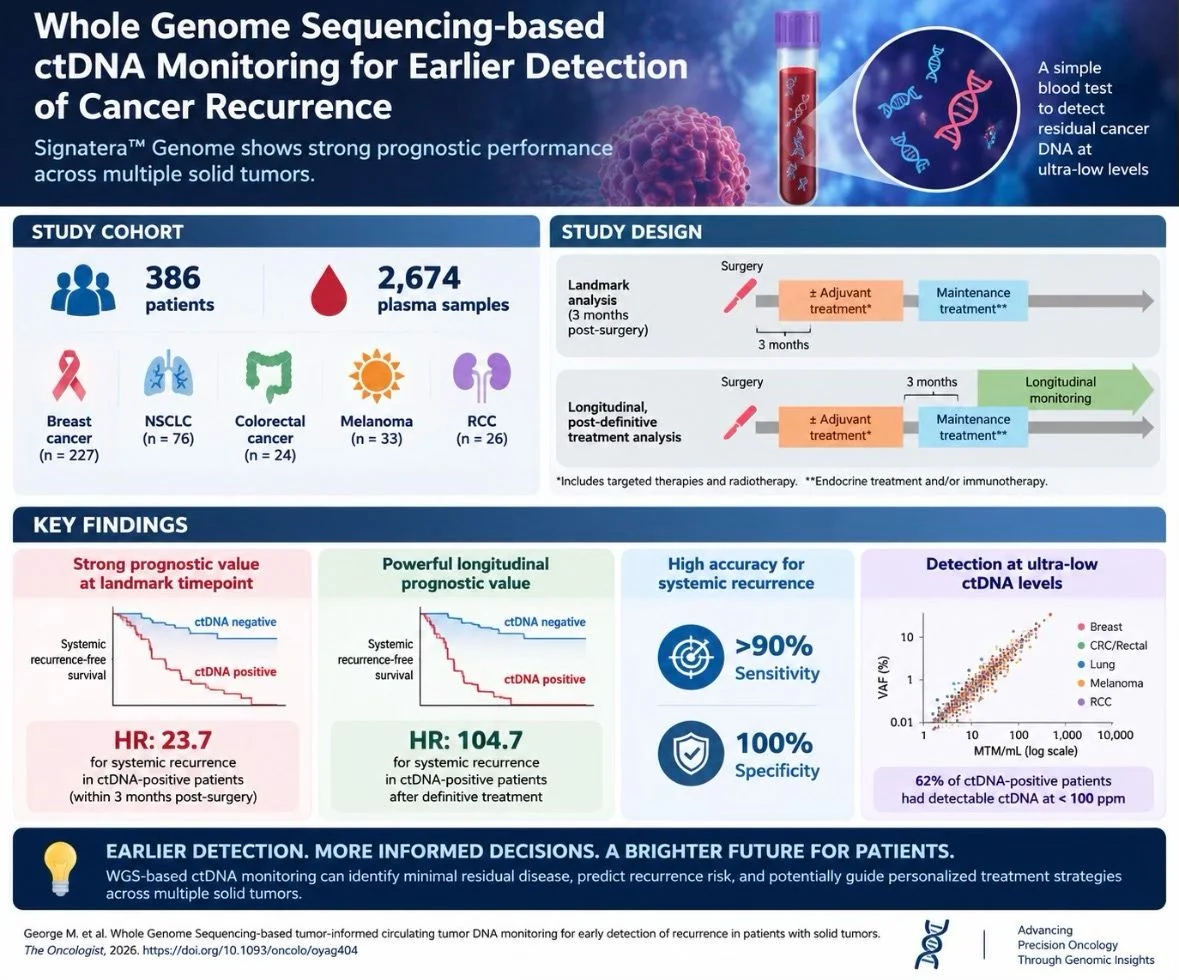
The retrospective pan-cancer analysis included 386 patients and 2,674 plasma samples across five solid tumor types: breast cancer, non-small cell lung cancer, colorectal cancer, melanoma, and renal cell carcinoma.
Key findings:
- Strong prognostic value: MRD positivity within three months after surgery was associated with significantly worse systemic distant recurrence-free survival (DRFS) (HR: 23.7; p < 0.0001).
- Potential benefit from adjuvant therapy: Among MRD-positive patients, 12-month systemic DRFS was 67.1% with adjuvant treatment versus 33.3% without treatment—a 33.8 percentage-point difference.
- Median systemic DRFS was also longer in treated versus untreated MRD-positive patients (34.6 vs. 8.8 months), although this difference was not statistically significant due to small patient numbers.
- Potential for treatment de-escalation: MRD-negative patients showed no clear systemic DRFS benefit from adjuvant therapy, raising the possibility that molecular risk stratification could help identify patients who might avoid unnecessary treatment in the future.
- Powerful longitudinal monitoring: MRD positivity during post-treatment surveillance was strongly associated with systemic recurrence (HR: 104.7; p < 0.0001).
- Ultra-sensitive detection: The assay demonstrated greater than 90% sensitivity and 100% specificity for systemic recurrence in longitudinal surveillance, with 62% of ctDNA-positive patients having detectable ctDNA at levels below 100 parts per million.
The bigger picture
The true potential of ctDNA monitoring extends beyond detecting recurrence.
It raises an important clinical question:
Can we move from treating patients based primarily on clinicopathological risk factors toward tailoring adjuvant therapy according to molecular evidence of residual disease?
These findings offer encouraging evidence supporting that direction.
However, the retrospective design, small treatment subgroups, and non-randomized treatment decisions mean that prospective clinical trials are essential before MRD status can reliably guide treatment escalation or de-escalation.
The future of precision oncology may not simply be about detecting cancer earlier, but also about identifying who needs additional treatment, who may not, and when intervention could make the greatest difference.”
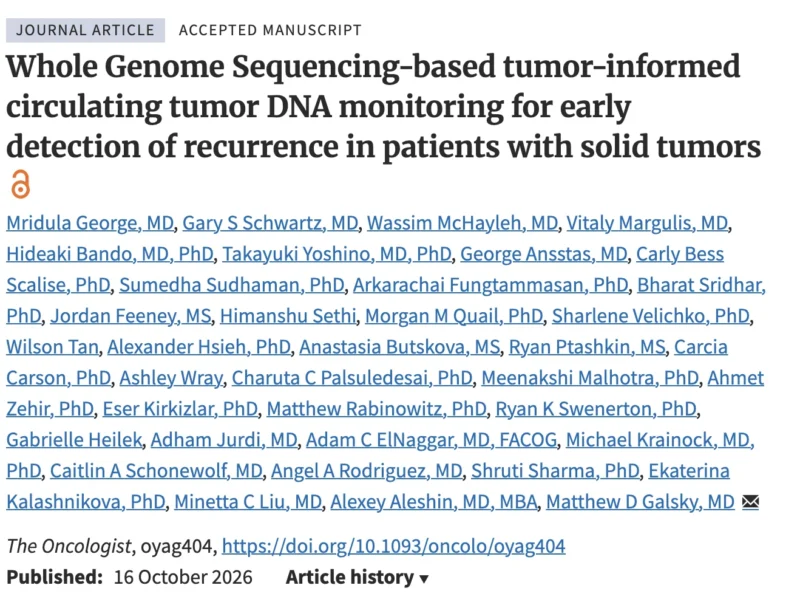
Title: Whole Genome Sequencing-based tumor-informed circulating tumor DNA monitoring for early detection of recurrence in patients with solid tumors
Authors: Mridula George, Gary G Schwartz, Wassim McHayleh, Vitaly Margulis, Hideaki Bando, Takayuki Yoshino, George Ansstas, Carly Bess Scalise, Sumedha Sudhaman, Arkarachai Fungtammasan, Bharat Sridhar, Jordan Feeney, Himanshu Sethi, Morgan M Quail, Sharlene Velichko, Wilson Tan, Alexander Hsieh, Anastasia Butskova, Ryan Ptashkin, Carcia Carson, Ashley Wray, Charuta C Palsuledesai, Meenakshi Malhotra, Ahmet Zehir, Eser Kirkizlar, Matthew Rabinowitz, Ryan K Swenerton, Gabrielle Heilek, Adham Jurdi, Adam C ElNaggar, Michael Krainock, Caitlin A Schonewolf, Angel A Rodriguez, Shruti Sharma, Ekaterina Kalashnikova, Minetta C Liu, Alexey Aleshin, Matthew D Galsky.
Other articles featuring Kefah Mokbel on OncoDaily.