Kefah Mokbel, Chair of Breast Cancer Surgery at London Breast Institute and Honorary Professor of Medicine at Cardiff University School of Medicine, shared a post on LinkedIn:
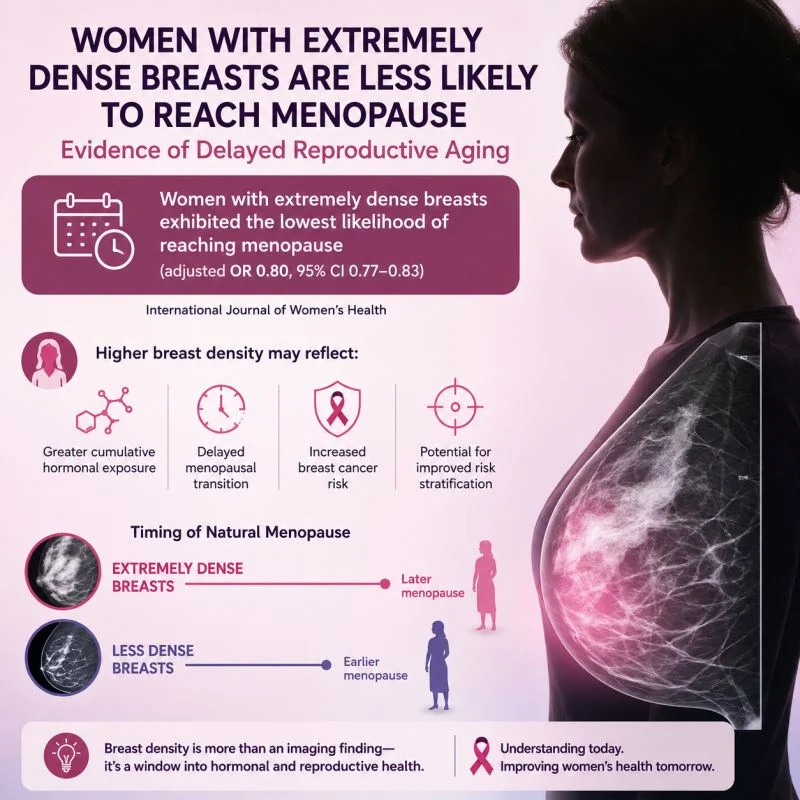
“Women with Extremely Dense Breasts Are Less Likely to Reach Menopause: Evidence of Delayed Reproductive Aging
A newly published population-based study has reported an intriguing association between mammographic breast density and the timing of natural menopause.
The investigators found that women with extremely dense breasts had the lowest likelihood of reaching menopause (adjusted OR 0.80, 95% CI 0.77–0.83), suggesting a significantly delayed menopausal transition compared with women with less dense breasts. (Dove Medical Press)
This finding adds to the growing body of evidence that mammographic breast density may reflect more than just breast cancer risk. It may also serve as a marker of reproductive aging and cumulative hormonal exposure.
The clinical implications are noteworthy:
- Dense breast tissue is a well-established independent risk factor for breast cancer.
- Delayed menopause extends lifetime exposure to endogenous oestrogens, another recognised breast cancer risk factor.
- The observed relationship may help explain, at least in part, the biological link between breast density and breast cancer development.
- Mammographic breast density could potentially contribute to more personalised risk stratification and prevention strategies.
As our understanding of breast density evolves, it is becoming increasingly clear that it represents not merely an imaging characteristic but a window into broader hormonal and reproductive health.
Potential Biological Explanation
The observed association between extremely dense breasts and delayed menopause is biologically plausible, as mammographic breast density is strongly influenced by ovarian hormones, particularly estradiol. Women with dense breasts may represent a phenotype characterized by prolonged ovarian hormonal activity, slower reproductive aging, and delayed depletion of the ovarian follicular reserve. Consequently, both high breast density and later menopause may arise from a common underlying biological process rather than a direct causal relationship. In addition, shared genetic, hormonal, and growth factor pathways that regulate breast tissue composition and reproductive aging may contribute to this association. This mechanism is clinically relevant because both high mammographic density and late menopause are independently associated with increased breast cancer risk, likely through greater cumulative exposure to endogenous estrogens and a more proliferative breast microenvironment.”