Kefah Mokbel, Chair of Breast Cancer Surgery at London Breast Institute and Honorary Professor of Medicine at Cardiff University School of Medicine, shared a post on LinkedIn:
“Targeted Axillary Dissection After Neoadjuvant Therapy: Further Validation from a Major Meta-Analysis
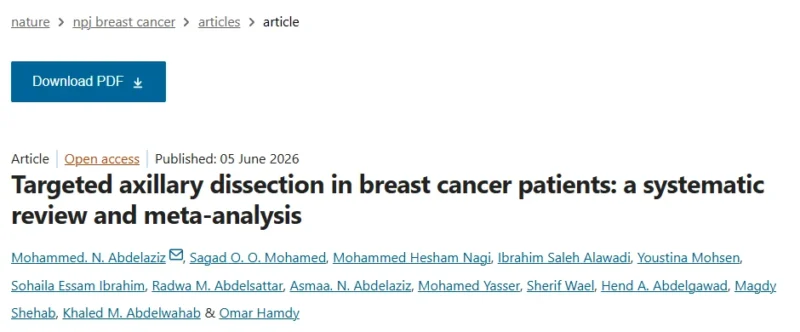
Colleagues from Mansoura University have published an updated systematic review and meta-analysis in npj Breast Cancer, providing the most comprehensive evidence to date on targeted axillary dissection (TAD) in initially node-positive breast cancer patients achieving clinical nodal downstaging after neoadjuvant systemic therapy.
Across 59 observational studies, TAD demonstrated:
- Pooled identification rate: 95.1% (95% CI: 93.2–96.5%)
- Pooled false-negative rate: 6.37% (95% CI: 5.02–8.04%; I² = 0.0%)
- Overall diagnostic accuracy: 94.68% (95% CI: 91.70–96.63%)
- Targeted–sentinel node concordance: 73.34%
Crucially, performance was consistent across all marking techniques (clip, carbon, magnetic, radioactive seeds) and localisation methods — supporting implementation using locally available technologies.
These findings firmly establish TAD as superior to SLNB alone in this setting and support its adoption as a standard surgical approach for appropriately selected patients.
I am pleased that two of our previously published systematic reviews and pooled analyses were cited in this work, contributing to the evidence base that has shaped current practice.”
Title: Targeted axillary dissection in breast cancer patients: a systematic review and meta-analysis
Authors: Mohammed Abdelaziz, Sagad Mohamed, Mohammed Nagi, Ibrahim Alawadi, Youstina Mohsen, Sohaila Ibrahim, Radwa Abdelsattar, Asmaa Abdelaziz, Mohamed Yasser, Sherif Wael, Hend Abdelgawad, Magdy Shehab, Khaled Abdelwahab, Omar Hamdy
Read the Full Article.