






Karuna Ganesh, Physician Scientist at Memorial Sloan Kettering, shared a post on LinkedIn:
“Thrilled to share our latest work is out today in Nature.
Phenotypic plasticity is a hallmark of cancer – but we do not know what triggers cells to switch states. Cells in the gut do this constantly: when intestinal stem cells are lost to injury, already-differentiated cells rewind, give up their identity, and become stem cells again to rebuild the tissue. Metastatic colorectal cancer hijacks exactly this program to seed new organs.
We found a single molecular switch at the center of it: the RNA-binding protein ZFP36L2, mutated in 5–10% of colorectal cancers.
What we show:
- It couples stress sensing to cell fate. ZFP36L2 binds AU-rich 3’UTRs of stress-response mRNAs and pulls them into dynamic biomolecular condensates where they’re degraded – shutting off the alarm. Cells can’t rewind into a stem cell state while the alarm is still ringing.
- It is required for regeneration. Mice lacking intestinal ZFP36L2 can’t dedifferentiate after injury. They fail to restore LGR5+ stem cells and can’t heal.
- It is required for metastasis. In patient-derived colorectal cancer organoids, depleting ZFP36L2 abrogated metastatic seeding in the liver and lungs.
- Its loss is a double-edged sword. When ZFP36L2 is mutated, cancer cells cannot re-enter the stem cell state – so they escape sideways, into non-canonical neuroendocrine- and squamous-like identities linked to treatment resistance and worse outcomes. We see this in patient tumors, not just models.
- The therapeutic implication: tumors depend on ZFP36L2 to manage the stress of metastasizing. Disrupt it fast enough and the cell can’t adapt – it self-destructs. Do it slowly and you select for something worse. Kinetics matter. Related ZFP36-family proteins are mutated in ~10% of solid tumors, so we suspect this logic extends well beyond the gut.
Our Cancer Grand Challenges team REWIRE-CAN is finding ways to rewire colorectal cancer cells back into vulnerable states and holding them there. ZFP36L2 gives us a concrete handle on exactly that problem. It tells us which state a cell is in, what it takes to move it, and what goes wrong if you move it too slowly.
Enormous congratulations to first author Dr. Qingwen Jiang, who drove this from start to finish, to Manisha Raghavan for super resolution microscopy, all our collaborators and funders. Above all, our thanks to the patients who donated the tissue on which this work is built.”
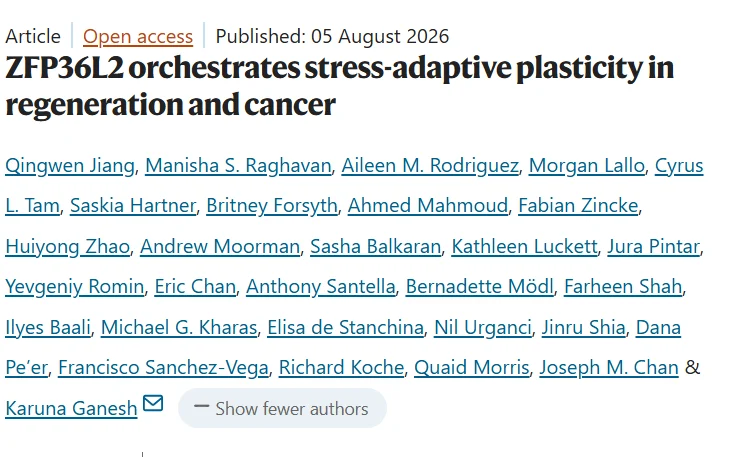
Title: ZFP36L2 orchestrates stress-adaptive plasticity in regeneration and cancer
Authors: Qingwen Jiang, Manisha S. Raghavan, Aileen M. Rodriguez, Morgan Lallo, Cyrus L. Tam, Saskia Hartner, Britney Forsyth, Ahmed Mahmoud, Fabian Zincke, Huiyong Zhao, Andrew Moorman, Sasha Balkaran, Kathleen Luckett, Jura Pintar, Yevgeniy Romin, Eric Chan, Anthony Santella, Bernadette Mödl, Farheen Shah, Ilyes Baali, Michael G. Kharas, Elisa de Stanchina, Nil Urganci, Jinru Shia, Dana Pe’er, Francisco Sanchez-Vega, Richard Koche, Quaid Morris, Joseph M. Chan, Karuna Ganesh
Other articles about colorectal cancer on OncoDaily.