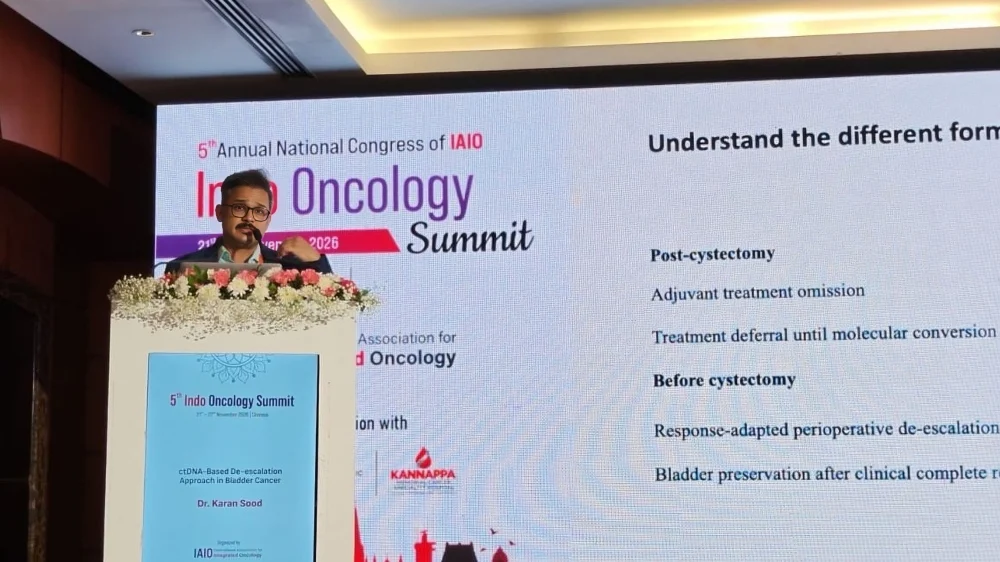
Karan Sood, Medical Oncologist in the Department of Medical Oncology at the Advanced Centre for Treatment, Research and Education in Cancer (ACTREC), shared on LinkedIn:
“It was a privilege to speak on ‘De-escalation Approaches in Urinary Bladder Cancer in 2026’ at the 5th Indo Oncology Summit.
This discussion feels particularly timely because precision oncology is no longer only about escalating treatment for high-risk disease.
Increasingly, it is also about identifying who may safely receive less treatment.
In bladder cancer, that conversation is rapidly evolving around ctDNA-guided adjuvant treatment omission or deferral, response-adapted perioperative strategies, and bladder preservation after a clinical complete response.
The central question is changing from:
‘What is the maximum treatment we can give?’
to
‘What is the minimum effective treatment this individual patient actually needs?’
That shift is important.
De-escalation is not undertreatment.
When supported by robust biomarkers, molecular response, and prospective evidence, it represents a more refined form of precision oncology-one that aims to preserve outcomes while reducing toxicity, overtreatment, cost, and long-term treatment burden.
Bladder cancer may become one of the most important models for learning how to integrate ctDNA, treatment response, and molecular risk into truly individualized perioperative decision-making.”
You can also read: Cretostimogene Reduces Bladder Cancer Recurrence Risk by 68% in Phase 3 PIVOT-006 Trial․