Joshua Omale, Research and Programs Associate at Slum and Rural Health Initiative Network, shared on LinkedIn:
“Chapter 24
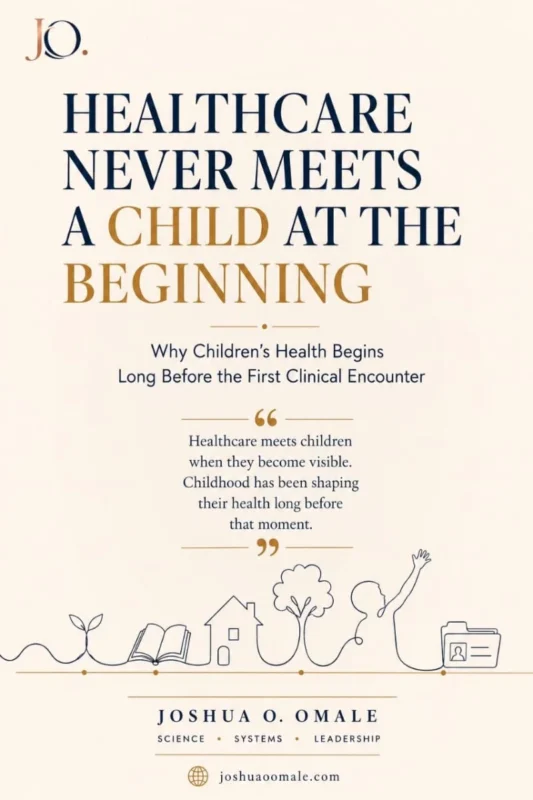
Healthcare never meets a Child at the Beginning
One of the quiet assumptions in healthcare is that a child’s story begins when the child becomes visible to the health system.
A history is taken.
An examination follows.
Investigations are requested.
A diagnosis is made.
And from that moment, the child’s journey appears to have begun.
Yet visibility is not the same as beginning.
Long before a child becomes a patient, biology has already been responding to the world. Nutrition has shaped development. Environmental exposures have left their imprint. Relationships, education, infection, poverty, safety and opportunity have all been influencing health in ways no clinical encounter can fully reconstruct.
Healthcare meets a child at a particular chapter. It rarely meets the child at the beginning of the story.
That distinction changes how we think about children’s health.
It reminds us that treatment begins at the point of care, but health begins much earlier.
Across many African settings, enormous effort is rightly invested in improving diagnosis, strengthening referral systems and expanding specialist services. These priorities are indispensable.
Yet perhaps one of the most unspoken conversations lies beneath them.
What if many of the forces shaping a child’s health have already been at work for years before the health system ever becomes involved?
If that is true, then children’s health cannot be understood only by asking how well we treat disease once children become patients. It must also ask what shaped their health before they were ever recognised by healthcare.
The future of children’s health will depend not only on better medicine, but on a deeper understanding of where the story truly begins. Because healthcare does not begin a child’s story, It joins one already in progress.
Building at the intersection of science, systems and leadership for the future of children’s health in Africa.”