






Joshua Omale, Research and Programs Associate at Slum and Rural Health Initiative Network, shared on LinkedIn:
“Chapter 15
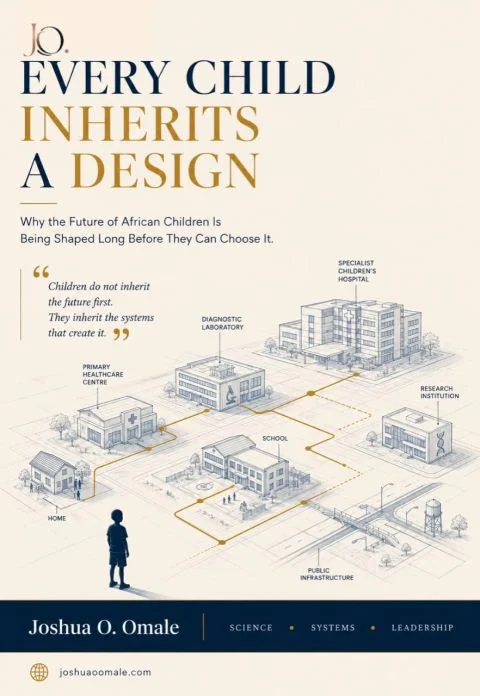
Every Child Inherits a Design
Why the Future of African Children is being shaped long before they can choose it.
Every child enters a world already designed by other people:
They inherit a health system they did not build.
This is one of the least examined realities in children’s health: before children inherit the future, they inherit the systems that produce it.
The timing of a diagnosis is not accidental. It reflects how recognition, primary care, referral and diagnostic capacity were designed.
Access to treatment is not merely a clinical matter. It reflects choices about financing, procurement, workforce distribution, regulation and political priority.
Whether a child benefits from genomic medicine, advanced pathology, clinical trials or emerging therapies depends not only on scientific progress, but on whether institutions were intentionally built to carry that progress to them.
Even the absence of care is often a form of design:
- A medicine that is never stocked
- A pathology result that takes months
- A family travelling hundreds of kilometres for specialist care
- A child repeatedly treated for the wrong illness before the correct diagnosis is considered
These experiences can appear like isolated failures, but often, they are the predictable outcomes of systems that were never designed around the complete journey of the child.
Design is not limited to architecture.
- It exists in the distance between a community and a hospital.
- In the questions included in a medical curriculum.
- In the diseases prioritised by research funders.
- In the populations represented in genomic databases.
- In the way ministries divide responsibility.
- In the data a country chooses to collect, and the children who remain invisible when it does not.
This is why building the future of children’s health in Africa requires something more fundamental:
Designing from the realities, journeys and possibilities of African children themselves.
The systems African children inherit should not be weakened copies of systems designed elsewhere.
They should be deliberate expressions of what we believe African children deserve. That means designing research and care together.
Children are often described as the future. But that statement can conceal our responsibility in the present.
Children do not inherit an abstract future.
- They inherit what we fund.
- What we neglect.
- What we regulate.
- What we research.
- What we connect.
What we are courageous enough to build.
Every generation leaves children a design.
The defining question is whether ours will be worthy of the lives that must grow within it.
Building at the intersection of science, systems, and leadership for the future of children’s health in Africa.”
Read other articles about Africa on OncoDaily.