



Jordan Johnson, Founding Partner at Bridge Oncology, shared on LinkedIn:
“Every November, radiation oncology opens the final fee schedule, finds one number, and exhales.
This year that number will look good on the surface.
The proposed rule raised treatment delivery about 16-21%.
But it also cut planning, management and SBRT, the services shorter courses depend on. And the conversion factor still drops.
I grew up in Kilgore, Texas, where an oil field was pushed harder than anyone could manage until discipline arrived from outside.
U.S. radiation oncology has run the same play for 25 years.
Now the decline curve is here: courses grew 6.8% in 2025, billable delivery grew 1.1%, and a replacement wave is coming at today’s borrowing costs.
The final rule tells you what Medicare pays in 2027. It doesn’t tell you whether your program should exist in 2037.
That decision belongs to whoever owns the program, and the window to make it on your own terms is closing.
The headline everyone will read
Within days, CMS will publish the CY 2027 Physician Fee Schedule final rule. Most radiation oncology programs will open it, find one number and exhale.
In the proposed rule, that number looked good.
CMS estimated a 3% positive impact for radiation oncology overall and 5% for freestanding centers. The level 1 treatment delivery code, 77402, was set to rise about 23%. After years of cuts, it will read like relief.
It isn’t. It is the wrong number to read. The same proposal cut the services that shorter courses depend on: weekly treatment management fell about 4% and dose planning about 6%. SBRT was trimmed too. It also proposed national pricing for proton delivery.
Underneath it all, the conversion factor drops about 1.7% as the temporary 2.5% bump expires.
The final rule will tell programs what Medicare pays next year. It will not tell them whether their program should exist in ten years. That second question is the one that matters now, and almost no one is asking it in time.
What an oil field taught me about radiation oncology
I grew up in Kilgore, Texas. In 1930, a wildcatter named Dad Joiner proved the largest oil field anyone had ever found just south of town. He had borrowed far more than he could cover. Within weeks his holdings were in receivership, and H.L. Hunt bought the discovery well for about $1.34 million.
Joiner found the field. Hunt kept it. Both men bet the house. What separated them was how much of the bet was borrowed.
Then nobody slowed down. More than 1,000 wells went up in downtown Kilgore alone.
Oil collapsed to pennies a barrel. In 1931 the governor declared martial law and shut in more than 1,600 wells. Discipline arrived one way or another: either the operators imposed it, or someone else did, on their terms.
U.S. radiation oncology has run the same play for 25 years. Per-fraction payment sat on 40-plus-fraction courses. Hospitals were paid more than freestanding centers for the same treatment.
Money was nearly free. With about 4% of the world’s people, the U.S. built roughly a quarter of its linear accelerators and close to 40% of its proton centers. It runs about 11 machines per million people; the IAEA calls 4 adequate.
The machines weren’t the mistake. Underwriting 15- and 20-year assets as if flush production would last forever was.
Why this rule lands differently
Every November brings a fee schedule. This one arrives on top of three things that didn’t exist a year ago.
- A new standard of care. In October 2026, ASTRO’s prostate guideline recommended 20 or 28 fractions over conventional courses for every risk group, with five-fraction SBRT as a standard option. Conventional fractionation already fell from 75% of prostate courses in 2016 to 22% in 2025.
- A payment structure moving in two directions. The rule pays more per delivery while paying less for planning, management and SBRT. Delivery is the service hypofractionation removes. Planning and SBRT are the services it depends on.
- A replacement wave. Equipment bought in 2006–2011 is now 15 to 20 years old, with the 2012–2016 wave close behind. Each linac and vault refresh is a $3 million to $5 million decision, financed at today’s rates.
The result shows up in one gap. In 2025, treatment courses grew 6.8%. Billable delivery grew 1.1%. Patients are still coming. They just generate fewer of the units the fee schedule pays for.
That is also why proton therapy feels this first.
PARTIQoL found no meaningful quality-of-life difference between protons and IMRT for low- and intermediate-risk prostate cancer. Proposed national pricing removes local contractor rates. A business plan built on long prostate courses now faces fewer fractions and a weaker clinical case.
The math a fee schedule can’t fix
More than 80% of a radiation program’s cost is fixed. That single fact is why a modest rate change matters less than it looks, in either direction.
In Bridge Oncology’s Total Cost of Care model, a single-machine program carries about $5.19 million a year and earns about $12,900 per patient. It breaks even near 402 patients. At 500 patients it runs a 19.6% margin. At 300, it loses about 34%.
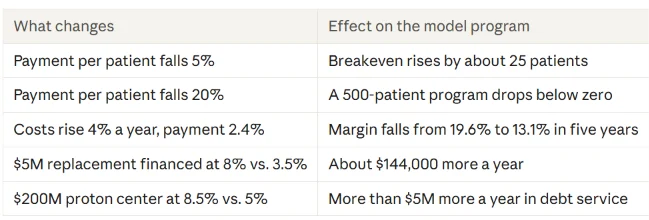
Read the final rule against that table. A delivery increase helps a program only if its patients still receive enough fractions to bill. A planning cut lands on every patient, however short the course.
The distress record shows what happens when assumptions outlive reality. Georgia’s proton center borrowed $368 million, treated more than 1,000 patients a year, and still sold to Emory for about $105 million before closing.
Arkansas defaulted. San Diego never reached breakeven. GenesisCare cut $1.7 billion of debt. High volume didn’t save them. Capital structure decided them.
A governance problem, not a data problem
The Deepwater Horizon wasn’t lost to one bad call. A negative pressure test came back abnormal, and the crew rationalized it. Radiation oncology has had a decade of negative pressure tests: CMS rules, hypofractionation trials, guidelines. Each was seen, discussed and set aside, because the well was still flowing.
The warning signs were public. The problem is that no one with authority is wired to them.
- Vendors see the whole market, but the provider’s fixed cost is their revenue, and their growth has moved abroad. IBA delivered nine proton rooms in 2025; seven went to China.
- CMS and payers see the data but act through prices, one rule cycle at a time.
- Lenders and distressed buyers act at breach or default.
- Physicians and local systems owe the most to patients and usually see the economics last.
That leaves one actor who holds the obligation, the authority and the timing at once: the owner of the program.
That means the health system board, its executives and radiation oncology leadership, working with physicians and an independent view of total cost of care. They can act three to five years before the end-of-support letter, while the asset still has value.
What they usually lack is the instrument. Most boards hear about radiation oncology when it is already in trouble.
Bridge Oncology is working with multiple health systems and organizations right now on what that strategy needs to be. That answer cannot come from the vendor or its consulting arm, and it shouldn’t.
A vendor’s advisory team is like a former vendor executive arriving as a consultant with the inside story. The expertise is real, but it was earned selling the fixed-cost base the program is now trying to escape.
The advice to buy one fewer machine, regionalize a site or skip a replacement has to come from someone whose revenue doesn’t depend on the answer.
What to do in the 30 days after the rule
The final rule is the best moment of the year to turn a payment update into a strategy conversation. The numbers are fresh and the board is paying attention.
- Re-run the model by course type, not by code. Price a conventional course, a 20- or 28-fraction course and a five-fraction SBRT course under the 2027 rates, including full technology cost per episode. The delivery increase and the planning cut net out differently for each.
- Underwrite to year ten, not year one. Re-run every pending capital plan under the new guideline’s fraction mix. Stress-test it against a narrowing indication as screening and molecular profiling advance.
- Put the indicators in front of the board. Equipment age and support status, volume against breakeven, replacement reserve, cost of ownership, payer mix, workforce, leakage, parent-system pressure and debt covenants. Report them annually, not when the replacement request arrives.
- Ask the vendor test questions before renewal. Will service contracts be repriced to today’s volumes? Will older platforms stay supported? What does the vendor put at risk?
- Decide as a market while there are choices. Replace, refurbish, regionalize, partner or close. Keep a spoke wherever daily travel would block care.
- Push for payment that rewards efficiency. A case rate alone falls short. Episodes built on diagnosis, stage, intent and evidence-based fractionation pay for the cancer rather than the machine.
The cost of waiting is concrete. Acting early keeps every option open and prices the asset as a working program. Acting after the letter, the breach or the default usually leaves one: sell at a discount or close.
Kilgore’s boom ended. Kilgore didn’t.
Every Christmas, Kilgore lights its old derricks with stars. The town learned to live with a field that had to be managed rather than simply produced.
U.S. radiation oncology faces the same transition. About 50.8 million Americans already live in counties with no radiation oncology site, and 427 counties lost sites between 2018 and 2025.
Physicians followed patients. Capital did not. The decisions about where radiation therapy survives will be made in the next five to ten years, by deliberate choice or by default.
The final rule tells you what Medicare will pay in 2027. What your program does with the next decade is a decision only its owners can make.
Over the coming months, I’ll be walking through this in The Accountable Oncology Series, a webinar series built on The Accountable Oncology Trilogy: Not About Access, Beyond Payment and Built to Last.
Each session connects one book to what is happening now and what to do before the decision is forced.”
Other articles about radiation oncology on OncoDaily.