






Jordan Johnson, Founding Partner at Bridge Oncology, Board Member at the National Association of Medication Access and Patient Advocacy (NAMAPA), Founder of The Healthcare Hub, shared on LinkedIn:
“Case and Point: The Data Are Catching Up to the Economics of Radiation Oncology
Bridge Oncology has been making this argument for four years. I have been making it for nearly a decade. New evidence continues to point in the same direction. The question now is what healthcare leaders choose to do with the information. We didn’t take a chance we made a choice to just deliver the facts.

There is a difference between changing a position when the environment changes and changing a position every time the industry conversation changes. In healthcare strategy, consistency matters because meaningful structural problems rarely emerge overnight. They develop over years, often while the industry focuses on the most visible symptoms rather than the forces creating them.
For nearly a decade, I have argued that the challenges facing radiation oncology cannot be understood through reimbursement or geographic access alone. For the past four years, Bridge Oncology has institutionalized that same position through our work with health systems, physician practices, cancer centers, policymakers, and industry stakeholders. We have consistently maintained that the long-term challenge facing community radiation oncology is fundamentally economic: the cost structure, capital requirements, payer environment, treatment utilization, workforce model, and operating infrastructure have become increasingly misaligned.
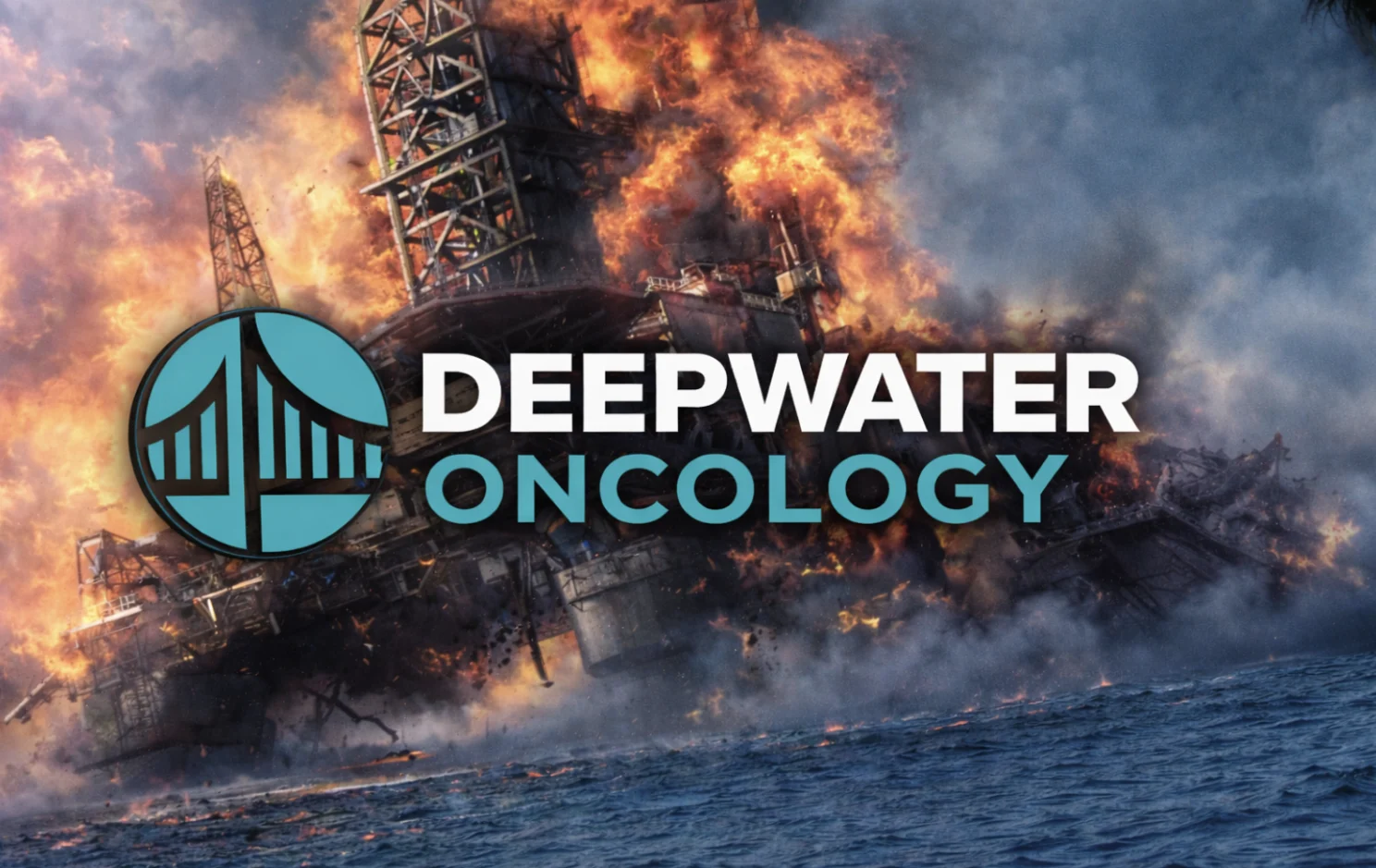
The was fully presented in Deepwater Oncology:
Recent national evidence examining radiation oncology practice-site disappearance provides another case in point. The research appropriately identifies substantial geographic disparities and demonstrates that rural and freestanding radiation oncology practices face disproportionate vulnerability. However, when those findings are evaluated alongside population density, payer mix, hospital economics, capital availability, and the broader deterioration of rural healthcare infrastructure, they reinforce something Bridge has been saying for years: access is the consequence of sustainability, not an independent economic condition.
The Evidence Is Increasingly Pointing Upstream
The national radiation oncology access discussion has understandably focused on where treatment facilities are disappearing. Recent research reports that approximately 50 million Americans live in counties without a radiation oncology practice and identifies rural and freestanding facilities as particularly vulnerable. These findings are important because prolonged travel for radiation therapy can create significant clinical, financial, and logistical burdens for patients.
However, identifying where infrastructure has disappeared does not fully explain why it disappeared. That distinction is critical because the solution depends entirely upon the diagnosis. If geography is considered the primary problem, the logical policy response is to increase the number of treatment locations. If reimbursement is considered the primary problem, the response becomes increasing payment. If the underlying problem is instead a structural mismatch between the economics of radiation oncology and the markets in which care must be delivered, neither intervention alone will create durable access.
Bridge Oncology has approached this issue by looking upstream from closure. Our analysis has examined radiation oncology infrastructure alongside population density, LINAC distribution, payer mix, reimbursement patterns, capital investment, and rural hospital closures. When these variables are considered together, the pattern becomes increasingly difficult to dismiss. Markets with stronger commercial payer penetration, healthier operating margins, population growth, and greater access to capital are better positioned to maintain and replace equipment, recruit clinicians, and continue investing. Markets characterized by smaller populations, weaker payer economics, workforce shortages, constrained hospital finances, and limited capital experience substantially greater difficulty maintaining comparable infrastructure.
This does not eliminate the access problem. It explains why the access problem develops.
Need Did Not Determine Where America Built Radiation Oncology
One of the most important assumptions to challenge is the idea that the United States originally developed an equitable radiation oncology network based primarily upon population need and that we are now watching that network deteriorate.
That is not how healthcare infrastructure was built.
Cancer occurs in every socioeconomic class and every geographic region, but capital investment does not distribute itself according to disease burden alone. Radiation oncology infrastructure developed where organizations could economically justify constructing facilities, purchasing multimillion-dollar equipment, recruiting specialized workforces, maintaining technology, and eventually replacing those assets.
Population density influenced those decisions because volume matters. Commercial payer penetration mattered because reimbursement affects revenue. Referral networks mattered because they influence utilization. Hospital financial strength mattered because radiation oncology requires substantial capital. Access to debt and investment capital mattered because linear accelerators, facilities, imaging systems, and information technology require continuous reinvestment.
Our analysis has demonstrated that communities with stronger employer-sponsored insurance tend to show greater capital investment, higher LINAC density, stronger recruitment capacity, more frequent equipment replacement, and lower closure rates. Conversely, markets with greater dependence on government reimbursement frequently face substantially greater financial pressure.
The implication is significant. What we now describe as a geographic maldistribution of radiation oncology is not simply evidence that the healthcare system failed to place enough treatment facilities in certain locations. It is also evidence that healthcare capital historically accumulated where the economic environment supported investment.
In other words, need existed everywhere, but investment did not.
We Built the Infrastructure Around an Economic Model That Changed
The current instability also reflects another problem that has been developing for years. Much of America’s radiation oncology infrastructure was built during an era when the clinical and financial model looked very different from the one that exists today.
Historically, many patients received 35 to 45 radiation treatments. That treatment volume generated substantial throughput and predictable revenue capable of supporting linear accelerators, treatment planning systems, imaging technology, facilities, staffing models, and continuous capital replacement.
Then the clinical science improved. Hypofractionation allowed many patients to receive equivalent or superior treatment in significantly fewer fractions. This development has been an important advancement for patients because it can reduce travel, treatment burden, time away from employment and family, and overall healthcare utilization.
However, the fixed costs required to operate radiation oncology did not decline proportionally with treatment utilization. Linear accelerators remain expensive. Service agreements continue to increase. Software platforms have proliferated. Cybersecurity has become essential. Workforce shortages have increased labor costs. Prior authorization has created permanent administrative infrastructure. Regulatory requirements and quality expectations have continued to expand.
The result is a contradiction that Bridge has repeatedly highlighted: radiation oncology became more clinically efficient while much of the operating model became more expensive.
For a high-volume metropolitan program with favorable payer economics, that contradiction may be manageable. For a low-volume community program with a weaker commercial payer mix and limited access to capital, it can become existential.
The Closure or Breaking Point Is Not the Event That Created the Problem
The industry also needs to reconsider how it thinks about facility closures. A radiation oncology program does not become unsustainable on the day leadership announces that it is closing.
The economic deterioration usually begins much earlier. Margins compress, capital replacement is postponed, technology upgrades are deferred, staffing vacancies become harder to fill, maintenance costs increase, and organizations become increasingly reluctant to make additional investments. As infrastructure ages, competitiveness and recruitment can deteriorate further. Lower volume then places additional pressure on margins, reinforcing the cycle.
Eventually, leadership confronts a significant capital decision. A linear accelerator requires replacement, a facility requires renovation, or another major investment becomes unavoidable. At that moment, the organization must determine whether several million dollars of additional capital can reasonably be deployed into that market.
When the answer is no, consolidation or closure follows.
Our previous analysis identified this progression as a predictable cycle in which weakening margins lead to reduced investment, aging infrastructure, declining competitiveness, lower volume, additional margin pressure, and eventually closure.
Only at the end of that process does the problem become visible on an access map.
The loss of access is therefore real, but it is the final event in a much longer economic process.
Radiation Oncology Is Not Experiencing This in Isolation
The overlap with broader rural healthcare instability is particularly important because it provides evidence that this is not simply a radiation oncology reimbursement problem.
Many of the communities experiencing radiation oncology instability are also confronting rural hospital closures, physician recruitment challenges, reductions in obstetric services, trauma center instability, and declining specialty care availability.
These services do not share an identical reimbursement methodology, yet they are struggling in many of the same markets. This suggests that the common denominator extends beyond any individual CPT code, Medicare conversion factor, or specialty-specific payment policy.
The broader problem is the economics of maintaining healthcare infrastructure in markets where patient volume, payer mix, workforce availability, operating margins, and access to capital cannot support the cost structure that has developed around care delivery.
Radiation oncology may simply expose that problem earlier because the specialty combines exceptionally high fixed costs with significant technology and workforce requirements.
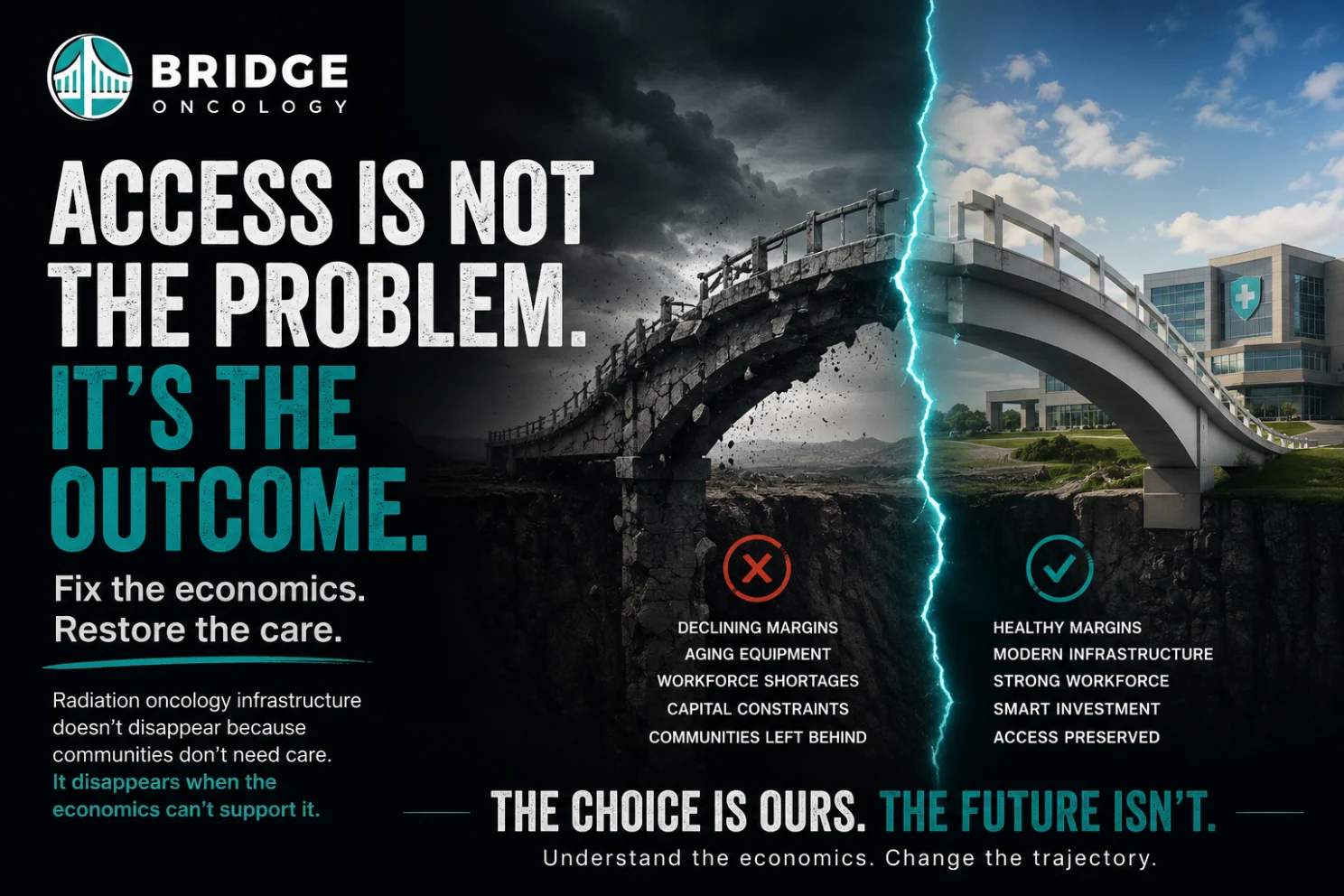
Four Years at Bridge. Nearly Two Decades of the Same Argument.
For Bridge Oncology, the importance of these findings extends beyond another research publication or another set of maps. They demonstrate why consistency in healthcare strategy matters.
Bridge Oncology has been publicly advancing this economic-sustainability argument for approximately four years. I have personally been raising many of these same concerns for nearly a decade. The terminology has evolved, the data have improved, and the urgency has increased, but the fundamental position has remained remarkably consistent.
We have argued that declining reimbursement cannot be evaluated independently from increasing costs. We have argued that hypofractionation would change the economics of treatment delivery. We have argued that capital replacement would eventually become a defining challenge for lower-volume programs. We have argued that payer mix materially influences where healthcare infrastructure can survive. We have argued that workforce shortages, administrative burden, technology costs, vendor pricing, and operational inefficiency must be included in any serious discussion about sustainability. Most importantly, we have argued that protecting access without repairing the economic foundation supporting access is not a long-term strategy.
The significance of consistency is not about claiming victory when additional evidence emerges. It is about demonstrating that the position was developed from an understanding of the underlying economics rather than from whichever policy issue happened to dominate the industry conversation at a particular moment.
Healthcare has no shortage of opinions. What matters is whether the framework continues to explain what happens as the market evolves.
Increasingly, this one does.
Being Right About the Problem Is Not Enough
There is also an important distinction between recognizing a problem and acting upon it. Evidence does not force healthcare organizations to change. It simply makes the consequences of maintaining the status quo increasingly difficult to defend.
Health systems still have choices.
They can continue operating radiation oncology as an isolated department and evaluate performance primarily through historical volume and reimbursement metrics, or they can begin managing oncology as an integrated service line in which capital, workforce, payer strategy, technology, operations, and total cost of care are evaluated together.
Organizations can continue replacing equipment according to traditional capital cycles without reconsidering whether the underlying delivery model is appropriate for the market, or they can redesign how clinical resources are deployed across regional networks.
They can continue adding technology and software because each individual investment promises incremental improvement, or they can begin asking whether every investment actually reduces the total cost of delivering an episode of care.
They can wait until a rural or community program reaches the point where equipment replacement is financially impossible, or they can identify vulnerability years earlier and intervene before the capital decision becomes irreversible.
Policy leaders face similar choices. They can continue responding to individual reimbursement reductions and facility closures, or they can develop payment methodologies that recognize meaningful differences in rurality, patient volume, payer mix, capital requirements, and the minimum infrastructure necessary to maintain safe local care.
The information does not dictate a single solution, but it removes the excuse that the problem was unforeseeable.
The Next Model Must Be Built Intentionally
Recognizing the economic origin of the problem does not mean accepting that economically vulnerable communities should lose radiation oncology. It means acknowledging that maintaining care in those communities may require a fundamentally different delivery model.
Regional networks can distribute fixed costs across multiple facilities. Centralized treatment planning and remote dosimetry can improve workforce utilization. Enterprise physics models can extend scarce professional resources across broader geographies. Direct Virtual Supervision can provide additional flexibility where clinically and legally appropriate. Artificial intelligence and automation can reduce administrative and clinical workload if they replace existing costs rather than simply adding another technology layer. Shared revenue-cycle, prior-authorization, compliance, and operational infrastructure can reduce unnecessary duplication across smaller programs.
Payment methodologies must evolve as well. A low-volume rural radiation oncology program cannot reasonably be evaluated under precisely the same economic assumptions as a high-volume metropolitan center. Market density, realistic treatment volume, payer mix, capital replacement requirements, workforce conditions, and the minimum infrastructure necessary to safely maintain local treatment should all become part of the sustainability calculation.
The objective should not be preserving every component of the historical radiation oncology delivery model. The objective should be preserving clinically appropriate access by designing a model capable of surviving the economics of the next twenty years.
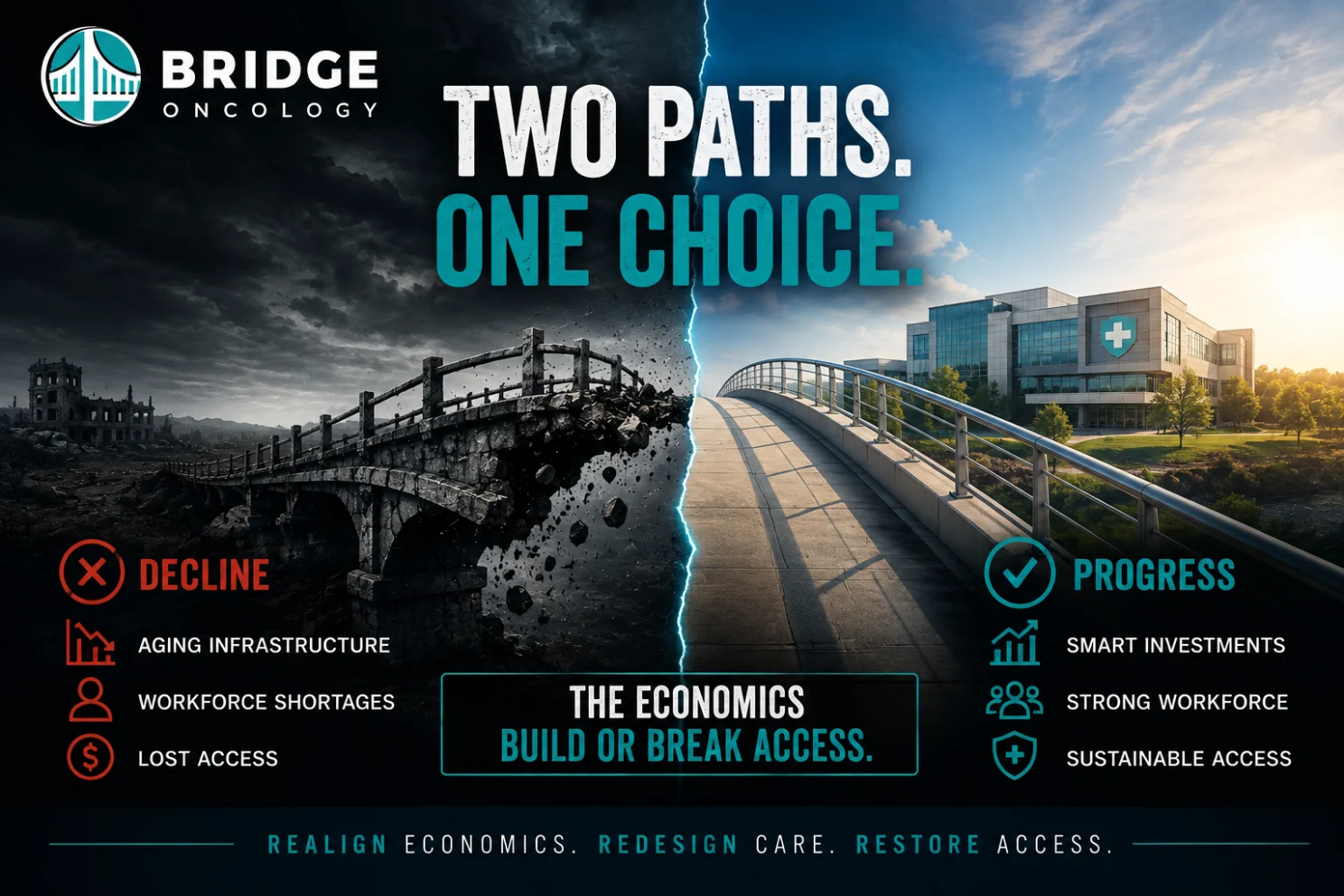
Case and Point: The Information Is Here. What Happens Next Is a Choice.
The newest evidence does not mean that every argument Bridge Oncology has made is settled, nor does it mean that geographic access should become secondary. Patients experience the consequences of distance, treatment delays, transportation barriers, workforce shortages, and facility closures directly, and those consequences deserve serious attention.
What the evidence increasingly demonstrates is that those outcomes cannot be separated from the economic environment that produces them.
Population density affects volume. Payer mix influences revenue. Revenue contributes to margin. Margin determines the capacity to invest. Capital supports equipment replacement and technology. Investment supports workforce and infrastructure. Sustainable infrastructure ultimately determines whether patients continue to have reasonable local access to care.
When that sequence reverses, the outcome is equally predictable. Weak economics compress margins, reduced margins constrain capital, limited capital produces deferred investment, aging infrastructure and workforce instability follow, and eventually consolidation or closure occurs.
That is why Bridge Oncology has continued to push this conversation upstream.
For four years as an organization, and for nearly a decade in my own work, the message has remained consistent because the underlying economics have remained consistent: sustainable access requires sustainable infrastructure, and sustainable infrastructure requires an economic model capable of supporting it.
The data are becoming clearer. The patterns are becoming harder to dismiss. The consequences of waiting are becoming increasingly visible.
At this point, the question is no longer whether healthcare leaders have enough information to recognize the problem.
The question is what they choose to do with it.
Consistency matters because it tells us whether we understood the problem before the outcome became obvious. Leadership matters because once the evidence is available, continuing the same approach is no longer simply a failure of prediction. It is a decision.
That is the case and point.
Bonus Round That Will Be 100% Correct
ROCR is attractive because it gives radiation oncology something the industry desperately wants: payment predictability. Unfortunately, predictability is not sustainability.
For years, Bridge Oncology has argued that radiation oncology does not fundamentally have a reimbursement problem. It has an economic model problem. Declining fractions, rising technology costs, vendor pricing, service contracts, workforce shortages, administrative burden, aging infrastructure, and capital requirements have fundamentally changed the economics of delivering care.
ROCR does not fix those problems. It simply puts a new payment envelope around them.
That is particularly dangerous as CMS and the broader House of Medicine move toward site neutrality, resource efficiency, outcomes accountability, and total cost of care. Radiation oncology risks locking itself into a specialty-specific case-rate model derived largely from historical payment assumptions while healthcare moves in the opposite direction.
ROCR therefore becomes a convenient deterrent from confronting the elephant in the room: what radiation oncology costs to deliver and why.
Changing how Medicare pays does not eliminate inefficient infrastructure, expensive technology, administrative complexity, or unsustainable capital models.
The specialty has a choice. It can protect yesterday’s economics through ROCR, or redesign radiation oncology for where healthcare is going.
ROCR sidesteps accountability. Sustainable reform requires confronting it.”
Other articles featuring Jordan Johnson on OncoDaily.