






Jemma S., Portfolio, Programme and Project Delivery Consultant, Medical Writer, shared on LinkedIn:
“Precision oncology is entering its next chapter.
It’s about more than scientific discovery alone; it’s about implementing the science and driving the next evolution of oncology.
For many years, the focus has rightly been on scientific discovery. Yet this only fulfils its purpose when it is translated into actionable knowledge, implemented into practice, and reaches the patient.
Identifying cancer genes. Sequencing tumours. Discovering biomarkers. Developing targeted therapies. Expanding our understanding of cancer biology and the individual terrain.
These advances have transformed oncology and are worthy of celebration.
But discovery alone is not enough.
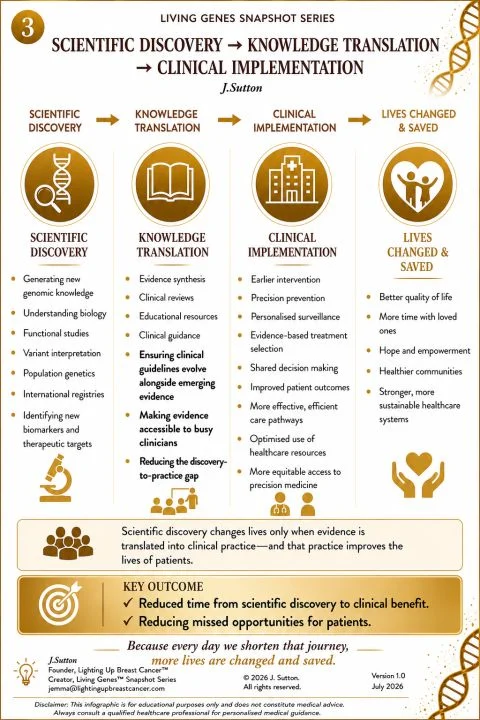
Our next challenge, and greatest opportunity is ensuring scientific discovery moves rapidly through knowledge translation into clinical implementation and widespread adoption.
Every delay between publication and clinical practice represents patients who may not benefit from the latest evidence, creating missed opportunities to improve outcomes.
The future of precision oncology isn’t just about deeper biological and genetic insights or generating more data. It is also about building healthcare systems that continually learn, adapt and evolve as new evidence emerges.
That means:
- Translating evidence into practical clinical guidance
- Ensuring clinical guidelines and protocols evolve alongside emerging evidence
- Making high-quality evidence readily accessible to busy clinicians
- Embedding precision medicine into everyday clinical pathways
- Delivering earlier intervention, personalised surveillance and more informed treatment decisions.
Ultimately, precision oncology is measured not by the number of discoveries we make, but by how effectively those discoveries reach patients and improve lives.
For me, one of the defining priorities of the next decade is reducing the discovery to practice gap and accelerating the adoption of beneficial discoveries into the standard of care.
Every step we shorten this journey means patients benefit sooner from the best available evidence while reducing missed opportunities for care.
What is needed is an active, responsive healthcare system that routinely incorporates real-world data and continuous feedback, shortening the journey from scientific discovery to standard care.
My vision? A healthcare system where discoveries are rapidly synthesised, translated, implemented and evaluated in a continuous cycle of learning, adaptation and improvement.
One that routinely uses real-world patient data to refine treatment protocols and continually improve outcomes.
We need to think not only about the discoveries of tomorrow, but about the healthcare system that will deliver them – efficiently, equitably and at scale.”
Other articles about Precision Oncology on OncoDaily.