Jean-Sebastien Frenel, Professor of Medical Oncology at the University of Nantes, shared a post on LinkedIn:
“Can a routine pathology slide reveal which ovarian cancer patients will benefit most from PARP inhibitors?
I’m excited to share our latest work on using AI and computational pathology to improve treatment selection for patients with ovarian cancer, now published in NPJ Digital Medicine.
Today, HRD testing helps identify ovarian cancer patients who are most likely to benefit from PARP inhibitors. However, HRD does not tell the whole story, and patients with the same HRD status can experience very different outcomes.
In this study, we asked whether routine diagnostic HandE slides could provide additional predictive information. Using data from the phase III PAOLA-1 randomized trial, we developed a deep learning model that analyzes treatment-naive primary tumor whole-slide images to estimate an individual patient’s benefit from maintenance olaparib plus bevacizumab versus bevacizumab alone.
Our model generates a continuous Estimated Treatment Improvement (ETI) score by combining image-derived features with randomized treatment assignment and progression-free survival data.
Our key findings:
- ETI demonstrated a strong treatment-biomarker interaction (HR 0.36, 95% CI 0.22–0.59), comparable to HRD status.
- ETI remained independently associated with outcomes after adjustment for clinical variables and HRD status.
- The model further stratified treatment benefit within both HRD-positive and HRD-negative tumors.
- Attention maps suggested that multifocal tumor-infiltrating lymphocytes may be associated with greater benefit from olaparib.
Beyond improving precision medicine, better treatment selection means fewer unnecessary treatments, reduced toxicity, lower healthcare costs, and more sustainable cancer care. This is an exciting step toward unlocking the predictive information hidden in routine pathology images.
My sincere thanks to all collaborators, clinical investigators, pathologists, data scientists, and above all, the patients whose participation to PAOLA trial made this research possible.
AI-derived histology biomarkers are moving toward becoming a routine complement to molecular testing in oncology.”
Giuseppe Caruso, Gynecology Oncology Specialist at European Institute of Oncology, shared this post a post, adding:
“Proud to have contributed to this work showing how AI can unlock predictive signals of PARPi efficacy hidden in routine pathology slides and help refine treatment selection in ovarian cancer. A great example of computational pathology moving closer to clinical impact.”
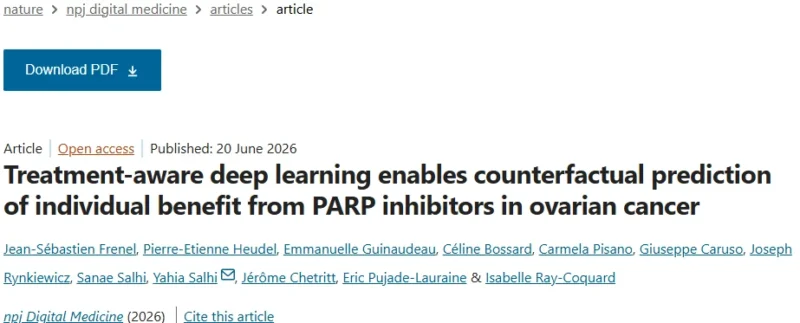
Title: Treatment-aware deep learning enables counterfactual prediction of individual benefit from PARP inhibitors in ovarian cancer
Authors: Jean-Sébastien Frenel, Pierre-Etienne Heudel, Emmanuelle Guinaudeau, Céline Bossard, Carmela Pisano, Giuseppe Caruso, Joseph Rynkiewicz, Sanae Salhi, Yahia Salhi, Jérôme Chetritt, Eric Pujade-Lauraine, Isabelle Ray-Coquard
Read the Full Article.