





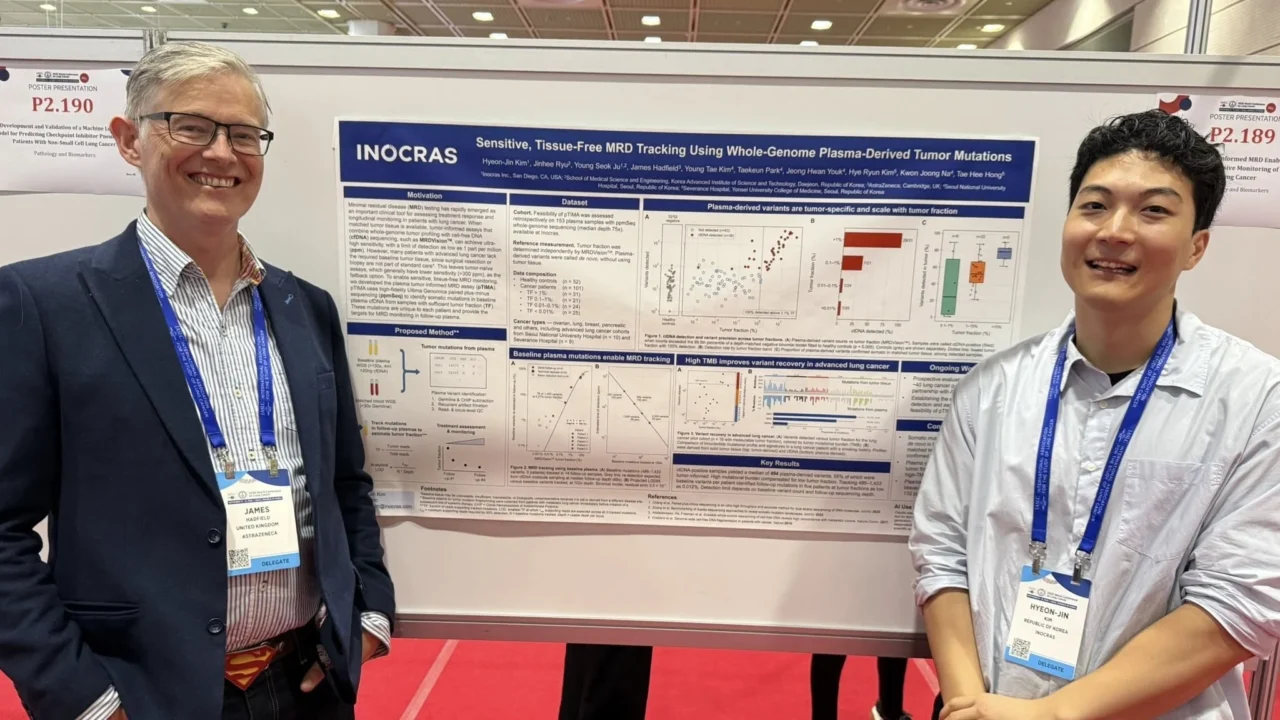
James Hadfield, Director ctDNA and Epigenomics Oncology Translational Medicine at AstraZeneca, shared on LinkedIn:
“Did you ever stop to think that tumor-informed MRD might be possible without tumor tissue?
I was honored to be invited by Inocras Inc. to present our work on the development of a plasma-Tumor Informed Assay for MRD. This proof-of-concept demonstrates how baseline plasma, in metastatic disease, can be used instead of FFPE tissue to identify patient-specific somatic mutations using Ultima Genomics whole-genome cfDNA sequencing, which are then tracked in follow-up samples to support treatment-response assessment and disease monitoring – without requiring matched tumour tissue without the requirement for FFPE tumor tissue.
In this retrospective evaluation, plasma-derived variants scaled with tumour fraction and mutational burden, and baseline mutation profiles were re-detected during follow-up at tumour fractions as low as 0.012%. i.e. better than mostt Tumor Naive Assays. A follow-up prospective evaluation in lung cancer is now underway.
This approach could help extend sensitive MRD monitoring to patients who currently lack suitable tissue, which for NSCLC can be 15-30% of biopsied patients, and this can be much higher for diseases where metastasis occurs late like Prostate cancer.
Thanks to Hyeon-Jin Kim, YoungSeok Ju, Kyunghwa Rebecca Jang and the Inocras Inc. team for hosting me in Seoul.
PS: I am now catching a train to Busan so if you don’t see any more posts from me on LinkedIn you’ll know it’s happened again!”
Other posts featuring James Hadfield on OncoDaily.