






Ido Wolf, Professor of Oncology at Tel Aviv University, shared a post on LinkedIn:
“Fifteen years later.
Our work has stood the test of time and is now cited in the Journal of Clinical Oncology (JCO), one of the leading oncology journals.
I don’t usually celebrate citations. But this one feels special.
Back in 2008, we started investigating a question that attracted virtually no interest: the relationship between GLP-1 and breast cancer.
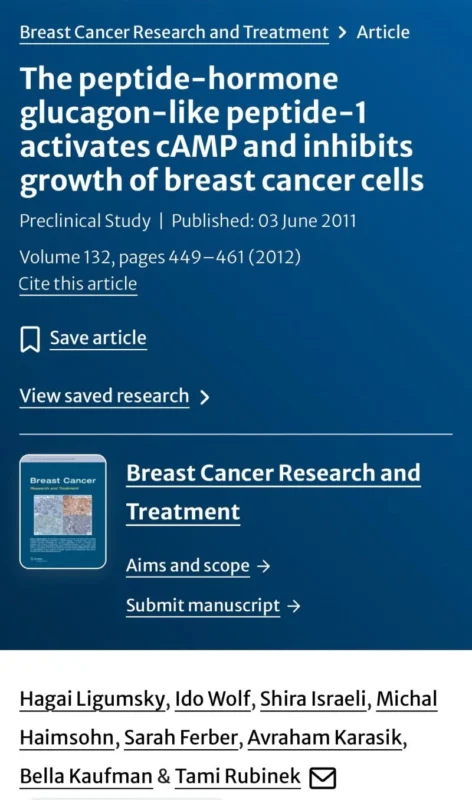
In 2011, we published the first study to demonstrate anti-tumor activity in of GLP-1 in breast cancer models. Beyond showing the effect itself, we also identified key elements of its underlying mechanism of action. The paper appeared in a relatively modest journal, but the science was rigorous, and the findings remain novel and important.
Today, GLP-1 has become one of the hottest topics in medicine, and it is gratifying to see that our work is recognized and cited.
One of the lead authors, Dr. Hagai Ligumsky, was then a PhD student in our laboratory. He played a key role in uncovering the underlying mechanism of action of GLP-1 in cancer. Today, Hagai is an outstanding physician-scientist in our oncology department, and seeing his continued contributions to oncology is a source of great pride.
It a reminder that important science doesn’t always begin in high-impact journals. Sometimes, it begins with a question that no one else is asking.”
Title: Metabolic Modulation in Cancer Care: The Potential Role of Glucagon-Like Peptide-1 Receptor Agonists
Authors: Hugo C. Temperley, Michael E. Kelly
Other articles featuring Ido Wolf on OncoDaily.