






IARC – International Agency for Research on Cancer shared a post on LinkedIn:
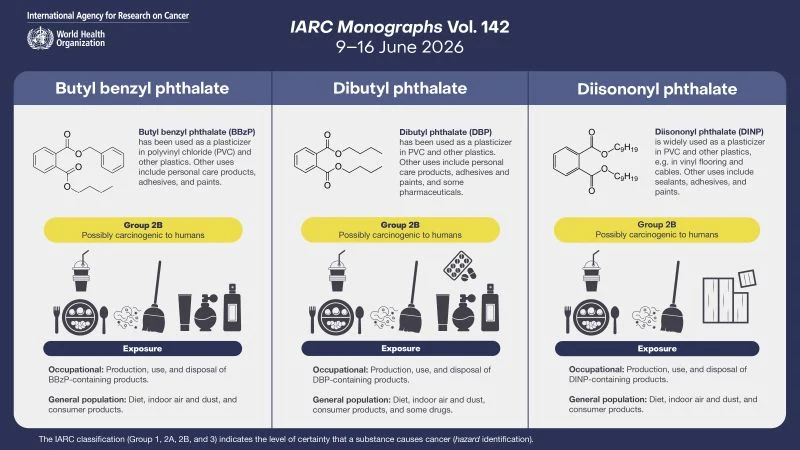
“An IARC Monographs Working Group evaluated butyl benzyl phthalate (BBzP), dibutyl phthalate (DBP), and diisononyl phthalate (DINP) as possibly carcinogenic to humans, Group 2B.
What does that mean?
The IARC Monographs evaluates cancer hazards into 1 of 4 group.
Groups 2A and 2B may appear confusing at first: what’s the difference?
Group 2A is “probably carcinogenic to humans”.
Group 2B is “possibly carcinogenic to humans”.
Group 2A, probably carcinogenic to humans, usually means there is convincing evidence for cancer in lab animals + some (not conclusive) evidence of cancer in humans, or consistent mechanistic evidence: the agent acts like a known carcinogen.
Group 2B: possibly carcinogenic to humans.
For agents in 2B, there is usually convincing evidence for cancer in lab animals but little/no info for humans, or some evidence for cancer in humans but not enough in animals to draw a conclusion.
Follow this link to a short video about the classification process.
For the most recently evaluated agents, BBzP, DBP, and DINP, mechanistic evidence was strong, and the evidence for cancer in animals was either sufficient (BBzP and DINP) or limited (DBP). Evidence for cancer in humans was inadequate.
The Working Group evaluated BBzP, DBP, and DINP as possibly carcinogenic to humans, Group 2B.
Don’t forget, the IARC Monographs classifications indicate strength of evidence that a substance can cause cancer, not the cancer risk associated with different routes and levels of exposure.
Agents in the same Group can have very different cancer risk.”
Other articles about IARC on OncoDaily.