






Humans of Oncology shared on LinkedIn:
“Lessons from 50+ Pull-Through Compartmental Glossectomies: Anatomical and Oncological Pearls from My Practice

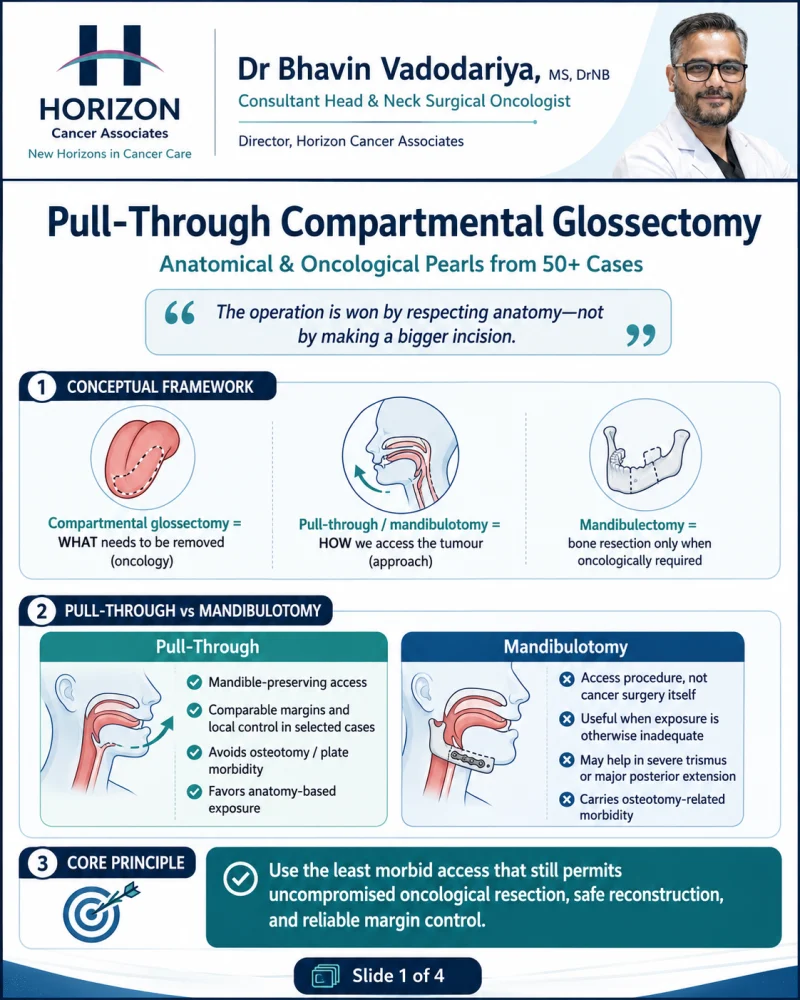
‘The operation is won by respecting anatomy not by making a bigger incision.’
Compartmental glossectomy defines what oncologically needs to be removed, whereas pull-through and mandibulotomy define how the tumour is accessed.
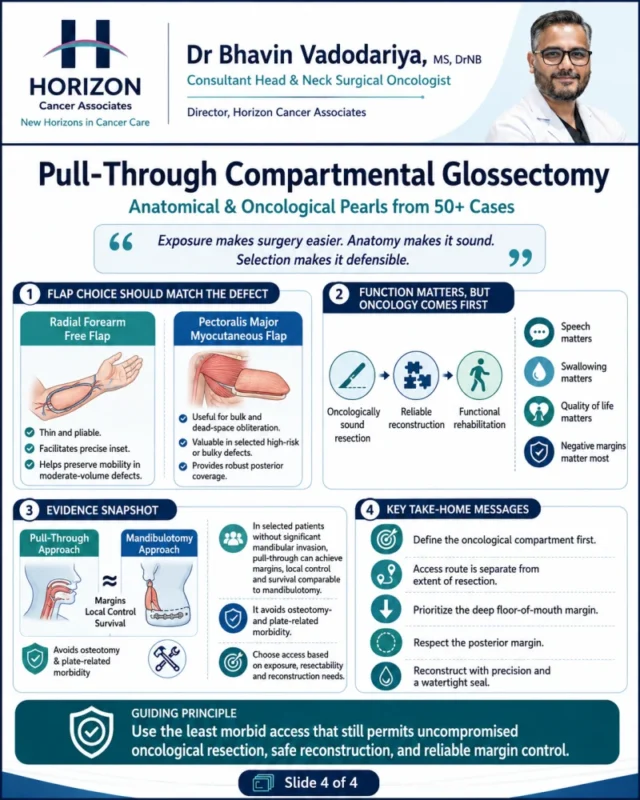
For appropriately selected advanced tongue and floor-of-mouth cancers without significant mandibular invasion, available evidence suggests that pull-through surgery can achieve margins, local control and survival comparable with mandibulotomy while avoiding osteotomy- and plate-related morbidity.
The principle of compartmental surgery is an en-bloc, three-dimensional anatomical resection along muscular, fascial, neural and vascular pathways rather than simply pursuing centimetric mucosal margins.
After more than 50 pull-through compartmental glossectomies, these are some of the anatomical and oncological lessons that have shaped my practice.
Pearl 1 Exposure Determines Oncological Quality
For extensive tongue cancers involving the floor of mouth, I rarely require mandibulotomy when adequate exposure can be obtained through a pull-through approach.
The important principle is not simply avoiding bone division.
It is achieving complete anatomical mobilisation.
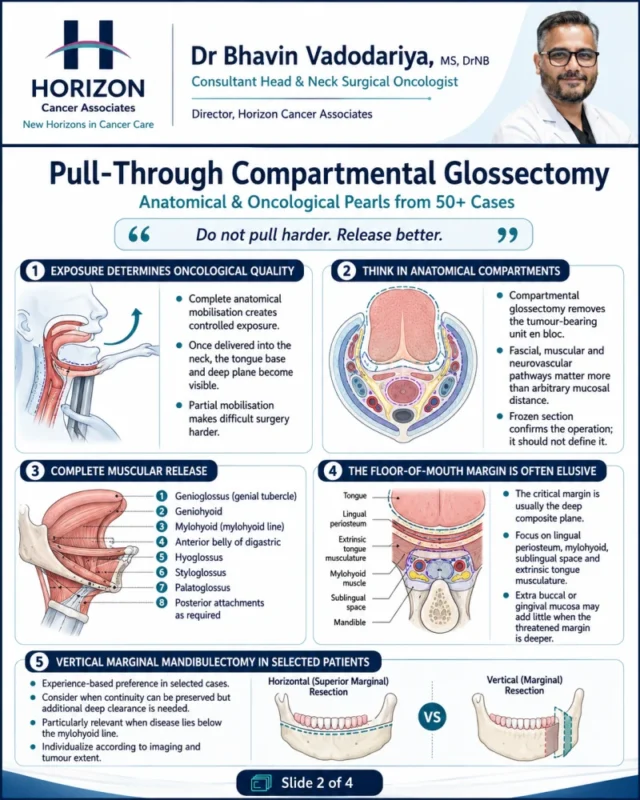
Once the tongue is adequately delivered into the neck, the tongue base becomes visible, the deep planes become easier to appreciate and the specimen can be handled under direct vision.
Partial mobilisation makes a difficult operation harder. Complete mobilisation makes a difficult operation controlled.
Pearl 2 – Think in Anatomical Compartments, Not Only Mucosal Margins
Wide local excision and compartmental glossectomy are conceptually different.
Compartmental surgery aims to remove the tumour-bearing anatomical unit en bloc, including the muscular, fascial and neurovascular pathways through which deep disease may spread.
The work of Calabrese, Ansarin and others has contributed significantly to this anatomical concept of tongue cancer surgery.
Frozen section remains extremely useful, but I consider it an adjunct to a well-planned three-dimensional resection.
Frozen section should confirm the operation not define the operation.
Pearl 3 – Complete Muscular Release Is the Key to Pull-Through Exposure
Most technically difficult pull-through resections are difficult because the tongue has not been completely mobilised.
Depending on tumour extent, the release may involve:
Genioglossus from the genial tubercle
Geniohyoid
Mylohyoid from the mylohyoid line
Anterior belly of digastric
Hyoglossus
Styloglossus
Palatoglossus
Posterior tongue-base/pharyngeal attachments when oncologically required
Once the relevant attachments are released, the specimen rotates naturally into the neck.
The lesson is simple:
Do not pull harder. Release better.
Pearl 4 – The Floor-of-Mouth Margin Can Be Deceptively Difficult
Junior surgeons naturally focus on visible mucosal margins.
In advanced tongue cancer, I worry much more about the deep composite floor-of-mouth margin.
The mandible separates the tongue–floor-of-mouth compartment from the buccal mucosa and frequently acts as an anatomical barrier.
Therefore, widening uninvolved gingival or buccal mucosa may add little when the true threatened margin is deeper at the lingual periosteum, mylohyoid, sublingual space or extrinsic tongue musculature.
When a floor-of-mouth margin remains close, the question should therefore be:
Is the deep anatomical compartment adequately cleared?
Not simply:
Can I remove another centimetre of mucosa?
Pearl 5 – Vertical Marginal Mandibulectomy in Selected Patients
When mandibular continuity can be preserved but additional deep clearance is required, I sometimes favour a vertical marginal mandibulectomy rather than a conventional horizontal superior marginal resection.
This is an experience-based preference.
The rationale is anatomical: significant floor-of-mouth disease may lie below the mylohyoid line, and removing only the superior alveolar portion of the mandible may not address the actual deep margin at risk.
A vertically oriented marginal resection can selectively remove the lingual mandibular buttress adjacent to the tumour-bearing floor-of-mouth compartment while maintaining mandibular continuity.
The extent of any mandibular resection must, however, remain dictated by preoperative imaging, intraoperative findings and oncological requirements.
Pearl 6 – Respect the Posterior Margin
The posterior margin deserves particular attention.
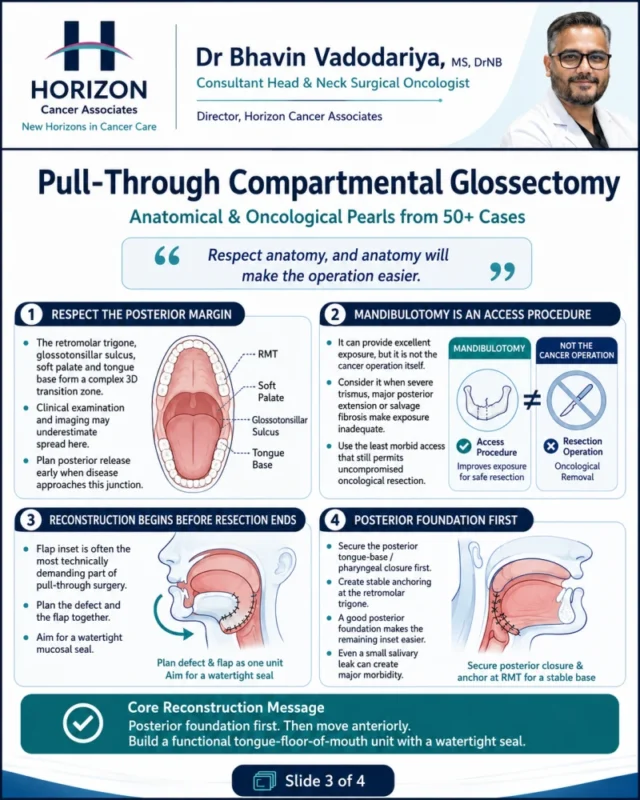
The retromolar trigone, glossotonsillar sulcus, soft palate and tongue base form a complex three-dimensional transition zone.
Clinical examination does not always demonstrate the full extent of disease in this region, and microscopic spread may extend beyond what appears obvious intraoperatively.
When disease approaches this junction, I plan the posterior release early and deliberately.
Adequate posterior exposure is far easier to create at the beginning of the operation than after an unexpected close frozen section.
Pearl 7 – Mandibulotomy Is an Access Procedure, Not an Oncological Procedure
Mandibulotomy can provide excellent exposure.
But dividing the mandible does not itself produce a better cancer operation.
Even after mandibulotomy, the surgeon still has to achieve the correct lingual periosteal, floor-of-mouth and muscular planes.
Therefore, my principle is:
Use the least morbid access that still permits uncompromised three-dimensional oncological resection.
Mandibulotomy remains valuable when severe trismus, posterior extension, salvage fibrosis or reconstructive requirements make adequate exposure impossible through a mandible-preserving route.
Pearl 8 – Reconstruction Begins Before the Resection Ends
One of the most underestimated challenges of pull-through surgery is the flap inset.
The resection may be straightforward once the tongue is delivered, but reconstruction occurs within a deep three-dimensional space where visualization can become progressively difficult.
In my practice, the most important part of the inset is the posterior foundation.
I prefer to secure the posterior tongue-base/pharyngeal closure first and then create stable anchoring points around the retromolar trigone before progressing anteriorly.
This gives the flap orientation and prevents the remaining inset from becoming a struggle.
A watertight mucosal seal is essential.
Even a small salivary leak in this region can result in significant wound morbidity, vascular exposure, prolonged admission and delay in adjuvant treatment.
Pearl 9 – The Flap Should Match the Defect
There is no universally ideal flap.
For many hemiglossectomy and moderate-volume pull-through defects, I frequently favour the radial forearm free flapbecause its thinness and pliability facilitate precise shaping and inset while preserving mobility of the remaining tongue.
For larger composite defects, substantial dead space or selected high-risk situations, a pectoralis major myocutaneous flap can remain extremely useful.
Its vascularised muscle provides bulk, fills dead space and offers additional tissue coverage around complex posterior defects.
The reconstruction should not simply ‘fill the hole’.
It should recreate a functional tongue–floor-of-mouth unit capable of swallowing, speech and tolerating postoperative radiotherapy.
Pearl 10 – Function Matters, but Oncology Comes First
Speech matters.
Swallowing matters.
Tongue mobility matters.
Quality of life matters.
But reconstruction cannot compensate for inadequate tumour clearance.
The sequence should remain:
Oncologically sound resection → reliable reconstruction → functional rehab
After more than 50 cases, my view of pull-through compartmental glossectomy has changed.
It is not simply a technique to avoid mandibulotomy.
It is a way of thinking about oral tongue cancer as a three-dimensional anatomical disease.
The best operation is not necessarily the operation with the largest incision or the greatest amount of tissue removed.
It is the operation that removes the correct anatomical compartment, preserves structures that do not need to be sacrificed, and leaves a defect that can be reconstructed reliably.
Exposure makes surgery easier. Anatomy makes it oncologically sound. Selection makes it defensible.
I would be interested to hear how other head and neck surgeons approach advanced tongue cancers with significant floor-of-mouth involvement and where they still find mandibulotomy particularly valuable.”