






Hannah Wardill, NHMRC/Hospital Research Foundation Fellow and Lead of Supportive Oncology Research Group at SAHMRI/Uni AdelaideMASCC Board Member, shared a post on LinkedIn:
“Supportive cancer care isn’t ‘extra’ care.
- It isn’t a luxury.
- It isn’t just about symptom relief.
- And it certainly isn’t something to think about only at the end of life.
Yet these misconceptions continue to influence how supportive care is funded, researched and delivered.
I’m delighted to share our latest commentary in American Society of Clinical Oncology (ASCO) Journal of Clinical Oncology GO, written alongside an incredible group of international colleagues and leaders in supportive oncology.
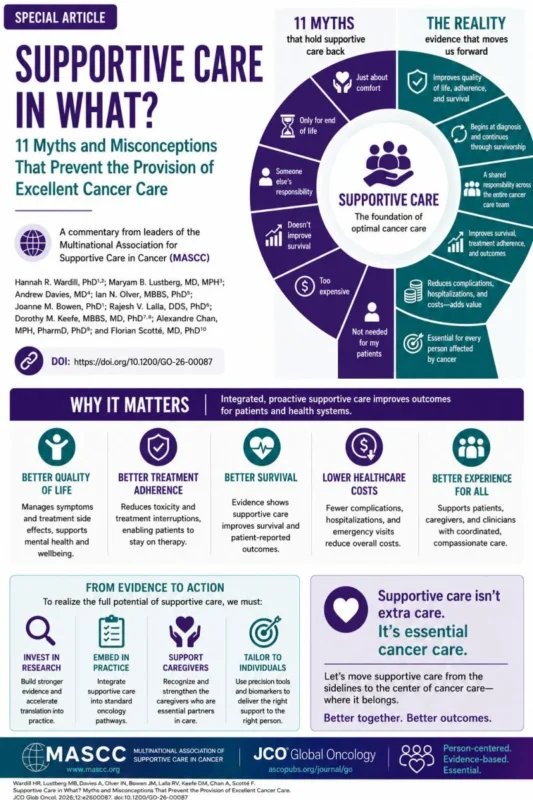
In this article, we tackle 11 common myths that continue to hold supportive cancer care back – from the belief that side effects are simply something patients must endure, to the misconception that supportive care doesn’t improve survival.
The evidence tells a very different story.
Supportive care:
- Improves quality of life
- Helps patients receive and complete optimal cancer treatment
- Reduces complications and healthcare costs
- Supports caregivers as well as patients
- And, importantly, can improve survival.
As cancer therapies become increasingly sophisticated, supportive care must evolve alongside them. The future of oncology isn’t simply about developing better anticancer treatments, it’s also about ensuring every person can safely receive, tolerate and benefit from those treatments.
One line from the paper captures our message best: Supportive care isn’t peripheral to cancer care. It is what enables excellent cancer care.
A huge thank you to my outstanding co-authors – Maryam Lustberg, Andrew Davies, Ian Olver, Joanne Bowen, Rajesh Lalla, Dorothy Keefe, Alexandre Chan, PharmD and Florian Scotté – and to the The Multinational Association of Supportive Care in Cancer (MASCC) Executive for supporting this work.
I hope this commentary sparks discussion, challenges assumptions and helps move supportive care from the sidelines to the centre of oncology where it belongs.”
Maryam Lustberg, Director of Breast Center/Chief Breast Oncology at Yale University School of Medicine, shared Hannah Wardill’s post:
“Amidst the noise and confusion about terminology, I think we all can agree that supportive care not an extra but essential component of cancer care.
Special shout out to Hannah Wardill, for leading our The Multinational Association of Supportive Care in Cancer (MASCC) leaders in this important commentary.”
Title: Supportive Care in What? Myths and Misconceptions That Prevent the Provision of Excellent Cancer Care
Authors: Hannah R. Wardill, Maryam B. Lustberg, Andrew Davies, Ian N. Olver, Joanne M. Bowen, Rajesh V. Lalla, Dorothy M. Keefe, Alexandre Chan, Florian Scotté
Other articles featuring Hannah Wardill and Maryam Lustberg on OncoDaily.