






Hana McMahon, Translational Molecular Diagnostics Scientist | Digital PCR | HPV Diagnostics at The University of Edinburgh, shared a post on LinkedIn:
“Cervical cancer elimination: are we underestimating the challenge?
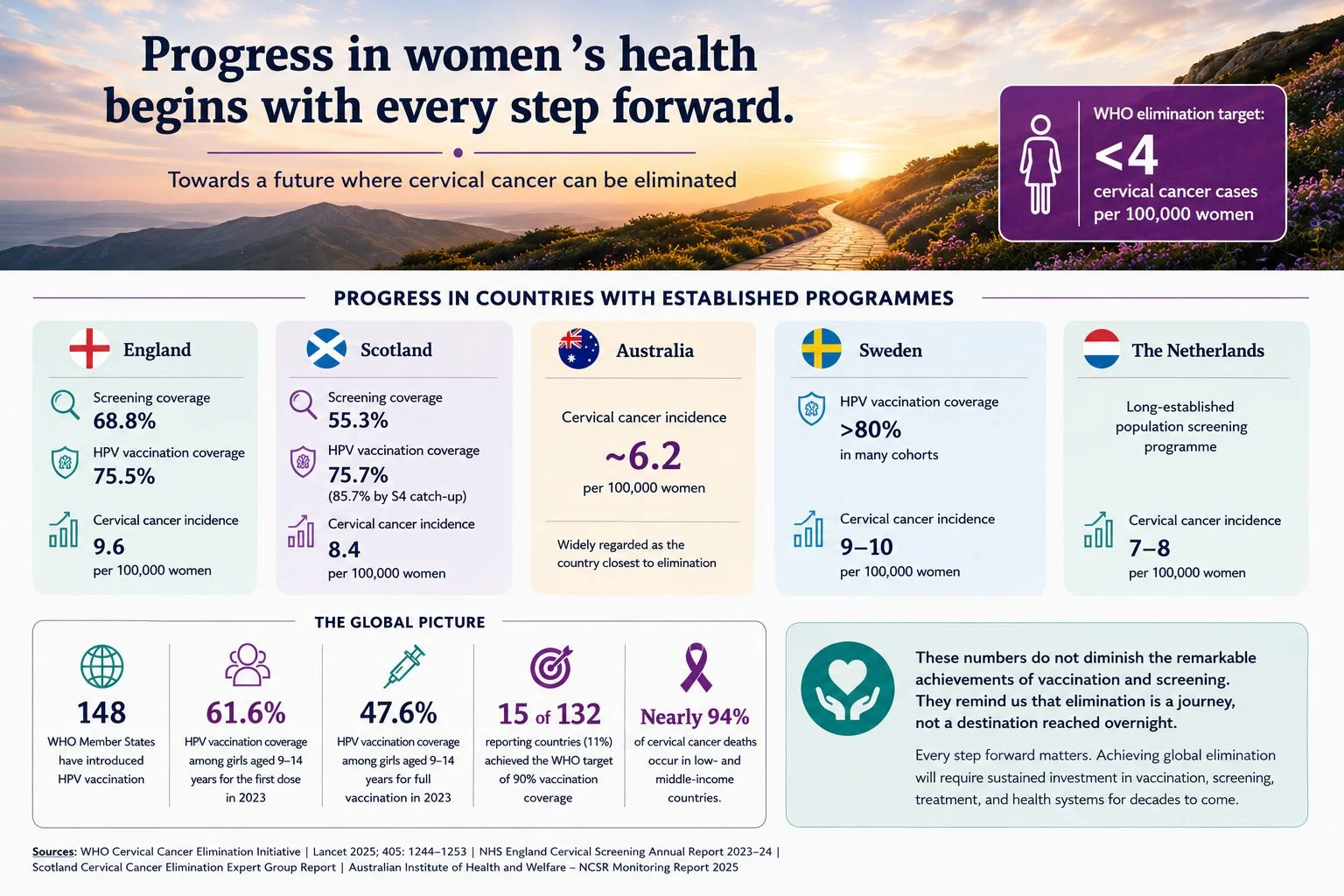
The WHO strategy aims to achieve the 90-70-90 targets by 2030 and ultimately reduce cervical cancer incidence to fewer than 4 cases per 100,000 women.
The progress made over the last two decades has been extraordinary. However, recent data from countries with mature vaccination and screening programmes suggest that the path to elimination may be longer and more complex than often assumed.
Consider countries where HPV vaccination and organised screening have been established for many years:
Australia
• Cervical cancer incidence: ~6.2 per 100,000 women
• Screening coverage: 74.2%
• Widely regarded as the country closest to elimination
Scotland
• Cervical cancer incidence: 8.4 per 100,000 women
• Screening coverage: 55.3%
• HPV vaccination coverage: 75.7% (85.7% by S4 catch-up)
England
• Cervical cancer incidence: 9.6 per 100,000 women
• Screening coverage: 68.8%
• HPV vaccination coverage: 75.5%
Sweden
• Screening coverage: ~83%
• One of the world’s strongest HPV prevention programmes
• Cervical cancer incidence remains approximately 9–10 per 100,000 women
The Netherlands
• Screening coverage: ~50%
• Long-established population screening programme
• Cervical cancer incidence remains approximately 7–8 per 100,000 women
Yet many countries with established programmes remain below the WHO 90-70-90 targets for vaccination and screening.
The challenge becomes even greater when viewed globally:
- 148 WHO Member States have introduced HPV vaccination.
- Global HPV vaccination coverage among girls aged 9–14 years was only 61.6% for the first dose and 47.6% for full vaccination in 2023.
- Only 15 of 132 countries reporting HPV vaccination data worldwide (11%) achieved the WHO target of 90% vaccination coverage.
- Nearly 94% of cervical cancer deaths occur in low- and middle-income countries.
If countries with mature vaccination and screening programmes continue to struggle to achieve the WHO 90-70-90 targets, how can these targets be achieved globally in settings where vaccination has only recently been introduced, organised screening is still developing, and access to treatment remains limited?
This is not an argument against elimination. Rather, it highlights the need for realistic expectations, sustained investment, equitable access to vaccination and screening, and strengthened treatment infrastructure if cervical cancer elimination is to become a global reality rather than a success achieved by only a handful of countries.”
More posts about Cervical cancer.