Hadi Mohamad Abu Rasheed, Scientific Advisor and Director of Programs at Qatar Cancer Society, shared on LinkedIn:
“What turns a National Cancer Control Plan from a document into a functioning mechanism for change?
One of the important discussions at the UICC World Cancer Congress 2026 in Hong Kong highlighted a persistent implementation gap. A 2025 analysis of National Cancer Control Plans (NCCPs) across 21 Asian countries found that while over 90% of plans addressed cancer prevention or treatment, only 57% incorporated legal and evaluation mechanisms, respectively.
Developing a plan is a policy achievement. Delivering it requires a health-system achievement.
Effective implementation requires an architecture built around governance, sustainable financing, accountable leadership, workforce capacity, reliable data and continuous evaluation. Equally important is the meaningful engagement of people affected by cancer in planning, implementation and evaluation.
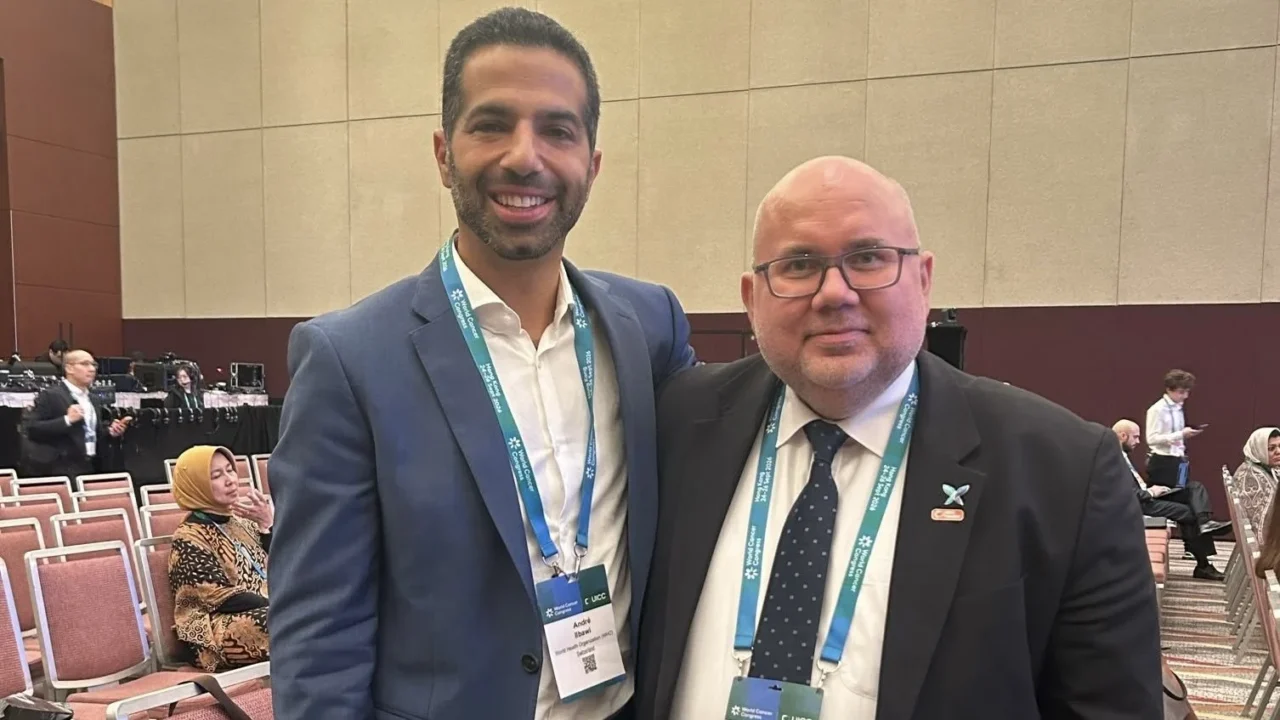
It was a particular pleasure to reconnect with and learn from Dr André Ilbawi, WHO Team Lead for Cancer Control, whose leadership in strengthening national cancer control efforts I greatly appreciate.
In this context, the WHO Academy’s course on National Cancer Control Planning for Programme Managers is a particularly valuable initiative, equipping policymakers, programme managers and civil society partners with practical competencies in prioritisation, costing, governance, implementation, monitoring and evaluation.
This is also where implementation science becomes essential, helping us understand what works, for whom, in which context, under what conditions, and how it can be sustained.
From my experience working across cancer policy, public health and civil society, I believe the question should no longer simply be whether a country has a cancer control plan, but whether it has the architecture, capacity and accountability to deliver it.
A National Cancer Control Plan should be an operating system for action, not simply a statement of intent.
Useful resources on national cancer control planning and implementation:
WHO Academy – National Cancer Control Planning for Programme Managers (2025)
An online course covering strategic planning, stakeholder engagement, prioritisation, costing, financing, implementation, monitoring and evaluation.
Gatellier et al. (2025). National cancer control plans in ANCCA member countries: advancing a pan-Asian cancer initiative. The Lancet Global Health, 13(8), e1476–e1483.
An open-access analysis of NCCPs across 21 Asian countries, highlighting gaps in governance, legal frameworks and evaluation mechanisms.
Title: National cancer control plans in ANCCA member countries: advancing a pan-Asian cancer initiative
Authors: Laureline Gatellier, Clarito Cairo, Jr, Sok King Ong, Rei Haruyama, Abhishek Shankar, Qazi Mushtaq Hussain, Namkha Dorji, Kinley Tshering, Babu Sukumaran, Dawin Thol, Yawei Zhang, Gauravi Ashish Mishra, C S Pramesh, Evlina Suzanna, Soeko W Nindito, Mohammad Biglari, Sarah K Abe, Rokshana Parvin, Jeongseon Kim, Byungmi Kim, Sungbin Yim, Madhawa Gunathilake, Champadeng Vongdala, Siti Norbayah Yusof, Uranchimeg Tsegmed, Erdenekhuu Nansalmaa, Kyaw Kan Kaung, Yi Yi Myint, Kishore Kumar Pradhananga, Aasim Yusuf, Gillian Li Gek Phua, Sudath Samaraweera, Suraj Perera, Suleeporn Sangrajrang, Giang Huong Nguyen, Tran Thi Thanh Huong, William Y K Hwang, Tomohiro Matsuda
Read the Full Article on The Lancet Global Health
WHO Academy – National Cancer Control Planning Webinar Series (2026)
Complementary learning sessions connecting theoretical knowledge with practical country experiences and implementation.”
You can also read: Highlights from World Cancer Congress 2026