






Global Health Otherwise shared on LinkedIn:
“Global health leadership and publishing remain dominated by men based in high-income countries, and researchers increasingly try to document this imbalance.
Van Daalen and colleagues (2026) present a Review examining how scholars measure diversity in these spaces. Since demographic data are rarely collected directly, researchers often guess a person’s gender, race, or nationality from clues like their name, photograph, or biography.
The authors show these guessing methods carry real risks. Names and photos frequently misclassify people, especially those from non-Western or marginalized backgrounds, and such errors can expose people to real harm, including discrimination in some countries.
The authors recommend five practices for researchers to follow, starting with asking people directly whenever possible, and only estimating characteristics when necessary and justified. They add that researchers must protect stored data, disclose their assumptions clearly, and remain transparent about the limits of these methods.
The authors argue that counting people alone will not fix global health’s deep power imbalances, since lasting change also requires shifting who actually holds decision-making power.
The authors call for researchers to prioritize self-reported data, apply inference methods cautiously and only when clearly justified, and remain transparent, since counting alone cannot achieve equitable global health governance.”
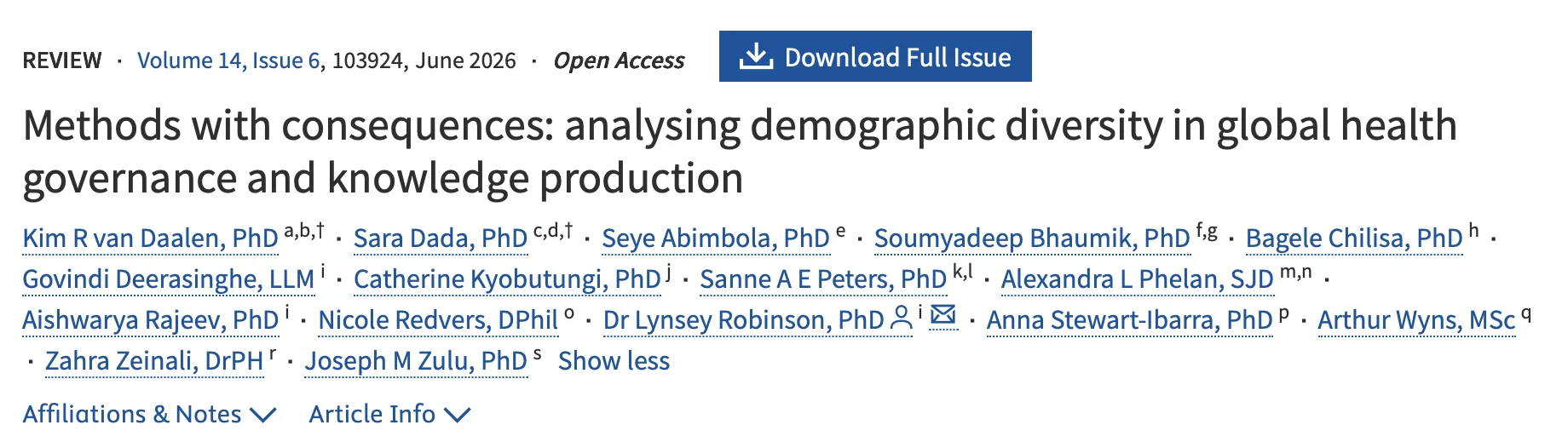
Title: Methods with consequences: analysing demographic diversity in global health governance and knowledge production
Authors: Kim van Daalen, Sara Dada, Seye Abimbola, Soumyadeep Bhaumik, Bagele Chilisa, Govindi Deerasinghe, Catherine Kyobutungi, Sanne Peters, Alexandra Phelan, Aishwarya Rajeev, Nicole Redvers, Lynsey Robinson, Anna Stewart-Ibarra, Arthur Wyns, Zahra Zeinali, Joseph Zulu
Read the Full Article on The Lancet Global Health
Other posts about Global Health Otherwise on OncoDaily.