





 Kenya
Kenya Global Health Otherwise shared a post on LinkedIn:
“When Research Meets Politics: How Evidence Actually Shapes Health Policy in Kenya
For decades, global health systems have assumed that good research automatically leads to better policy.
Getting evidence into the hands of decision-makers, the thinking goes, should be enough to drive change. Guleid and colleagues (2026) challenge this assumption directly, arguing that knowledge translation (KT), the process of moving research into policy action, is far more political, relational, and context-dependent than existing frameworks acknowledge.
Drawing on 35 interviews, 52 hours of observation, and 34 document reviews across Kenya’s national and county governments, the authors find that KT is practiced by a wide range of actors, not just researchers.
Policy-makers, development partners, and intermediaries all translate evidence, doing so through both formal channels and informal spaces like phone calls and corridor conversations. Evidence is used not only to inform decisions, but to justify positions already taken, build coalitions, and signal credibility.
Context, including institutional structures, political pressures, and fiscal constraints, shapes what counts as evidence and whose voices carry weight.
The authors recommend moving beyond technical KT toolkits toward adaptive, relationship-centered approaches that account for power and politics.
Guleid and colleagues (2026) show that turning research into policy in Kenya is deeply political, shaped by relationships, institutional context, and strategic evidence use rather than technical processes alone.”
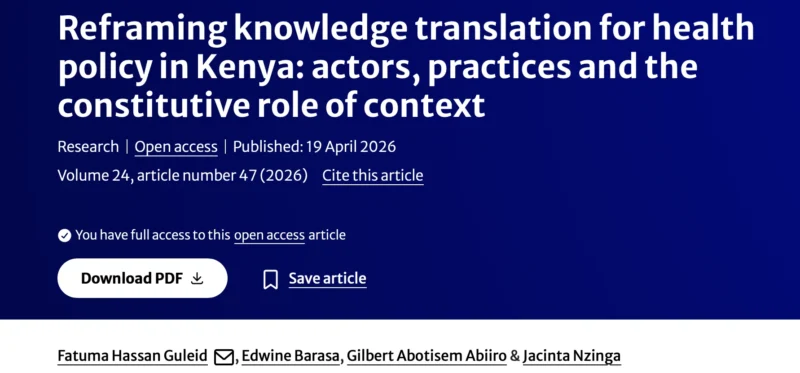
Title: Reframing knowledge translation for health policy in Kenya: actors, practices and the constitutive role of context
Authors: Fatuma Hassan Guleid, Edwine Barasa, Gilbert Abotisem Abiiro, Jacinta Nzinga
Read the Full Article.
Other articles from Global Health Otherwise.