






Glen Clack, Chief Medical Officer at TheraCryf, Consultant Chief Medical Officer at CV6 Therapeutics, Lecturer in Faculty of Health and Life Sciences Department at University of Exeter Medical School, shared on LinkedIn:
“A proof-of-concept strategy for agents with a reversal-of-resistance hypothesis
Executive summary
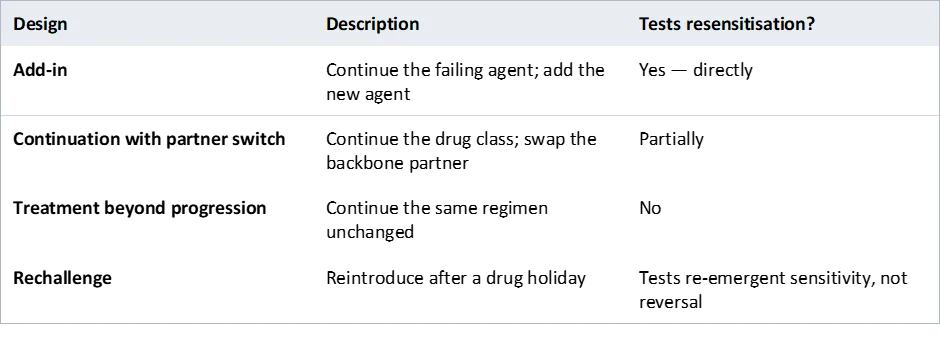
The add-in design, continuing a failing agent and adding an investigational compound, is the most direct clinical test of a resensitisation hypothesis. It is operationally cheap and fast, and it interrogates the mechanism in exactly the population where the mechanism is operative. It is also a harder efficacy bar than concurrent dosing, and easy to fail for reasons unrelated to the hypothesis under test.
The discriminating variable across the published literature is consistent: the design reads out where the resistance mechanism is dominant, single and measurable, and fails where resistance is polyclonal, adaptive or phenotypic.
Two intervention points are available: radiological progression and molecular (ctDNA) progression. They are complementary rather than alternative, and the recommended sequence is to use the radiological add-in as the cheap mechanism experiment and the molecular add-in as the value-creating confirmatory study.
Recent regulatory experience, principally the FDA advisory committee outcome for SERENA-6, has materially raised the bar for both. See Appendix A.
1. Design taxonomy
Four distinct designs are routinely conflated. Precision matters, because only the first is a clean test of resensitisation.
 2. Prior art
Generation 1: the cautionary tale
Multidrug-resistance reversal (verapamil, valspodar/PSC833, tariquidar, zosuquidar) and MGMT depletion with O6-benzylguanine plus BCNU or temozolomide.
Almost all failed, and largely for a single shared reason: the “reverser” altered clearance of the cytotoxic backbone, exposure rose, toxicity rose, the backbone was dose-reduced, and any therapeutic gain was cancelled out.
Implication for design. For any resistance-reversal PoC, the first question from a reviewer or DSMB will be whether the effect is pharmacological reversal or a pharmacokinetic interaction. Build intensive PK into the design and, ideally, demonstrate unaltered backbone exposure.
Generation 2: proof the design can work
The osimertinib/MET axis is the modern poster child.
SAVANNAH (savolitinib + continued osimertinib after progression on first-line osimertinib, MET-selected):
- Confirmed ORR 56.3% in the primary efficacy population; median PFS 7.4 months
- BICR concordant: ORR 55.0%, median PFS 7.5 months
- ORR 9% in patients without high MET overexpression/amplification
That final figure is the whole lesson. The design reads out only in the biomarker-defined subgroup where the resistance mechanism is dominant.
Replicated in the same axis:
- INSIGHT 2: tepotinib plus osimertinib, MET-amplified
- CHRYSALIS-2: amivantamab plus lazertinib: ORR 61% in MET-positive vs 14% in MET-negative; median PFS not reached vs 4.2 months
- Telisotuzumab vedotin plus osimertinib: MET overexpression
Generation 3: mixed results, and highly informative
CDK4/6 inhibition beyond progression in HR+/HER2− advanced breast cancer:
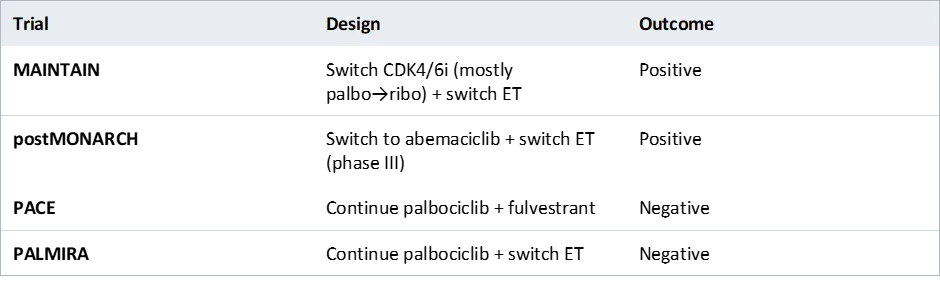 The pattern is unambiguous: the positive trials changed both the inhibitor and the endocrine partner; the trials that continued the identical agent showed no benefit. Pure ‘keep everything, add one thing’ performed worst.
3. Contribution of components: the SAVANNAH solution
The obvious regulatory objection to an add-in design is: if the backbone has failed, why keep it?
SAVANNAH answered this directly, embedding a randomised subset comparing savolitinib + osimertinib against savolitinib + placebo; explicitly to isolate the contribution of continuing the failed backbone.
If the hypothesis is genuinely resensitisation, a new-agent-monotherapy arm is scientifically mandatory and is the strongest single regulatory asset in the package.
4. Endpoints
Growth modulation index / PFS ratio
The within-patient control is the seductive feature. GMI = PFS2 : PFS1 (Von Hoff, 1998), with a conventional threshold of 1.3–1.33.
Advantages: reduces heterogeneity as each patient is their own control; permits small single-arm designs; yields a clinically interpretable estimate of benefit.
Weaknesses
- PFS1 is captured retrospectively on a different assessment schedule
- PFS shortens systematically with each successive line irrespective of drug activity
- PFS2 is censorable while PFS1 is not: the estimator is biased
- Thresholds are not standardised across trials
- Precision oncology experience is sobering (e.g. WINTHER did not meet this endpoint)
Recommendation. Use GMI as supportive/hypothesis-generating, never as the pivot.
Confirmed ORR
In a fast-growing tumour at progression, confirmed response is a cleaner and more convincing PoC signal. Radiological shrinkage in a lesion that was demonstrably growing on the backbone is close to a mechanistic proof of resensitisation.
5. Regulatory issues
Contribution of components. FDA’s 2013 codevelopment guidance and the EMA guideline on fixed and free combinations both apply, but the question is inverted here: you must justify continuing a drug the patient has objectively progressed on. A historical within-patient control will not support a claim. Expect to need the new-agent-monotherapy arm and, ultimately, randomisation against next-line SoC.
Ethics and the ‘denied effective therapy’ objection. Where an approved next line exists, continuing a failed one requires justification, a capped time on study, and unambiguous progression-off rules. This is materially easier where the population is biomarker-defined and the available next line is unimpressive.
IMP status of the backbone. Under EU CTR 536/2014 the continued backbone is very likely an auxiliary medicinal product , or an IMP if you are formally testing it. This drives labelling, QP release, traceability and supply obligations. Where the backbone is a competitor’s product you need a supply or CTA agreement, or reliance on commercial supply that most payers will not reimburse post-progression. This is frequently the single largest practical blocker.
Label consequence. A positive result buys a narrow post-progression combination indication, contingent on the partner’s label and continued availability. If the field subsequently moves the partner into an upfront combination, the indication evaporates.
6. Logistical issues
- Narrow enrolment window. Patients must be caught at progression, requiring pre-consent and pre-screening while still responding.
- Mandatory biopsy at progression to establish the resistance mechanism, with heavy screen-failure burden. SAVANNAH screened several hundred patients to reach a primary efficacy population of ~80.
- Adverse baseline. Patients enter with progressing disease: worse performance status, faster kinetics, higher early dropout, less tolerance of overlapping toxicity.
- Oligoprogression is a confounder, exclude it or handle it explicitly, since local therapy would produce the same apparent benefit.
- DDI and overlapping toxicity with the backbone usually require a safety run-in and a backbone dose-reduction rule, which then compromises interpretation.
7. Add-in versus concurrent dosing: is it a higher hurdle?
Operationally: no. It is substantially cheaper and faster: smaller n, enriched population, single-arm feasible, no requirement to beat an established frontline comparator.
Scientifically: yes. At radiological progression the tumour is polyclonal. The target mechanism typically accounts for only a fraction of the total burden, so even complete reversal in the target clone leaves the remainder growing. Effect sizes are compressed and durations short; 7.4 months even in the best-in-class SAVANNAH population.
Preclinical and evolutionary-dynamics work consistently favours upfront combination for preventing rather than reversing resistance. A negative add-in study can therefore easily be a false negative for a drug that would work concurrently, the failure mode most worth avoiding.
Concurrent dosing gives a softer, more likely-positive read, but cannot distinguish resistance reversal from simple additivity, exposes sensitive patients to unnecessary combination toxicity, and requires a large randomised trial with OS or mature PFS.
8. The molecular intervention option
Principle
Move the intervention point upstream: trigger the add-in at molecular progression, emergent resistance mechanism in ctDNA, or rising tumour fraction, rather than waiting for RECIST progression. This directly addresses the objection that sinks the radiological add-in: polyclonal, bulky, fast-growing disease in which the target clone is a minority.
Prior art
Two trials define the field, both in HR+ breast cancer and ESR1.
PADA-1 established feasibility: serial ddPCR surveillance of ESR1 during AI + palbociclib, randomising at rising ESR1 mutation without progression to switch to fulvestrant with continued palbociclib.
SERENA-6 did it registrationally, described as the first global registrational study to use ctDNA surveillance to detect a drug-induced acquired resistance mutation before progression and direct a treatment adaptation:
- Patients on ≥6 months first-line AI + CDK4/6i entered surveillance; Guardant360 CDx every 2–3 months, timed to routine imaging
- At ESR1 detection without progression, randomised double-blind and double-dummy to switch AI → camizestrant with the same CDK4/6i continued
- Median PFS 16.0 vs 9.2 months; 12-month PFS 60.7% vs 33.4%; 24-month 29.7% vs 5.4%
- PFS2 HR 0.52 (27% maturity); OS immature (12%)
- Discontinuation for AEs 1.3% (camizestrant) and 1.9% (AI)
Important caveat: both are partner-switch-with-backbone-continuation designs, not true add-ins. The pure molecular add-in, retain the entire failing regimen, add the reversal agent at molecular emergence, is essentially untested. That is the white space, and also the risk.
Why this suits a reversal-of-resistance agent
- The resistant clone is oligoclonal and small, the best chance of demonstrating true reversal
- The backbone is demonstrably still working, so you are testing resensitisation of a live drug rather than resurrection of a dead one. This largely dissolves both the contribution-of-components objection and the ethical objection to continuing failed therapy
- Patients are well: good PS, low burden, tolerance for combination toxicity, long runway
- It yields a quantitative pharmacodynamic endpoint on the actual mechanism
That last point is the strongest argument. SERENA-6 demonstrated it: camizestrant profoundly reduced ESR1 mutant allele fraction within 8 weeks while AF rose in many patients continuing AI; total ctDNA clearance was 51.0% vs 1.9%, and clearance correlated with improved OS (HR 0.39).
‘Does adding my drug collapse the resistant clone’s allele fraction by week 8?’ is a faster, cleaner and more mechanism-specific PoC read than ORR in a growing tumour, and it is within-patient, generating serial pre/post kinetics from every subject.
Regulatory position
Molecular progression is accepted as an entry criterion and stratification factor. It is not accepted as an endpoint in advanced solid tumours. SERENA-6 is the template: ctDNA triggers randomisation, but the primary endpoint remained investigator-assessed PFS by RECIST v1.1.
Expect:
- Companion diagnostic co-development obligation; an approved assay, not a home-brew. PADA-1’s in-house ddPCR would not have supported registration
- Pressure on lead-time bias, since part of the PFS gain is arithmetic rather than biological
- Hard questions on OS (see Appendix A)
- The ‘why not simply give it to everyone upfront?’ challenge; the surveillance strategy only wins if toxicity or cost makes universal upfront use unattractive
Logistics: the real cost
The funnel is brutal. SERENA-6 screened 3,256 patients, of whom 548 (17%) had an ESR1 mutation detected during surveillance, and 315 were ultimately randomised, over a three-year enrolment. You are funding serial assays across a large surveilled cohort, most of whom never randomise, plus site infrastructure for a monitoring cadence many centres do not run.
Budget the screening phase as a programme in its own right.
Assay–mechanism fit: the hard constraint
This design works where the resistance mechanism is a blood-detectable point mutation at reasonable allele fraction:
- ESR1 mutations
- EGFR C797S
- RAS re-emergence on anti-EGFR therapy
- ABL kinase-domain mutations
It works poorly where resistance is amplification-driven (MET copy number in plasma is detectable but insensitive), expression-driven, epigenetic, or phenotypic (EMT, lineage plasticity, stromal).
If the reversal target cannot be reliably interrogated in plasma at the moment it emerges, this option is closed and the radiological add-in is the only route. A fallback exists, triggering on rising tumour fraction or molecular tumour burden rather than a specific variant, but it is less specific, harder to power, and supports a weaker mechanistic claim.
9. Comparison and recommended sequence
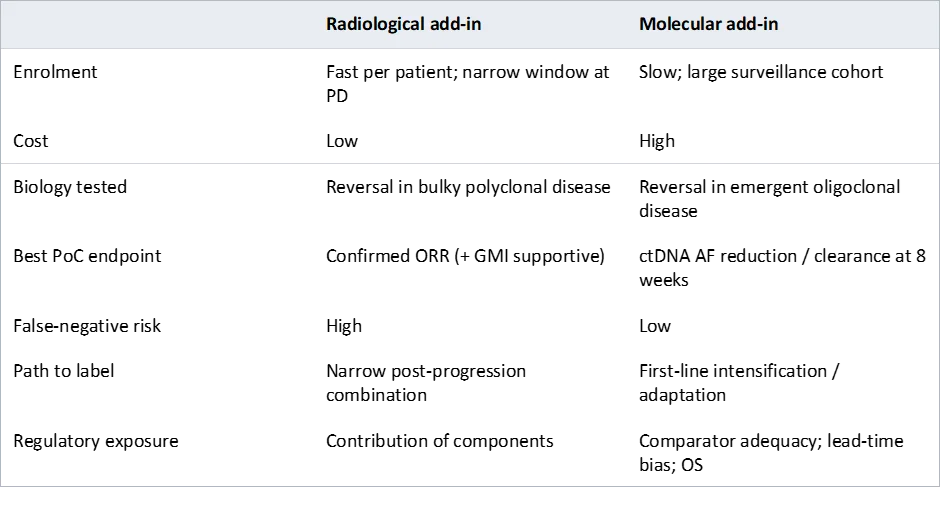
Recommended sequence
- Radiological add-in as the cheap, fast mechanism experiment. If the drug produces confirmed responses even in bulky resistant disease, the hypothesis is strongly supported and the expensive step is de-risked.
- Molecular add-in as the value-creating study. This is where the commercially meaningful, first-line-adjacent indication sits and where the effect size will be largest.
Do not run the molecular study first. The screening burden makes it far too expensive to fail on a hypothesis not yet tested cheaply.
Design economy. Run ctDNA surveillance inside the radiological add-in study, using the pool of patients already being pre-consented. This delivers assay validation, mechanism-emergence incidence and surveillance-cadence feasibility data, all required for the molecular trial, funded by a study being run regardless.
10. Summary recommendations
Treat the add-in study as a mechanism experiment, not an efficacy experiment. Specifically:
- Biomarker-select at progression, with paired biopsy and ctDNA
- Include a new-agent monotherapy lead-in or a randomised new-agent-plus-placebo arm to answer contribution of components
- Run intensive PK to exclude an exposure-mediated effect
- Use confirmed ORR as primary, with GMI supportive
- Generate paired pharmacodynamics demonstrating reversal in situ
- Pre-specify post-progression therapy and mandate crossover: see Appendix A
- Use the result to justify the concurrent or molecular randomised trial, not to substitute for it
Appendix A: Regulatory and HTA challenges: recent evidence
The sharpest documented resistance to these designs has come from two directions, and neither is quite the one usually anticipated.
A1. The live test case: FDA and SERENA-6
This is the most important recent datapoint, and it went badly.
FDA’s ODAC voted 6–3 against SERENA-6 having demonstrated clinically meaningful benefit, citing immature OS data and trial design concerns.
The Agency’s stated objections map almost exactly onto the vulnerabilities of both designs discussed above:
- The trial was not designed to prove that early switching at ESR1 detection is superior to switching at radiographic progression
- No crossover to camizestrant plus CDK4/6i was permitted for control-arm patients at progression
- Control-arm patients continued AI + CDK4/6i for a median of 9.2 months after a resistance mutation had already been detected
AstraZeneca has been arguing the case substantially on ctDNA clearance data.
The academic critique ran in parallel:
- AI maintenance in the control arm was arguably suboptimal: mutant ER is constitutively active, so peripheral oestrogen suppression is ineffective; maintaining a therapy despite known resistance is difficult to justify molecularly
- PFS and PFS2 alone are misleading where patients receive multiple sequential therapies
- With immature OS, no crossover and no standardised post-progression treatment, long-term benefit remains uncertain
- PFS2 was compromised by investigator’s-choice subsequent therapy with no crossover, violating the conditions under which PFS2 is interpretable
- PFS2 origin-point mismatch: measured from randomisation, but patients had already received AI + CDK4/6i for a median of 23 months
Generalised lesson. In both the radiological and molecular add-in designs, the engine of the design is that the control arm remains on something already declared, on molecular evidence, to be failing. Regulators will read that as an artificially weakened comparator.
Mitigation. Either make the comparator a genuine active next-line SoC, or pre-specify and mandate post-progression therapy with crossover, so that PFS2 and OS remain interpretable.
A2. The German HTA challenge: the one that costs money
More concrete than a general ethics objection, and where attention should be focused.
Under AMNOG, added benefit must be demonstrated against the G-BA-determined appropriate comparator therapy (zweckmäßige Vergleichstherapie, zVT); this determines price negotiation with the GKV-SV. The mechanism that catches add-in designs is blunt:
- The ACT should reflect current standard of care
- Its choice is entirely at G-BA’s discretion
- If the evidence does not include comparative data versus the ACT, G-BA concludes additional benefit not proven (Zusatznutzen nicht belegt)
- Indirect treatment comparison is the only fallback, held to methodological standards that are very difficult to meet
Applied to the radiological add-in. A patient progressing on first-line therapy has, in G-BA’s view, an established second-line option, that is the zVT. A trial comparing “failed backbone + new agent” against “failed backbone alone” has not compared against the zVT at all. Outcome: no additional benefit proven, and a reference price.
Applied to the molecular add-in. No better, and possibly worse. G-BA’s zVT is defined by clinical practice, and molecular progression is not a recognised clinical state in German practice. The comparator therefore becomes “watchful continuation until radiographic progression, then second-line SoC”, precisely the arm you beat, but not the arm G-BA regards as the standard.
Compounding endpoint risk. While regulators accept PFS and response rate as primary morbidity endpoints, G-BA has mostly excluded them from its assessments. In a substantial minority of assessments, the ACT specified by G-BA has differed from the comparator actually used in the phase III trial. A PFS-driven, ctDNA-triggered, non-zVT-controlled trial is close to a worst case for AMNOG.
Mitigation. Procedural and cheap relative to the exposure, request a G-BA advice meeting (fee-bearing, but it commits their reasoning) before the protocol is locked, and align it with EMA scientific advice and the EU HTA Regulation Joint Clinical Assessment process. Do this at the design stage of the confirmatory trial, not the PoC.
A3. Enrolment before standard of care is exhausted
German scepticism here is real, but is better characterised as practice and culture than as published policy.
The formal basis derives from:
- EU CTR 536/2014, Article 28: anticipated benefits to subjects or to public health must justify the foreseeable risks
- Declaration of Helsinki: testing against the best proven intervention, with withholding permitted only where no proven intervention exists or where there is compelling methodological justification
German ethics committees and BfArM/PEI have historically applied this more strictly than most Member States, a legacy of the pre-CTR Arzneimittelgesetz requirement that research in patients be eigennützig, i.e. of direct potential benefit to the participant. In practice this manifests as country-specific protocol addenda and, occasionally, Germany declining to participate in a design that other Member States accept.
Transatlantic divergence is now stark. FDA’s Project FrontRunner runs in the opposite direction, explicitly encouraging development of new oncology agents in earlier lines rather than in heavily pretreated refractory populations, on the grounds that last-line settings deliver both worse biology and worse patients. There is also a growing published critique of the traditional phase I entry criterion, patients typically qualify at the point where they have exhausted standard life-prolonging options, which generates psychosocial dynamics that complicate consent. “SoC exhausted” is not the ethically superior position it has been assumed to be.
A4. Practical consequences for design
- The radiological add-in is strengthened, not weakened, by the German objection. You are adding to therapy, not withholding it. Frame it explicitly this way in the CTA: no patient is denied anything they would otherwise receive; the only question is whether they additionally receive something more.
- The molecular add-in is exposed by it, because the control arm knowingly continues a therapy shown to be failing. Build in mandatory crossover at radiographic progression and pre-specified post-progression therapy. SERENA-6’s failure to do either is what gave ODAC its opening, and will give G-BA the same opening.
- Seek formal advice early and in parallel: EMA scientific advice, G-BA consultation, FDA Type C. Treat divergence between them as a design input rather than a nuisance. On this class of design the agencies genuinely disagree: a protocol that satisfies FDA’s Project FrontRunner instincts may not survive a German ethics committee, and vice versa.
- Budget for an OS-interpretable design from the outset. Every criticism above reduces to the same one: you demonstrated that you can delay an event you defined, not that the patient lived longer or better.
Key references
Add-in / resistance reversal
- Ahn M-J et al. SAVANNAH: savolitinib + osimertinib after progression on osimertinib. Ann Oncol 2025 (ELCC 2025, Abstract 2O)
- SAVANNAH randomised subset: savolitinib + osimertinib vs savolitinib + placebo. J Clin Oncol 2025;43(16 suppl):8513
- INSIGHT 2: tepotinib + osimertinib, MET-amplified NSCLC
- CHRYSALIS-2: amivantamab + lazertinib, MET-positive vs MET-negative
CDK4/6i beyond progression
- Kalinsky K et al. postMONARCH: abemaciclib + fulvestrant after CDK4/6i progression. J Clin Oncol 2025
- Mayer EL et al. PACE. J Clin Oncol 2024;42:2050–60
- Llombart-Cussac A et al. PALMIRA. J Clin Oncol 2025;43:2084–93
- Kalinsky K et al. MAINTAIN. 2023
Endpoints
- Von Hoff DD. Growth modulation index / PFS ratio, 1998
- Kovalchik S, Mietlowski W. Statistical methods for a phase II trial with a GMI endpoint. Contemp Clin Trials 2011;32:99–107
- Mick R, Crowley JJ, Carroll RJ. Control Clin Trials 2000;21:343–59
- Benchmarking PFS ratio as primary endpoint in precision oncology. npj Precis Oncol 2025
Molecular intervention
- Bidard F-C et al. PADA-1. Lancet Oncol 2022;23:1367–77
- Turner N et al. SERENA-6. N Engl J Med 2025; J Clin Oncol 2025;43(17 suppl):LBA4
- SERENA-6 extended analysis and ctDNA dynamics. Lancet Oncol 2026
- Evaluating the clinical utility of ctDNA testing to identify molecular cancer progression: lessons from SERENA-6. npj Breast Cancer 2026
- Assessing the clinical readiness of the SERENA-6 strategy. The Oncologist 2025;30(9)
Regulatory / HTA
- FDA Guidance: Codevelopment of Two or More New Investigational Drugs for Use in Combination, 2013
- FDA Oncology Center of Excellence, Project FrontRunner
- Regulation (EU) No 536/2014, Article 28
- Declaration of Helsinki (2024 revision)
- G-BA appropriate comparator therapy (zVT) methodology; IQWiG General Methods
Early benefit assessment in oncology: acceptance of regulatory primary endpoints by G-BA.”
Other posts featuring Glen Clack on OncoDaily.