






Glen Clack, Lecturer in Faculty of Health and Life Sciences Departmen at University of Exeter Medical School, shared a post on LinkedIn:
“Every so often a paper arrives that does the useful, slightly uncomfortable work of holding a mirror up to the field and telling us whether we have actually reformed or merely resolved to.
Colleagues at the Sarah Cannon Research Institute have done precisely that. Writing in JCO Oncology Advances, they reviewed 367 phase I protocols activated across eight drug-development units between 2021 and 2024, the bulk of them (82%) first-in-human. The question posed was the honest one: Has Project Optimus changed what we do, or only what we say from the podium?
The reassuring answer is that it has changed what we do. Bayesian and model-informed dose-finding, once the recondite preserve of a few statisticians muttering in a corner, is now visibly mainstream. The Procrustean old ritual of driving to the maximum tolerated dose and then stretching the patient to fit it is, at long last, in retreat. We have started, genuinely, to kick the tyres on a range of doses rather than crowning the highest survivable one and calling it a result.
The less comfortable finding is the one worth dwelling on. Patient-reported outcomes remain conspicuously, almost systematically, absent. We have grown fluent in the pharmacology of ‘less is more’ whilst staying oddly deaf to the very people best placed to adjudicate it: the patients taking the drug. It is a curiously apophatic species of progress, defined more by the toxicity we now decline to inflict than by any positive account of how someone actually feels on treatment.
None of which is a counsel of despair. The trajectory is right, and a Panglossian reading is not wholly unearned. But the paper is a faintly minatory reminder that operationalising a paradigm is not the same as finishing it. The dose-finding half of the revolution is well underway. The listening half has barely begun.
Mrs C, to whom I read the abstract aloud over breakfast, observed that a man who devotes his working life to optimising doses might profitably optimise the number of times he checks his inbox before the coffee has even brewed. Boadicea, characteristically, reserved judgement.”
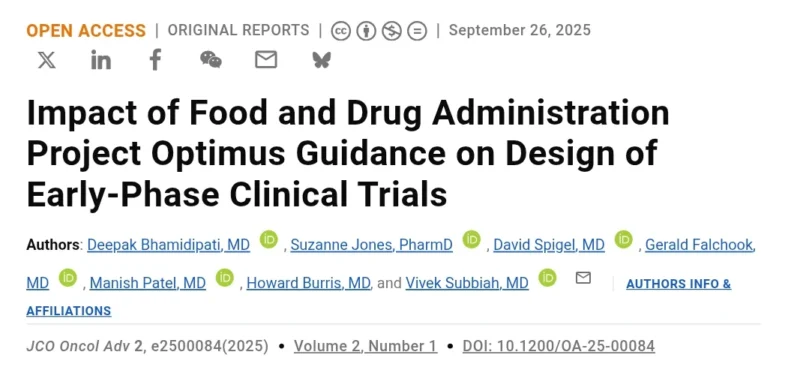
Title: Impact of Food and Drug Administration Project Optimus Guidance on Design of Early-Phase Clinical Trials
Authors: Deepak Bhamidipati, Suzanne Jones, David Spigel, Gerald Falchook, Manish Patel, Howard Burris, Vivek Subbiah.
Other articles about Sarah Cannon Research Institute on OncoDaily.