Gilberto Lopes, Chief of the Division of Medical Oncology at the Sylvester Comprehensive Cancer Center, shared on LinkedIn:
“Competition matters in healthcare.
At its best, competition should help produce better services, lower costs, and stronger incentives to respond to patients rather than simply to bargaining power.
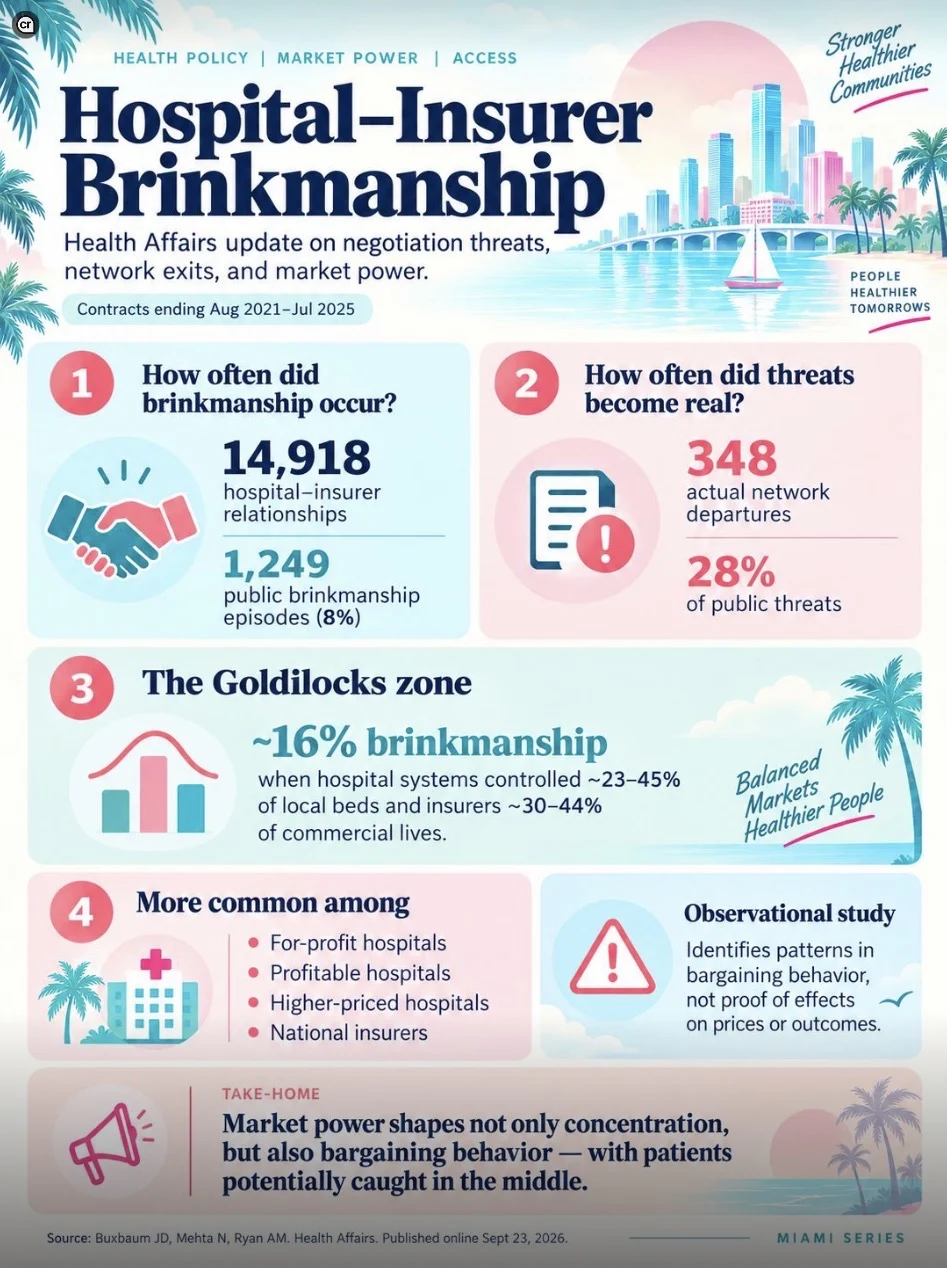
A new Health Affairs study offers an interesting window into what happens when hospital systems and insurers negotiate from positions of meaningful market power.
- The investigators studied 14,918 hospital-insurer relationships and found:
1,249 public brinkmanship episodes (8% of relationships) - 348 actual network departures
- brinkmanship was most common in a ‘Goldilocks zone’ where neither side dominated, but both had enough leverage to threaten exit
The study also found more brinkmanship among:
- for-profit hospitals
- profitable hospitals
- higher-priced hospitals
- national insurers
An important caveat: this is an observational study. It does not prove that brinkmanship raises prices, worsens access, or leads to poorer outcomes.
But it does tell us something important about the political economy of medicine.
Market concentration is not just about size. It changes behavior. It affects how organizations negotiate, how they use public pressure, and how patients may become part of the leverage in disputes over contracts and networks.
That is one reason competition matters.
Not because competition solves everything, but because healthcare systems work better when no single actor has so much leverage that bargaining itself starts to distort service, pricing, and access.
Better competition can mean better care, lower costs, and fewer patients caught in the crossfire.”
Read more articles featuring Gilberto Lopeson OncoDaily.