





Ermelinda Damko, Sr. Scientist at Regeneron, shared a post on LinkedIn:
“‘Beyond Static Genomes: What Really Makes an In Vitro Oncology Model “Best”?’
Overview
The most consequential shift in oncology model systems is not the move from two-dimensional to three-dimensional culture. It is the move from convenient surrogates to biologically decision-relevant systems. For years, the field optimized for throughput, tractability, and reproducibility. Those strengths built modern oncology discovery. But they also created a blind spot: many of the variables that determine whether a therapy works in patients—clonal diversity, cell-state plasticity, spatial drug exposure, stromal context, and immune architecture—are systematically stripped away in the models most commonly used to nominate drugs in the first place.
That is why the question “what is the best in vitro model?” is poorly framed when treated as a contest between platforms. The better question is: what is the lowest-complexity model that still preserves the biology governing response for the mechanism of action under study? Once that threshold is crossed, extra complexity becomes optional; below it, even elegant data can be misleading. Recent advances in patient-derived organoids, pan-cancer functional screening platforms, organotypic cultures, PDX-derived systems, and microphysiologic models suggest that oncology is entering a more mature phase in which model choice is increasingly organized around mechanism, translational intent, and decision latency rather than habit alone.
Why the old model hierarchy is breaking down
Two-dimensional cancer cell lines remain foundational because they solve practical problems better than any competing system. They are inexpensive, genetically tractable, scalable, and compatible with automated workflows, which makes them highly effective for target validation, early pharmacology, combination scanning, and structure–activity relationship campaigns. They also create experimentally clean conditions for isolating cell-intrinsic biology, which is why they remain indispensable in kinase signaling, synthetic lethal hypothesis generation, and CRISPR-based perturbation studies.
Their weakness is equally clear. Cells grown as monolayers on rigid plastic are exposed to an artificial mechanical environment, uniform nutrient access, and nonphysiologic polarity cues; as a result, they often diverge from patient tumors in architecture, signaling state, metabolic behavior, and treatment response. Comparative studies of 2D and 3D systems consistently show that 2D cultures can overstate efficacy and underrepresent resistance phenotypes linked to diffusion limits, hypoxia, quiescence, or multicellular organization. This does not make 2D models obsolete. It makes them selective. They are strongest when the critical biology is largely tumor cell intrinsic and weakest when response depends on tissue context.
That distinction matters more now because therapeutic mechanisms have become more context sensitive. Classical cytotoxics, targeted agents, antibody–drug conjugates, PARP inhibitors, immunotherapies, and tumor–stroma-modulating combinations do not fail for the same reasons. A model optimized for signal clarity is not automatically optimized for translational relevance. The old hierarchy, where 2D generates the lead, 3D adds realism, and in vivo studies provide validation, is being replaced by a question-driven architecture in which different model classes occupy distinct mechanistic niches.
3D systems did more than add structure
Three-dimensional spheroids and related scaffolded cultures changed the field because they restored more than morphology. They restored gradients. Spheroids reproduce oxygen and nutrient limitation, differential proliferation states, and drug-penetration constraints in ways that monolayers do not. Those features are not cosmetic. They influence DNA damage responses, apoptotic thresholds, metabolic stress programs, and adaptive resistance states. In direct comparisons between 2D and 3D formats, the same agent can produce materially different activity profiles depending on whether those gradients are present.
This is why 3D systems became so important for agents whose activity is shaped by tumor architecture rather than target occupancy alone. Cytotoxic payloads, radiosensitizers, drugs sensitive to cell-cycle distribution, and therapies whose efficacy declines under hypoxia or poor penetration often behave more realistically in spheroid models than in monolayer cultures. That said, most spheroid systems remain line-derived and only partially capture patient-specific heterogeneity, evolutionary history, or native stromal composition. They improve biologic realism without fully solving the translational problem.
The key insight is that 3D culture improved not only fidelity, but also failure detection. It became easier to identify compounds that looked compelling in 2D but were unlikely to survive architectural constraints found in tumors. In that sense, 3D models are as valuable for deselection as for discovery.
PDOs are changing the center of gravity
Patient-derived tumor organoids have emerged as the most credible in vitro platform for functional precision oncology because they sit at an unusually productive intersection of fidelity, expandability, and assayability. Across recent work, the case is consistent: PDOs retain many of the defining features of parental tumors, including driver mutations, broad copy-number architecture, lineage features, and major transcriptional programs, while remaining amenable to ex vivo perturbation. What distinguishes PDOs from earlier patient-derived formats is that they are not merely descriptive avatars. They are operational test systems.
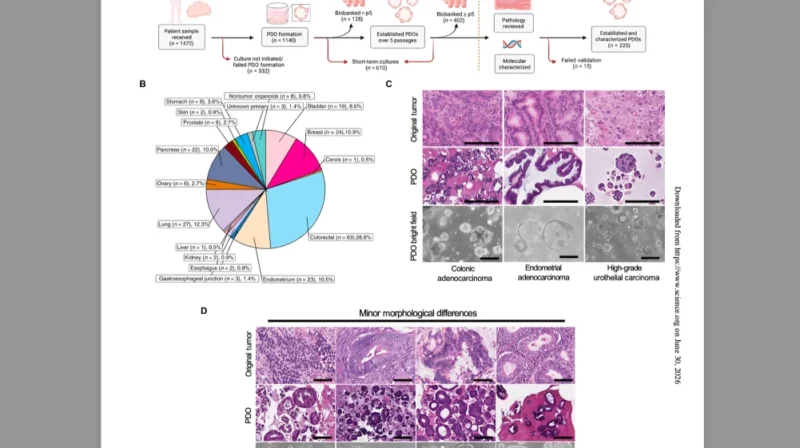
The strongest recent dataset supporting that claim is the pan-cancer PDO study reported in Science Advances, which established a platform of 220 PDOs derived from 190 patients across 15 tumor types. The study is notable not only for scale, but for the rigor of its benchmarking. Tumor–organoid pairs were compared by histopathology, genomic features, and clonal composition, showing that PDOs can preserve major tumor traits and, importantly, retain meaningful subclonal structure rather than collapsing into a single dominant culture-adapted state. That matters because intra-tumoral heterogeneity is not background noise. It is often the substrate for partial response, residual disease, and early resistance.
The broader importance of this platform lies in what it enables. Once a patient-derived model preserves enough of the relevant disease state, live-drug phenotyping becomes more informative than biomarker matching alone. This is the conceptual bridge between organoid technology and functional precision oncology. A tumor model that reproduces static genomic features but cannot be perturbed at scale is useful. A model that preserves biology and produces actionable pharmacology is strategically different.
That distinction was already emerging in the earlier pan-cancer organoid platform that showed tumor organoids could be generated and profiled across multiple cancer types under standardized conditions while supporting phenotypic drug-response analyses. The newer pan-cancer Science Advances platform extends the field from feasibility to a more persuasive benchmark for translational utility.
The real value of functional models is not fidelity alone
The most important argument for patient-derived functional models is not that they look more like tumors. It is that they can reveal vulnerabilities that orthodox biomarker logic misses. This is where the field becomes genuinely interesting.
The pan-cancer PDO study used live drug screening to identify sensitivity patterns that were not fully explained by canonical genotype–response rules, including talazoparib activity extending beyond classical BRCA-centered expectations in subsets of models. This is exactly the type of signal a genomics-first workflow is structurally likely to miss: a pharmacologically real vulnerability that sits downstream of a broader damage-response state, replication-stress context, or composite phenotype rather than a single textbook biomarker.
That observation is reinforced by adjacent organoid studies. In patient-derived breast and lung tumor organoids, TP53-mutant, BRCA-wild-type models have shown synergistic sensitivity to temozolomide plus talazoparib, with enhanced DNA damage signaling, whereas TP53–wild-type organoids do not show the same pattern. The point is not that TP53 mutation should now be treated as a universal PARP inhibitor biomarker; the evidence base is not that mature. The deeper lesson is that organoid-based functional assays can identify pharmacologic response states that fall outside rigid biomarker orthodoxy, and can do so in a way that is mechanistically suggestive rather than merely empirical.
This is where functional precision oncology has sharpened the debate. A growing body of work argues that genotype often underspecifies phenotype, especially in tumors shaped by plasticity, prior treatment, convergent resistance programs, and microenvironmental selection. The role of a superior model is therefore not just to preserve tumor identity; it is to preserve enough of the response-determining state that therapeutic perturbation becomes interpretable.
PDX and PDxO models remain strategically important
It would be a mistake to interpret the rise of organoids as a displacement of PDX biology. Patient-derived xenografts remain among the most information-rich translational models available, particularly for studying acquired resistance, schedule dependence, exposure–response relationships, and tumor evolution under prolonged in vivo pressure. Recent reviews emphasize their persistent value for validating drug combinations, understanding escape routes, and examining biology that depends on growth in a living host.
Their limitations are practical rather than conceptual. PDX models are slow, expensive, and not always aligned with the time window required for patient-facing treatment selection. They also undergo stromal replacement and are shaped by a murine host context that can complicate interpretation for certain questions. But none of that diminishes their value in the R&D stack. It clarifies it.
PDX-derived organoids help connect these worlds. A breast cancer PDxO platform demonstrated that ex vivo drug screening on organoids derived from PDX tumors could recapitulate in vivo response patterns and, in a clinically relevant case, guided identification of a therapy associated with a complete response and substantially longer progression-free survival than prior regimens. That study remains important because it illustrates a model architecture that is likely to persist in industry: PDX for depth, PDxO for throughput, and integrated interpretation across both.
The microenvironment problem is now the main frontier
If PDOs have become the center of gravity for functional in vitro oncology, then the major unresolved problem is no longer whether they are useful. It is what they leave out. Conventional long-term organoids are often epithelial-enriched systems that incompletely preserve immune cells, fibroblasts, endothelial components, and the dynamic physical properties of tumor stroma. For some drug classes, that is acceptable. For others, it is disqualifying.
This matters most for mechanisms in which response is distributed across multiple cellular compartments. Immunotherapies are the obvious example, but they are not the only one. Stromal-targeted combinations, vascular-directed agents, trafficking-dependent modalities, nanocarrier-based delivery, and many ADCs depend on features like tissue architecture, diffusion, phagocytic engagement, cytokine tone, antigen accessibility, and bystander effects that are only partially represented in classic organoid systems.
That is why organotypic and organ‑on‑a‑chip systems have gained attention. Comparisons of PDOs with patient-derived organotypic tumor spheroids and tumor fragments emphasize a useful division of labor: long-term expandable PDOs are highly effective for tumor cell–intrinsic sensitivity testing, whereas organotypic models and tumor‑on‑a‑chip platforms can preserve endogenous immune and stromal components and recreate key mechanical and transport cues needed to interrogate immunotherapy response and microenvironment-shaped resistance.
The 2.5D lung adenocarcinoma platform developed from malignant pleural effusions is particularly interesting in this regard. The study reported retention of a large fraction of key genomic and immune-microenvironmental features alongside drug-response patterns that correlated with patient outcomes, while also improving practicality relative to more elaborate 3D systems. Whether 2.5D becomes a broadly generalizable category remains to be seen, but the work demonstrates an important principle: the field does not always need maximal complexity. It needs sufficient contextual fidelity at operationally realistic speed.
Microfluidic tumor–on‑a‑chip platforms extend that logic into controlled perfusion, vascular behavior, and dynamic transport. Tumor–vessel‑on‑a‑chip models have been used to study nanocarrier and ADC-like conjugate extravasation, endothelial adhesion, immune-cell trafficking, and shear-dependent delivery, directly surfacing failure modes that 2D and static 3D systems simply cannot see. Tumor organoid‑on‑a‑chip systems have likewise emerged as powerful tools for immunotherapy discovery, supporting co‑culture of tumor organoids with autologous or engineered immune cells under defined flow and gradient conditions to probe checkpoint blockade, T‑cell engager activity, cell-therapy dynamics, and resistance mechanisms in a patient‑proximal way.
Organ‑on‑a‑chip is therefore not a niche add‑on; it is becoming the natural home for mechanisms where physics and traffic are part of the drug. ADCs are a clear example: once antigen binding and internalization are established, the hard problems are often penetration across a leaky, heterogeneous vasculature, diffusion into dense tumor parenchyma, limited access to poorly perfused regions, and bystander killing in partially antigen-negative niches. Vascularized tumor‑on‑a‑chip platforms allow those variables to be tuned and measured directly under physiologic flow, rather than inferred from bulk viability in static culture.
T‑cell engagers and checkpoint inhibitors pose a complementary challenge: their efficacy depends on recruitment, arrest, extravasation, immunological synapse formation, exhaustion trajectories, and local cytokine networks. Immune-competent tumor organoid‑on‑a‑chip models, and T‑cell trafficking chips that capture rolling, adhesion, and transendothelial migration, are the first in vitro systems that can realistically assay those steps end‑to‑end. In that space, monolayers and even PDOs are no longer wrong; they are simply incomplete.
The right model depends on the mechanism of action
Model selection is most useful when organized by mechanism rather than by platform prestige alone. Two-dimensional cell lines remain strongest for kinase inhibitors, pathway dissection, and genetic perturbation studies in which the dominant variables are cell intrinsic. Three-dimensional spheroids add value for cytotoxics, DNA-damaging agents, radiosensitizers, and other penetration-sensitive therapies because they restore gradients, quiescence, and architecture-linked resistance states.
PDOs are better suited to targeted therapies, DNA damage response–directed agents, synthetic lethality programs, and broader precision-oncology matching because they preserve patient-specific tumor features while enabling functional drug testing at practical scale. PDxOs and PDX models become particularly important when the goal is translational follow-up, resistance interrogation, pharmacokinetic/pharmacodynamic–rich validation, or long-horizon evolution under selective pressure.
For immuno-oncology, stromal-targeted agents, and delivery- or trafficking-dependent modalities, organotypic systems, 2.5D platforms, and organ-on-chip models are often better aligned with the biology because they preserve more of the native tumor microenvironment or add transport realism under flow.
This framework becomes especially useful for complex modalities. ADC development, for example, is poorly served by a single model class. Monolayer systems may be sufficient for antigen dependence, internalization kinetics, and payload sensitivity in a reductionist setting, but they will underrepresent penetration barriers, bystander effects, and context-dependent trafficking. Spheroids can add diffusion and spatial response. PDOs can add patient-specific variability in lineage state and stress biology. Organotypic or microphysiologic systems may be required when stromal context or immune engagement materially shapes efficacy. The same logic applies to T‑cell engagers, checkpoint inhibitors, radiotherapy combinations, synthetic lethal strategies, and targeted‑plus‑immunotherapy regimens.
What the best model now looks like
The best in vitro oncology model in 2026 is therefore not a universally superior platform. It is the simplest experimentally deployable system that still preserves the biology most likely to determine response for the therapeutic question at hand. That formulation sounds modest, but it has major consequences. It means model quality should be judged not by resemblance alone, not by throughput alone, and not by novelty alone, but by decision relevance.
By that standard, PDOs currently occupy the strongest central position in the in vitro oncology landscape. They have crossed the threshold from promising technology to usable translational infrastructure because they preserve enough patient biology to matter while remaining experimentally tractable enough to screen. But they are not the endpoint. The real maturation of the field lies in abandoning one-model thinking altogether.
The future belongs to model stacks. Two-dimensional systems will remain essential for scalable discovery. Spheroids will continue to filter out context-fragile ideas. PDOs and PDxOs will anchor functional precision oncology and patient-proximal drug testing. Organotypic and microphysiologic systems—including organ‑on‑a‑chip—will increasingly define the frontier for immunology, stromal biology, and transport-aware therapeutics. The strongest oncology R and D organizations will not ask which model is best in the abstract. They will ask which model fails least dangerously for the mechanism they are trying to understand.”
Other articles about PDO on OncoDaily.