






Ermelinda Damko, Sr. Scientist at Regeneron, shared a post on LinkedIn:
“One of the cleanest mechanistic tests we’ve had in the ADC space just overturned a core assumption about how TROP2‑ and HER2‑targeting drugs actually work in metastatic breast cancer.
For years, we’ve behaved as if finely slicing ‘TROP2‑high’ and ‘HER2‑low’ would eventually give us a reliable compass for TOP1 ADCs – better antigen quantitation, better patient selection. Mishra et al.’s PNAS study does the technically demanding version of that experiment: single‑cell, calibrated TROP2/HER2 profiling on circulating tumor cells and matched metastatic biopsies, prospectively, in patients receiving sacituzumab govitecan, datopotamab deruxtecan, or trastuzumab deruxtecan.
Two key findings should make everyone working on ADCs pause:
- Outside HER2 amplification, baseline TROP2/HER2 levels are necessary for indication, but they are not the main drivers of who gets 9–10 months of benefit versus 6–8 weeks.
- A simple, mechanistically grounded dynamic readout – whether CTCs vanish or fall by ~80% after the first cycle – tracks durable benefit far better than any static ‘target‑high/target‑low’ label, while ADC‑after‑ADC switching within the same TOP1 payload class rarely restores meaningful sensitivity.
Scientifically, the hook is this: in these breast settings, TROP2‑ and HER2‑ADC programs are no longer target‑centric in the way we’ve been talking about them.
They are payload‑centric, time‑sensitive systems with antigen‑mediated selectivity. If your development or sequencing strategy is still built on ‘same payload, different antigen’, Mishra et al. provide a rigorous, patient‑level argument for why that framework is now misaligned with the biology.
When the Target Stops Being the Compass: Mishra et al. on TROP2/HER2 ADCs, Payload, and Time
Antibody – drug conjugates built against TROP2 and HER2 have become central tools in metastatic breast cancer. Sacituzumab govitecan and datopotamab deruxtecan aim at TROP2; trastuzumab deruxtecan extends HER2‑targeted therapy into HER2‑low and even ‘ultra‑low’ disease. The prevailing story has been reassuringly simple: define patients by antigen status, then deliver a highly potent TOP1‑inhibitor payload via an antibody that binds that antigen. Mishra et al. set up a study that gives this target‑centric narrative every possible chance to be mechanistically true-and then show that, for these agents in non‑amplified metastatic breast cancer, the better organizing axes are payload biology and time.
The discussion below keeps that paper central and treats it explicitly as a mechanistic test of our assumptions about TROP2/HER2 ADCs.
Epitope measurement: a rigorous test of the target hypothesis
The methodological design matters, because it determines how much weight we can put on negative results about antigen.
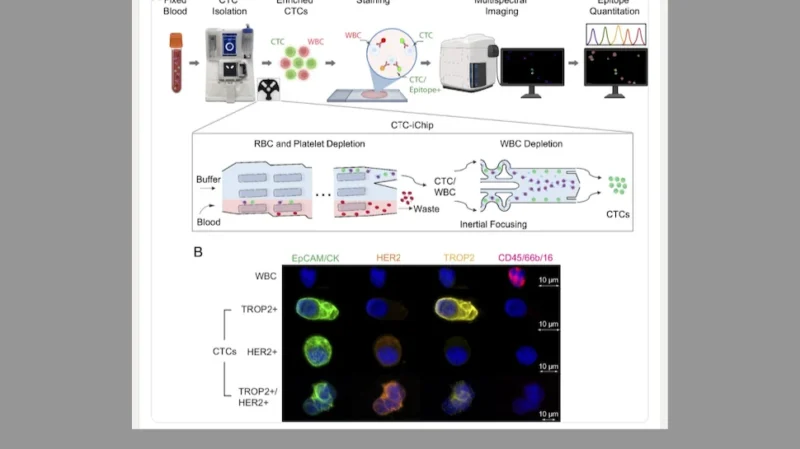
- CTC enrichment without target bias. Blood is collected into Streck tubes, ensuring consistent fixation and allowing delayed processing. CTCs are enriched using CTC‑iChip, which depletes red blood cells and magnetically tagged leukocytes via CD45/CD16/CD66b, avoiding EpCAM‑ or size‑based capture. This is intended to reduce selection for high‑EpCAM, epitope‑rich epithelial CTCs and to include smaller or less epithelial tumor cells.
- Stringent lineage definition. CTCs are defined as intact, nucleated, DAPI‑positive cells that express EpCAM/pan‑cytokeratin/CK19 and lack leukocyte markers. This ensures that TROP2 and HER2 are quantified on bona fide carcinoma cells rather than on mixed circulating populations.
- Single‑cell, calibrated epitope quantitation. Multispectral microscopy is used to stain for TROP2 and HER2 simultaneously, with narrow emission windows to minimize bleed‑through. Each CTC is assigned to null/low/medium/high classes based on calibration against reference breast cancer lines with known antigen expression, rather than arbitrary fluorescence thresholds.
- Matched tissue assessment. Metastatic biopsies are stained with the same antibody cocktails and analyzed with the same imaging pipeline, allowing direct comparison of single‑cell epitope distributions in solid lesions and blood.
In other words, the study is designed to test the ‘target‑high vs target‑low’ hypothesis under conditions where assay noise and selection bias are minimized. It is not a low‑fidelity retrospective: it is a mechanistically aligned, prospective measurement of what we say we care about.
Baseline antigen: permissive but not determinative
Given this platform, what do baseline TROP2 and HER2 levels actually explain?
Empirically:
- CTCs in both TROP2‑ADC and HER2‑ADC cohorts show broad within‑patient heterogeneity in TROP2 and HER2 expression, spanning null to high intensities. Patients with long responses and those with early progression both exhibit mixed CTC populations rather than clean ‘all‑high’ or ‘all‑null’ profiles.
- When patients are grouped by whether a majority of their CTCs are TROP2‑positive vs TROP2‑null, or HER2‑positive vs HER2‑null, both sides of each cut contain durable responders and early progressors. Tightening thresholds (for example, requiring ≥90% target‑positive CTCs) does not yield a robust stratification outside HER2 amplification.
- Biopsies often show higher fractions of strongly TROP2‑ or HER2‑positive tumor cells than the corresponding CTC populations, but these higher tissue fractions do not map consistently onto longer benefit. Tissue–CTC discordance is common and does not itself resolve clinical heterogeneity.
Mechanistically, the most defensible statement is:
- In heavily pretreated, HER2‑low and TROP2‑positive metastatic breast cancers treated with TOP1 ADCs, baseline antigen intensity-measured at single‑cell resolution in both tissue and CTCs-is insufficient as a primary predictor of benefit.
Antigen clearly remains necessary to justify ADC use and maintain a therapeutic window: these regimens still rely on some degree of target enrichment relative to normal tissues. But the data do not support treating TROP2/HER2 levels, in this context, as the main dial that determines who gets 10 months vs 2 months of added therapy.
For scientific coherence, it’s important to keep the scope narrow:
- This is a statement about non‑amplified breast cancer treated with TOP1‑linked TROP2/HER2 ADCs, not a general denial of antigen relevance in HER2‑amplified disease or antigen‑sparse tumors.
Within that scope, the result is robust enough to move baseline antigen from ‘putative compass’ to ‘background condition.’
Antigen at resistance: stable labels, evolving circuitry
If antigen intensity is not organizing baseline outcomes, perhaps it still governs escape-via antigen loss or down‑regulation under drug pressure. Mishra et al.’s longitudinal CTC data argue that this is not the dominant pattern in this cohort.
- In patients treated with TROP2‑ADCs, TROP2 expression distributions on CTCs at progression largely resemble baseline distributions. Strong responders who later progress still have mixtures of TROP2‑positive and TROP2‑negative CTCs; some resistant patients have only a few CTCs detectable, without a clear shift to a TROP2‑null majority.
- In HER2‑ADC‑treated HER2‑low patients, HER2‑positive CTC fractions at progression can increase, decrease, or remain stable. HER2 loss occurs but is one pattern among several, not a unifying feature of resistance.
These observations align with biopsy‑based resistance studies in trastuzumab deruxtecan: some lesions lose HER2, but many retain it and instead acquire alterations in TOP1, DNA repair pathways, and intracellular trafficking. Taken together, they support a resistance model in which:
- Antigen is often maintained at resistance, particularly in HER2‑low and TROP2‑positive non‑amplified tumors.
- The dominant adaptive pressure falls on payload handling (TOP1 mutations, DDR rewiring, efflux/uptake changes, lysosomal processing), not on antigen itself.
This matters for coherence: if the same antigen labels are still present on resistant cells, then switching from one antigen to another while keeping the payload class constant is unlikely to address the core resistance circuitry.
Early CTC dynamics: where mechanistic signal aggregates
The sharpest organizing axis Mishra et al. uncover is not antigen at t0, but the way CTC burden responds to the first cycle of ADC.
Three weeks after initiating TROP2‑ or HER2‑ADC, patients are grouped by CTC behavior:
- CTC‑low: no detectable CTCs or a decline of about eighty percent or more relative to baseline.
- CTC‑high: lesser decline or an increase in CTC counts.
Within each ADC cohort, this simple categorization correlates strongly with time on therapy:
- In the TROP2‑ADC cohort, CTC‑low patients typically remain on therapy for many months; CTC‑high patients tend to come off within a few months.
- In the HER2‑ADC cohort, CTC‑low patients again cluster around prolonged benefit; CTC‑high patients cluster around early progression.
Mechanistically, this is plausible and integrative:
- CTCs capture viable, shedding disease across multiple metastatic sites. An ADC that effectively reduces viable burden and suppresses dissemination should reduce or eliminate CTCs early.
- Failure to clear CTCs reflects composite failure along the chain-from antibody delivery through linker cleavage and payload action to downstream apoptosis-and/or pre‑existing resistant subclones.
Of course, CTC dynamics are not a pure ADC‑specific variable. They fold in intrinsic tumor aggressiveness, microenvironmental context, host factors, and prior treatments. The clean way to separate ADC‑specific information from generic ‘good biology’ would be to compare CTC trajectories and outcome under non‑ADC regimens and to adjust for baseline risk features.
Even without that fully controlled comparison, the relative hierarchy is clear in this dataset:
- Early dynamic burden metrics (CTC decline or clearance) carry much more prognostic information than static antigen levels.
- They are mechanistically closer to the true control parameters of these ADCs-payload sensitivity and effective debulking-than baseline epitope intensity.
Scientifically, this is an example of a useful aggregate observable: it sits where many relevant influences converge, rather than at one upstream node of the pathway.
ADC‑after‑ADC: payload‑centric cross‑resistance in practice
The sequential ADC data-HER2‑ADC after TROP2‑ADC and TROP2‑ADC after HER2‑ADC-highlight how a payload‑centered resistance landscape plays out clinically.
In this small but instructive cohort:
- First‑line TOP1 ADCs deliver median times on therapy on the order of seven to eight months.
- Second‑line ADCs, targeting the alternate antigen but using the same payload class, deliver median times around six weeks. Nine of ten second‑line courses end before six months; the one long responder had minimal exposure to the first ADC due to early toxicity rather than resistance.
At the same time:
- TROP2 and HER2 expression on CTCs is generally preserved at resistance in these patients, reinforcing that antigen has not been systematically lost.
- Single‑cell analyses show frequent co‑expression of TROP2 and HER2 within individual CTCs and tumor cells, reflecting shared epithelial lineage and overlapping target compartments.
Taken together, the parsimonious mechanistic conclusion is:
- Cross‑resistance between these ADCs in non‑amplified metastatic breast cancer is primarily a payload‑class phenomenon, not an antigen‑identity phenomenon. Once TOP1 resistance circuits are engaged, ‘same payload, different antigen’ mostly reshuffles exposure within a resistant system.
The sample size is small, and larger datasets will be needed to quantify this effect precisely and to see whether particular molecular subgroups (for example, those without TOP1 alterations) behave differently. But as a qualitative statement, the pattern is coherent with what we know about TOP1 ADC resistance and with the observed preservation of antigen.
DLL3 as a control case: epitope dependence depends on modality
Mishra et al. strengthen their argument by contrasting their breast ADC findings with prior DLL3/tarlatamab work using the same CTC platform.
For DLL3×CD3 bispecific tarlatamab in small‑cell lung cancer:
- DLL3 levels on CTCs tightly predict response; DLL3 immunohistochemistry on biopsies does not.
Mechanistically:
- DLL3 is essentially tumor‑restricted; tarlatamab’s effector function depends on forming DLL3–CD3 immune synapses. Epitope density directly gates synapse formation and T‑cell cytotoxicity. In that context, epitope lies on the control surface of the mechanism.
For TROP2/HER2‑TOP1 ADCs:
- Effector function is payload release and DNA damage. Linker cleavage can occur intracellularly and extracellularly; payload can diffuse and exert bystander effects; microenvironmental pharmacokinetics shape distribution. Epitope density on any given cell influences antibody binding but is not the sole determinant of lethal payload exposure.
This internal ‘positive control’ is important scientifically. It shows that:
- The same CTC imaging platform can behave as a textbook epitope biomarker when modality demands it.
- The weak epitope – outcome link observed for TROP2/HER2 ADCs reflects the biology of those regimens, not limitations of the assay.
The general principle is that epitope is a high‑value biomarker when effector function is tightly coupled to epitope engagement (bispecifics, CAR‑Ts, some internalizing ADCs in antigen‑addicted disease), and a lower‑value one when effector function is buffered by payload distribution and downstream circuitry.
What this means for TROP2/HER2 ADC practice and science
Taken together, Mishra et al. point toward a more mechanistically accurate working model for TROP2/HER2‑targeting TOP1 ADCs in non‑amplified metastatic breast cancer:
- Antigen: necessary for indication and selectivity; largely stable under TOP1 ADC pressure in this cohort; insufficient, on its own, as a primary stratifier of benefit.
- Payload class: central to efficacy and cross‑resistance; once the tumor adapts to TOP1 inhibition, second‑line TOP1 ADCs rarely add substantial benefit, even if antigen switches.
- Time and burden dynamics: early CTC clearance or large decline is a strong composite readout of successful payload delivery and debulking; failure to achieve it is an early warning of resistance.
- Modality: determines whether epitope sits on the control surface (DLL3 bispecifics) or upstream of a payload‑dominated control surface (these ADCs).
For the field, this suggests several concrete shifts:
- Stop expecting static ‘TROP2‑high/HER2‑low’ labels to behave like robust, first‑order predictors of benefit for TOP1 ADCs in non‑amplified disease. Treat them as necessary but not sufficient conditions.
- Elevate early dynamic burden metrics (CTC, ctDNA) into primary design elements for trials and treatment pathways-used to decide whether to persist on a given ADC or pivot to another modality.
- Design ADC portfolios and sequencing strategies around non‑cross‑resistant payload classes and linker architectures, rather than around incremental variations in antigen with shared payload chemistry.
- Use CTC platforms to track the evolution of payload‑focused resistance circuitry (TOP1 mutations, DDR signatures, trafficking changes), and to ask where and when payload‑centric governance should override target‑centric habits.
Broader significance: aligning measurement with control parameters
Beyond TROP2 and HER2, Mishra et al. are important because of how they use a data‑rich platform. They do not use single‑cell CTC imaging to add yet another descriptive layer to the target narrative. They use it to test a mechanistic claim: that target intensity is the main compass for these ADCs in these patients.
The answer, in this cohort, is ‘no.’ The biology, as revealed by CTC dynamics, resistance trajectories, and antigen stability, is organized more around payload class and early debulking than around baseline TROP2/HER2 intensities.
That negative result is precisely the kind of thing which, handled carefully, advances the field. It tells us that our measurement habits need to be re‑aligned: we have been interrogating the antigen space deeply, while the true control parameters have shifted toward payload and time. The scientific question is no longer ‘how do we get better TROP2/HER2 assays?’ but ‘how do we design, sequence, and monitor ADCs in a way that reflects the payload‑centric, time‑sensitive biology this kind of careful work reveals?’
That is the pivot Mishra et al. offer-and the pivot Data‑Rich, Insight‑Poor – CXXVII is encouraging the field to take seriously.”
Other articles about Cancer Types on OncoDaily.