Douglas Flora, President-Elect Association of Cancer Care Centers at Association of Cancer Care Centers, shared on LinkedIn:
“Nineteen papers a day: can agentic AI solve the oncologist’s evidence trap?
‘Knowledge is proud that he has learned so much; Wisdom is humble that he knows no more.’ – William Cowper
In the first six months of 2025 alone, PubMed indexed over 3,400 breast cancer publications. That averages roughly 19 papers every single day, layered on top of multiple guideline updates and hundreds of conference abstracts. For practicing oncologists, staying current while delivering thoughtful patient care has become an overwhelming challenge.
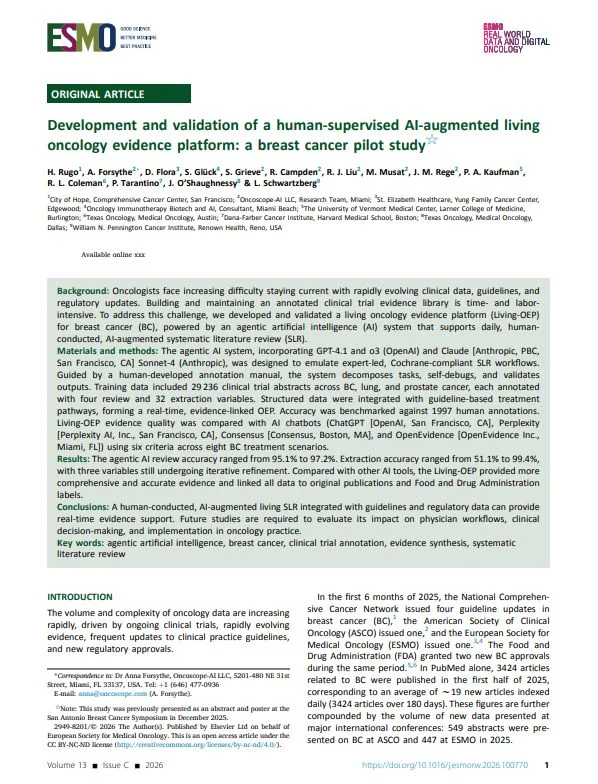
To help bridge this gap, our team developed and validated a living oncology evidence platform (Living – OEP) for breast cancer. The goal was simple: create a reliable, real-time evidence synthesis engine designed to support daily, human – conducted, AI – augmented systematic literature reviews.
Key takeaways from our latest manuscript:
High screening accuracy: The agentic architecture achieved 95.1% to 97.2% accuracy in Cochrane – compliant screening tasks.
Significant time savings: The platform annotated 1,997 publications in 7.25 hours compared to 174.7 hours required by human experts, representing a 95.9% reduction in annotation time.
Rigorous grounding: Across eight complex treatment scenarios, Living – OEP delivered greater completeness and guideline concordance than standard conversational AI tools, with every data point linked directly to original literature and FDA labels.
This system is built to assist structured curation, not make autonomous treatment decisions. The clinician remains central. By letting AI handle the heavy lifting of evidence extraction and validation, we hope to free up cognitive bandwidth for the human side of oncology. There is still refinement ahead, particularly across complex extraction variables, but this marks an encouraging step toward driving smarter, real – time cancer care.
On a personal note, as a former current breast oncologist, it is pretty surreal to see my name alongside some clinicians I have revered for decades. Over twenty years ago as a young doctor, I spent hundreds of hours in my car sharing long commutes with the esteemed voices of Hope Rugo, Joyce O’Shaughnessy, Stefan Glück, and their host, Neil Love, absorbing their wisdom on countless Research To Practice CDs.
And to Lee Schwartzberg, I have said it many times: your example paved the way. I would never have imagined starting a peer – reviewed journal had you not shown what a community oncologist with a commitment to academic scholarship could accomplish.
Thanks to Anna Forsythe and Jessicca R. for inviting me to be a part of this cool project. Keep pushing!
Title: Development and validation of a human-supervised AI-augmented living oncology evidence platform: a breast cancer pilot study
Authors: H. Rugo, A. Forsythe, D. Flora, S. Glück, S. Grieve, R. Campden, R.J. Liu, M. Musat, J.M. Rege, P.A. Kaufman, R.L. Coleman, P. Tarantino, J. O’Shaughnessy, L. Schwartzberg
You can also read:
FDA Expands Artificial Intelligence Capabilities with Agentic AI Deployment