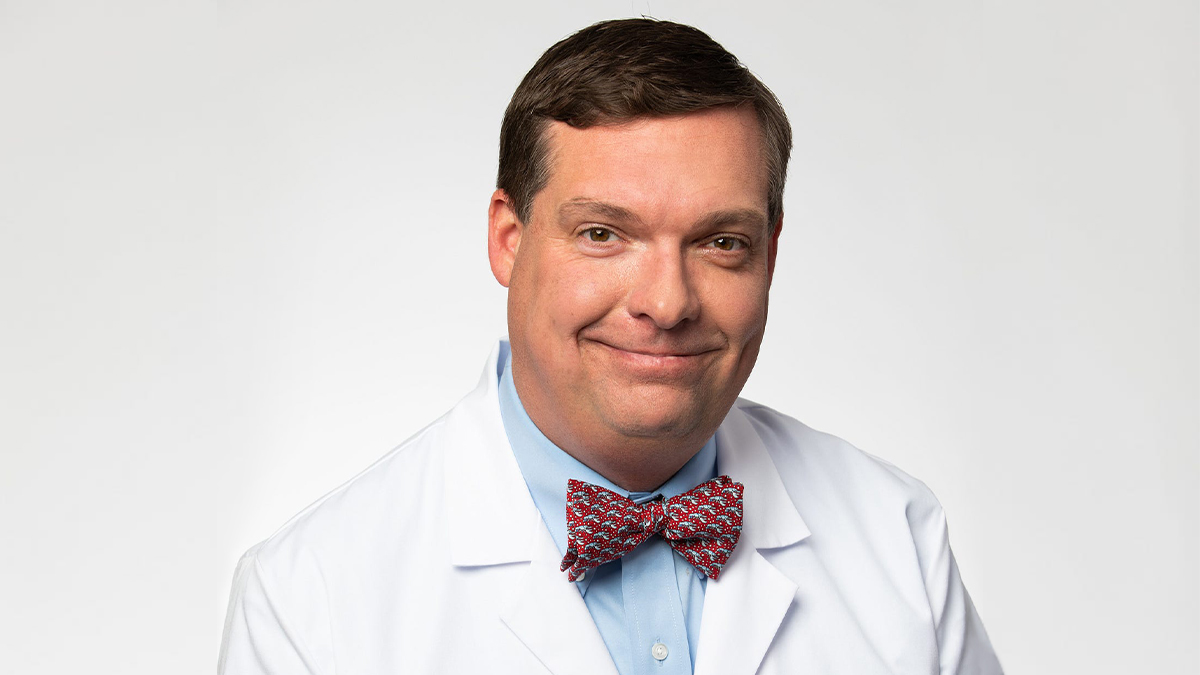
Douglas Flora, President-Elect of the Association of Cancer Care Centers and Executive Medical Director of Yung Family Cancer Center, St. Elizabeth Healthcare, shared on LinkedIn:
“Treating the hardware while forgetting the software.
‘The greatest mistake in the treatment of diseases is that there are physicians for the body and physicians for the soul, although the two cannot be separated.’ – Plato
When we identify psychosocial distress in a patient with cancer, what happens next? Modern oncology has achieved extraordinary precision in targeting tumor biology. We sequence genomes and deploy targeted therapies with remarkable accuracy. Yet roughly 40% of oncology patients have a diagnosable psychiatric disorder. We have become experts at treating the hardware, but we frequently fail to support the software, the human mind processing this trauma.
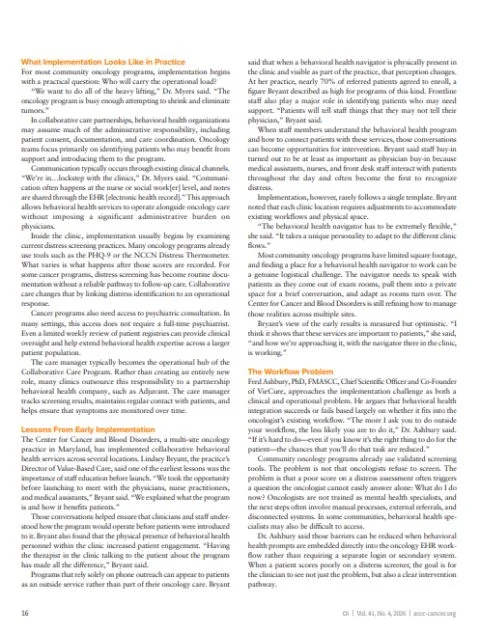
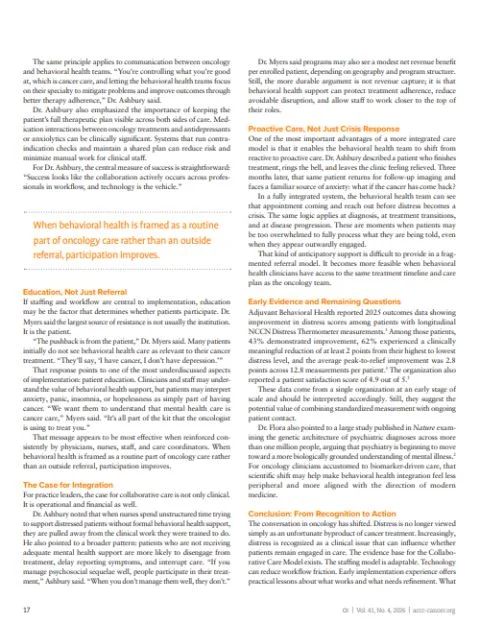
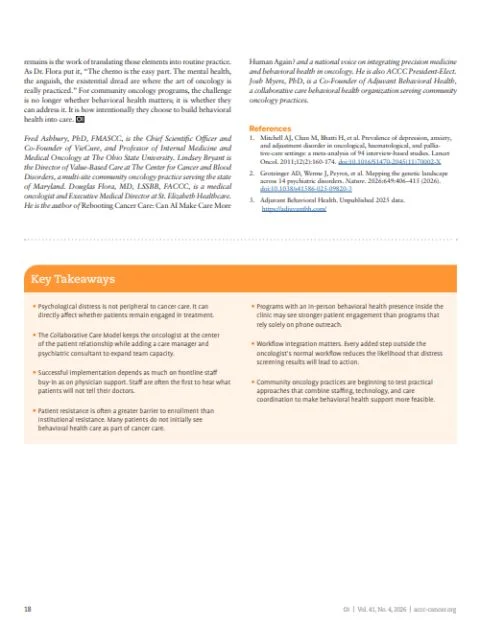
Our latest article in Oncology Issues explores the Collaborative Care Model as a practical approach to integrating behavioral health into the oncology workflow. Co-authored with Fred Ashbury, Lindsey Bryant and Josh Myers, the piece examines how to move psychosocial care from a simple screening to a meaningful intervention.
The Collaborative Care Model keeps the oncologist as the primary physician while expanding the team around that relationship. A care manager tracks patient-reported outcomes and acts as the primary touchpoint, while a psychiatric consultant provides specialty expertise across the population without needing to see every patient directly.
Implementation succeeds or fails based largely on whether it fits into the existing clinical workflow. Adding steps outside normal operations reduces the likelihood that distress screening results will lead to action. Embedding behavioral health prompts directly into the electronic health record workflow, rather than requiring a separate login, reduces friction for the clinician.
Staff buy-in is as critical as physician support. Frontline staff interact with patients throughout the day and often become the first to recognize distress, hearing what patients will not tell their doctors. Programs with an in-person behavioral health presence inside the clinic may also see stronger patient engagement than those relying solely on phone outreach.
Patient education remains an underdiscussed barrier. Many patients do not initially view behavioral health care as part of their cancer care, interpreting anxiety or hopelessness as simply part of having cancer. They often push back, arguing they have cancer, not depression. We must help them understand that mental health care is cancer care.
The chemotherapy is often the easy part. The mental health, the anguish, and the existential dread are where the art of oncology is really practiced. It is time to make behavioral health a routine part of cancer care, rather than an outside referral.”

Other articles featuring Douglas Flora on OncoDaily.