






Douglas Flora, Executive Medical Director of Yung Family Cancer Center at St. Elizabeth Healthcare, President-Elect of the Association of Cancer Care Centers, and Editor-in-Chief of AI in Precision Oncology, shared a post on Substack:
“The Long Way to Zero
‘Research on infectious causes of human cancers has great potential for future surprises.’
Harald zur Hausen, Nobel Lecture, 2008
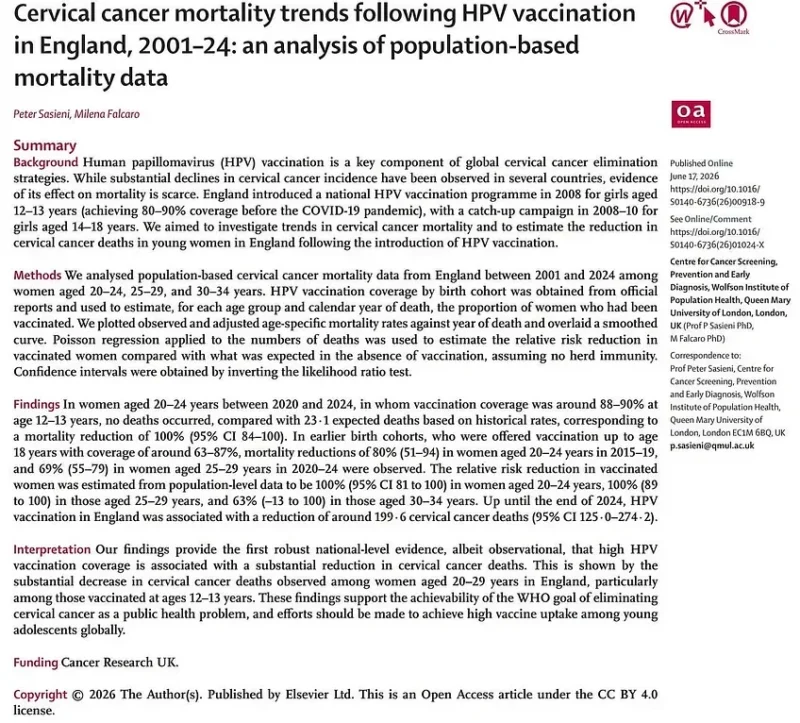
Between 2020 and 2024, not one woman aged 20 to 24 died of cervical cancer in all of England. The statisticians had expected about twenty-three. The number that occurred was none.
You should read that sentence twice, because medicine almost never gives us the chance to write it. A new analysis in The Lancet by Peter Sasieni and Milena Falcaro at Queen Mary University of London puts the mortality reduction in that group at 100 percent.
These were the girls who, at twelve and thirteen, lined up in school gymnasiums to be vaccinated against a virus most of their parents had never heard of. Nearly nine in ten of them got the shot. And so, a decade and a half later, a cancer that has killed women for as long as we have kept records simply did not show up to claim them.
To understand how strange and hard – won that zero is, you have to walk it backward – through a century and a half of people being right before they could prove it.
Start in Verona, in 1842. An Italian surgeon named Domenico Rigoni-Stern, an amateur epidemiologist with a clerk’s patience, went through the city’s death registers and noticed something that made no sense under the medicine of his day. Cancer of the womb was common among married women, widows, and prostitutes – and nearly absent among nuns. He guessed, cautiously and against the grain, that the disease might travel with sexual contact. His data were thin and his conclusions were later picked apart, as early observations usually are. But he had seen the shape of the thing: this cancer behaved less like bad luck and more like something passed from one body to another.
It took the rest of the world a hundred and thirty years to take the hint seriously.
For most of the twentieth century, the betting money said cervical cancer was caused by herpes. When a German virologist named Harald zur Hausen stood up in the 1970s and said it was the wrong suspect – that the culprit was the human papillomavirus, the same dull family of viruses behind common warts – the room did not applaud.
He had come to the idea the hard way: he kept looking for herpes DNA in cervical tumors and kept failing to find it. So he went hunting for something else. It took him more than ten years. In 1983 his lab found the fingerprint of a new virus, HPV-16, hiding in tumor tissue. In 1984 they cloned HPV-16 and HPV-18, the two strains we now know cause roughly seventy percent of cervical cancers. He was given the Nobel Prize in 2008, and he used his lecture to say, in effect, that we had only started to look.
Knowing the cause is not the same as having a cure. A cause is a target. You still have to build the arrow.
That part of the story belongs to a small lab in Brisbane. In 1989, a Scottish-born immunologist named Ian Frazer met a Chinese molecular virologist named Jian Zhou at Cambridge. They had the same stubborn interest in a problem that looked unsolvable: HPV could not be grown in culture, which meant you could not make a conventional vaccine from it. Frazer brought Zhou and his wife, Xiao-Yi Sun, to the University of Queensland, and in 1991 they did something elegant.
They built an empty shell, a virus-like particle, the outer coat of HPV with none of its DNA inside. Harmless. Unable to infect anyone. But close enough to the real virus that the immune system would learn its face and remember it.
That shell is the vaccine. Nearly every dose given to a schoolgirl in England traces back to it.
Jian Zhou never saw what he had made. He died in 1999, at forty-two, years before the first vaccine was approved. Gardasil reached the market in 2006. England launched its national HPV program in 2008, offering the shot to every girl aged twelve to thirteen, with a catch-up campaign for older teens. Coverage climbed past eighty percent and stayed there. And then everyone waited, because cancer is patient, and you cannot measure deaths prevented in women who are still young and well.
We are now far enough downstream to count. The girls of 2008 are the women of 2024. The first ones through the program, vaccinated youngest, at the highest coverage, are the ones with the perfect record: zero deaths against twenty-three expected. The older cohorts, vaccinated later and at lower rates, show smaller but still enormous reductions – eighty percent here, sixty-nine percent there. The protection tracks the vaccine exactly: earlier and fuller coverage, larger effect. That is not the signature of chance. That is the signature of cause.
Across the whole country, the authors estimate the vaccine has already prevented around two hundred cervical cancer deaths. As Sasieni put it, it is amazing news that no woman aged twenty to twenty – four died of cervical cancer in the whole of England between 2020 and 2024.
The honest scientists, including the authors themselves, will tell you this is observational data, not a randomized trial, and that no single study closes the case forever. They are right to say so. But the careful caveats sit alongside a fact that is very hard to argue with: in a group where roughly two dozen young women should have died, none did.
I have spent my career in oncology, and I can tell you that zero is the rarest number we have. We measure our wins in months, in percentage points, in five-year survival creeping upward. We almost never get to write NONE. Cervical cancer in a young woman is a particular cruelty – it takes people at the beginning of their lives, often with small children, and the paperwork that follows a death like that is the worst part of this job. To watch that line on the chart fall to the floor and stay there is not something I expected to see.
So here is the part worth sitting with, especially now, when the value of basic research is treated as an open question.
None of this was obvious. None of it was fast. A surgeon in 1842 saw a pattern he could not explain. A virologist spent a decade being told he was chasing the wrong virus. Two researchers in Australia built a hollow shell of a thing, and one of them died before it saved a single life. Public money funded most of it, across borders and across decades, with no guarantee at any step that the next one would pay off. That is what funding science actually looks like, not a transaction with a receipt, but a long, uncertain bet that knowledge compounds.
This time, it compounded all the way to zero.
We did not cure cervical cancer. We did something stranger and better. We are watching it fail to happen.
That is what good science does, when we are patient enough to let it.”
Title: Cervical cancer mortality trends following HPV vaccination in England, 2001–24: an analysis of population-based mortality data
Authors: Peter Sasieni, Milena Falcaro
Other articles about Cervical Cancer on OncoDaily.