






David Wazer, Professor and Chairman of Radiation Oncology at Brown University Health, shared a post on LinkedIn:
“Not So Fast: Why the ‘Negative‘ Grail Trial May Be a Turning Point in Cancer Screening
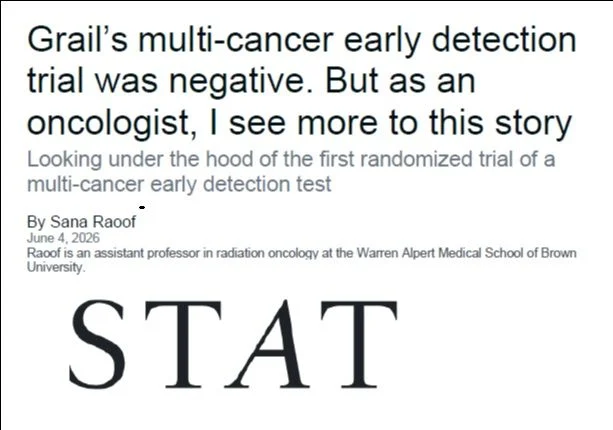
Dr. Raoof’s commentary in STAT provides an important reminder that a ‘negative‘ clinical trial is not necessarily a failed scientific experiment. Rather, the first randomized trial of a multi-cancer early detection (MCED) blood test may have generated some of the most informative data yet regarding the future of cancer screening.
The trial did not meet its primary endpoint of reducing stage III and IV cancers, but Dr. Raoof persuasively argues that this outcome may reflect limitations of endpoint selection rather than limitations of the technology itself. The observation that MCED testing reduced stage IV disease while increasing the detection of stage III cancers suggests a meaningful stage shift that could ultimately translate into improved outcomes, particularly in malignancies where curative-intent treatment remains feasible at stage III.
Perhaps the most compelling aspect of the article is its broader vision. Modern oncology invests enormous resources in increasingly sophisticated therapies for advanced disease, yet only a handful of cancers benefit from routine screening. MCED technologies challenge us to rethink that paradigm by expanding the opportunity for earlier diagnosis across many tumor types simultaneously.
While important questions remain regarding cost-effectiveness, optimal implementation, and impact on cancer-specific mortality, Dr. Raoof makes a convincing case that the Grail study should be viewed as the beginning – not the end – of the MCED story.
Progress in cancer control has always depended on learning from imperfect first-generation technologies. This landmark trial provides a roadmap for the next generation of studies and reinforces the central principle that the greatest opportunity to cure cancer lies in finding it earlier.”
Other articles featuring David Wazer on OncoDaily.