






Chris Warfield Thoracic Oncology specialist at Natera shared on Linkedin:
” ‘ctDNA test’ gets used like it names one thing. It doesn’t and the confusion can mislead a treatment decision.
Start with the job, not the acronym.
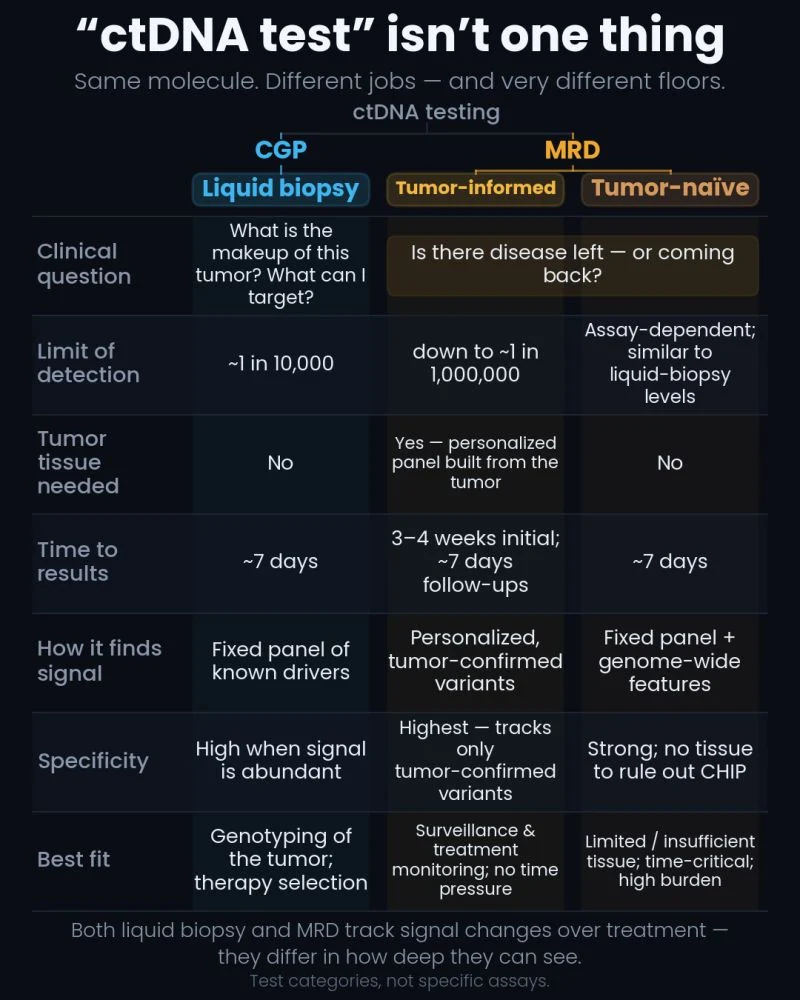
A liquid biopsy (comprehensive genomic profiling) answers: what is the makeup of this tumor, and what can I target? It finds the driver EGFR, ALK, KRAS so first-line therapy can be set at the first tumor board, no tissue waits. And it keeps working during treatment: re-genotyping each draw, it can catch resistance mutations and clonal evolution as they emerge what changed a quantitative MRD signal can’t give.
An MRD test answers: is there disease left, or coming back? It hunts a whisper.
Both are quantitative, and both monitor response you can track a changing signal on either. The difference is the floor. The best liquid biopsies bottom out around 1 part per 10,000; the most sensitive MRD tests reach roughly 1 part per 1,000,000 two orders of magnitude deeper.
So, reading a liquid biopsy‘s ‘undetectable’ as an MRD result is a category mistake: the signal hit the assay’s floor, not the patient’s zero. Call that clearance and you may be missing residual disease the test can’t see.
Narrow the lens to MRD alone, and a second distinction appears, one entirely inside this category: tumor-informed vs. tumor-naive.
Tumor-informer’s edge runs on both axes’ sensitivity and specificity and in current data the sensitivity gap may be wider. Both trace to the same root: the assay knows exactly which variants to track. Tracking many tumor-confirmed mutations at once surfaces signal at far lower tumor fractions; counting only what the tumor confirmed lets it ignore the rest. And “the rest” is mostly clonal hematopoiesis age-related mutations in blood cells (TP53, DNMT3A) a tumor-naïve panel can mistake for cancer. In low-burden surveillance, both edges protect the patient: catch a true recurrence early, keep a well patient out of an unnecessary workup.
But ‘more specific’ isn’t ‘always right.’ Match the test to the constraint:
Limited or insufficient tissue tumor-naive. The alternative isn’t a slightly worse test it’s no MRD data at all.
A short clock (neoadjuvant response; a read before the board convenes) tumor-naive starts on plasma now, while a bespoke panel is still being built.
Low burden, no time pressure (surveillance) tumor-informed leads, where its sensitivity and specificity change management.
Those line up for a reason: tumor-naive’s sensitivity limitation is concentrated in the low-burden setting why you don’t lead with it there, but it holds up where ctDNA is plentiful. (Newer naive approaches are narrowing that gap.)
The takeaway isn’t ‘informed good, naive backup.’ It’s: stop asking which ctDNA test, and start asking what job, what tempo, what tumor burden. The test fits the question not the reverse.
I work at Natera; views are my own.”
Other articles about ctDNA on OncoDaily.