National Cancer Institute (NCI) shared on LinkedIn:
“During Childhood Cancer Awareness Month, I’ve been thinking about one of the fundamental scientific challenges in childhood cancer research:
How do we make faster progress when the cancers we are studying are rare?
NCI supports research across the pediatric cancer continuum, from understanding the biology of these cancers to developing new treatments, improving clinical trials, and addressing the long-term needs of survivors. The researchers, clinicians, staff, advocates, and importantly, the patients and families who contribute to research exhibit an exceptional commitment, all working together to move this science forward.
However, rarity creates a fundamental scientific challenge. No single institution will see enough patients with different childhood cancers to answer all of the questions we need to answer.
So the question becomes: how do you connect data across institutions that may never see enough patients individually? NCI’s Childhood Cancer Data Initiative (CCDI) is one answer.
CCDI is working to make it possible for the research community to learn more effectively from every child, adolescent, and young adult with cancer. By connecting clinical and research data, expanding molecular characterization, and building an interoperable data ecosystem, we can help investigators ask questions across data sets that have historically existed in separate places.
We are already seeing important progress. The CCDI Data Ecosystem is connecting resources across the childhood cancer community. The Molecular Characterization Initiative is providing advanced molecular testing for young people with certain cancer types. The Pediatric, Adolescent, and Young Adult Rare Cancer Study is helping build the longitudinal data we need to better understand rare childhood cancers that are particularly difficult to study.
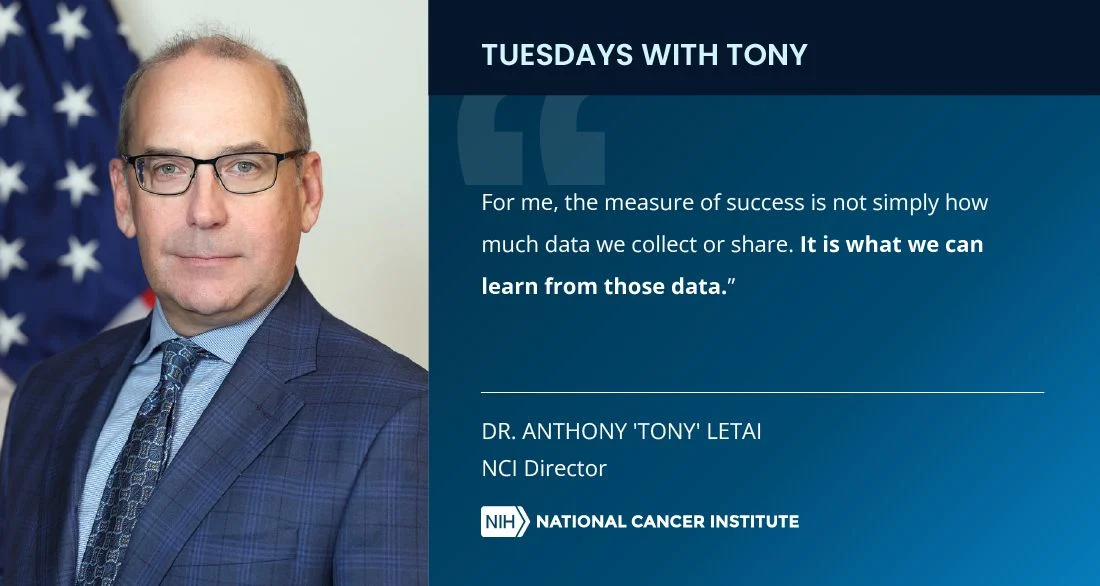
For me, though, the measure of success is not simply how much data we collect or share. It is what we can learn from those data.
Can they help us diagnose a cancer more precisely? Identify a therapeutic vulnerability? Design a better clinical trial? Understand why outcomes differ among patients? Can they help us improve the quality of life for survivors? Those are the questions that matter.
On September 18, NCI will bring the community together for the CCDI Symposium. It will be an opportunity to take stock of what has been built and, importantly, to think about what comes next, including interoperability, AI, and other approaches that can help us extract more knowledge from childhood cancer data.
Children are not simply small adults, and childhood cancers present distinct challenges. Those challenges provide incentive have become a reason to connect our science more effectively. If we make it easier for researchers everywhere to learn from every child who experiences cancer, we can turn small numbers of geographically scattered cases into meaningful, collective insights.”
— Tony.”