






Paolo Tarantino, 2025 Yvonne’s “Top Voice” Award Winner, Clinical Research Fellow at Dana-Farber Cancer Institute, Visiting Professor at McGill University, shared a post on LinkedIn:
“The first new adjuvant endocrine treatment to improve outcomes for breast cancer in decades.
Tucatinib improving outcomes in the first line HER2+ setting.
First data with sacituzumab govitecan in chemo-naive patients with HR+ disease.
And so much more.
See you in a few days in San Antonio!”
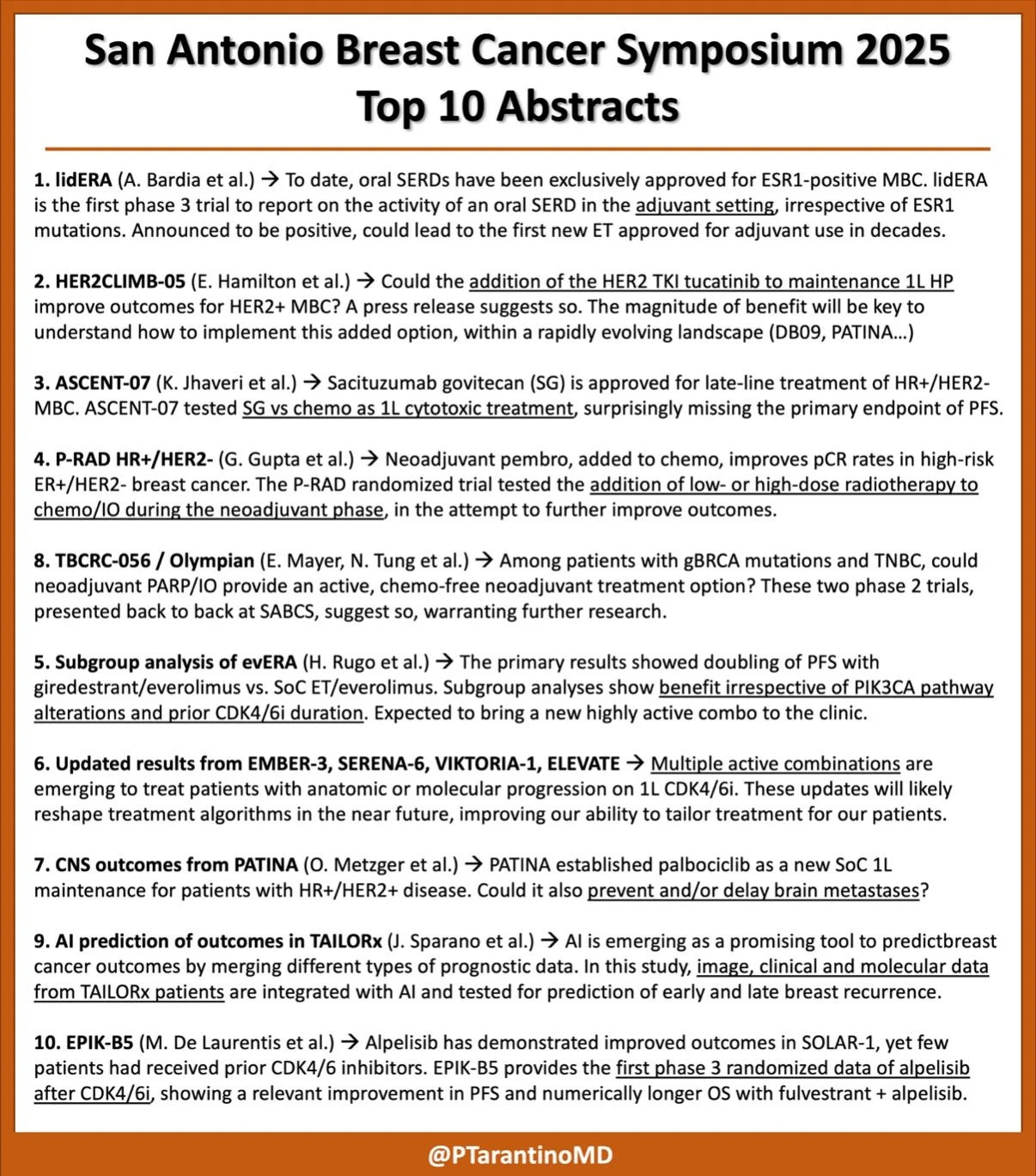
San Antonio Breast Cancer Symposium 2025 Top 10 Abstracts
1. lidERA (A. Bardia et al.) → To date, oral SERDs have been exclusively approved for ESR1-positive MBC. lidERA is the first phase 3 trial to report on the activity of an oral SERD in the adjuvant setting, irrespective of ESR1 mutations. Announced to be positive, could lead to the first new ET approved for adjuvant use in decades.
2. HER2CLIMB-05 (E. Hamilton et al.) → Could the addition of the HER2 TKI tucatinib to maintenance 1L HP improve outcomes for HER2+ MBC? A press release suggests so. The magnitude of benefit will be key to understand how to implement this added option, within a rapidly evolving landscape (DB09, PATINA…)
3. ASCENT-07 (K. Jhaveri et al.) → Sacituzumab govitecan (SG) is approved for late-line treatment of HR+/HER2- MBC. ASCENT-07 tested SG vs chemo as 1L cytotoxic treatment, surprisingly missing the primary endpoint of PFS.
4. P-RAD HR+/HER2- (G. Gupta et al.) → Neoadjuvant pembro, added to chemo, improves PCR rates in high-risk ER+/HER2-breast cancer. The P-RAD randomized trial tested the addition of low- or high-dose radiotherapy to chemo/IO during the neoadjuvant phase, in the attempt to further improve outcomes.
5. Subgroup analysis of evERA (H. Rugo et al.) → The primary results showed doubling of PFS with giredestrant/everolimus vs. SoC ET/everolimus. Subgroup analyses show benefit irrespective of PIK3CA pathway alterations and prior CDK4/6i duration. Expected to bring a new highly active combo to the clinic.
6. Updated results from EMBER-3, SERENA-6, VIKTORIA-1, ELEVATE → Multiple active combinations are emerging to treat patients with anatomic or molecular progression on 1L CDK4/6i. These updates will likely reshape treatment algorithms in the near future, improving our ability to tailor treatment for our patients.
7. CNS outcomes from PATINA (O. Metzger et al.) → PATINA established palbociclib as a new SoC 1L maintenance for patients with HR+/HER2+ disease. Could it also prevent and/or delay brain metastases?
8. TBCRC-056/Olympian (E. Mayer, N. Tung et al.) → Among patients with gBRCA mutations and TNBC, could neoadjuvant PARP/IO provide an active, chemo-free neoadjuvant treatment option? These two phase 2 trials, presented back to back at SABCS, suggest so, warranting further research.
9. Al prediction of outcomes in TAILORX (J. Sparano et al.) → Al is emerging as a promising tool to predictbreast cancer outcomes by merging different types of prognostic data. In this study, image, clinical and molecular data from TAILORX patients are integrated with Al and tested for prediction of early and late breast recurrence.
10. EPIK-B5 (M. De Laurentis et al.) → Alpelisib has demonstrated improved outcomes in SOLAR-1, yet few patients had received prior CDK4/6 inhibitors. EPIK-B5 provides the first phase 3 randomized data of alpelisib after CDK4/6i, showing a relevant improvement in PFS and numerically longer OS with fulvestrant + alpelisib.
More posts featuring Paolo Tarantino on OncoDaily.