






Breast Cancer in Young Woman Foundation (BCYW Foundation) shared a post on LinkedIn:
”Reframing Terminology, Risk, Evidence, and Decision-Making in Breast Cancer Prevention
Authors: Rakesh Kumar, Caroline Drukker, Marie-Jeanne T. F. D. Vrancken Peeters
The Core Myths
- Preventive mastectomy (with reconstruction) eliminates the risk of breast cancer
- Preventive mastectomy (with reconstruction) is a reasonable precaution for most young women
- Pain after mastectomy (with reconstruction) is temporary and only related to healing.
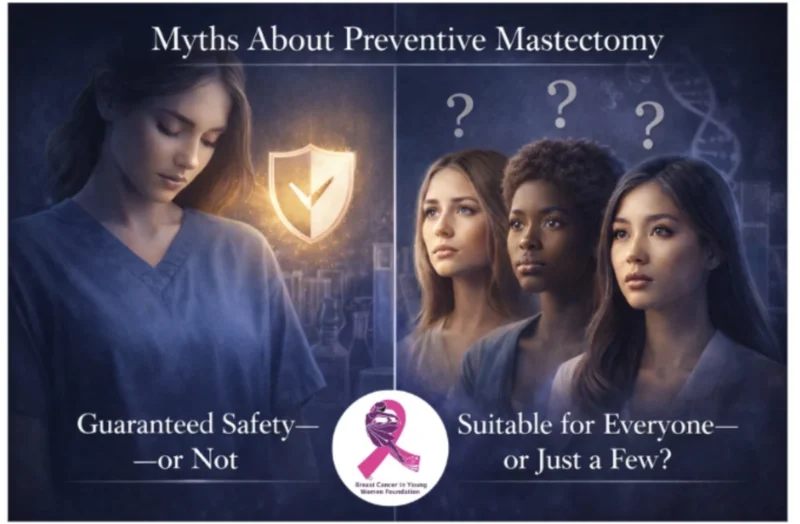
Over the past twenty years, an increasing number of young women have opted for preventive (prophylactic) mastectomy – the surgical removal of one or both breasts to significantly lower the risk of breast cancer.
Two common myths influence this trend: first, that preventive mastectomy provides complete protection from breast cancer; second, that it is a reasonable preventive measure for any woman seeking peace of mind.
Both of these myths are scientifically incorrect and may lead to over-medicalization, unnecessary surgeries, and misunderstood risk perceptions.
Despite growing awareness of genetics and risk management over the years, misinformation persists, especially among women under 40.
Many women base major life decisions on fear, incomplete information, or cultural notions of femininity, rather than trusting medical advice.
Because each main myth encompasses several smaller misconceptions, this article discusses the most common, widespread myths about preventive mastectomy and examines the medical facts and emotional burdens behind them.
It serves as an awareness guide rather than an exhaustive review of risk-reducing mastectomy in young women.
Myth 1: Preventive Mastectomy. Eliminates the Risk of Breast Cancer
Preventive mastectomy, particularly bilateral mastectomy, can significantly lower the likelihood of developing breast cancer.
However, it does not completely eliminate the risk, and therefore, it is wise to define this type of surgery as a risk-reducing mastectomy instead of a prophylactic or preventive mastectomy.
The National Cancer Institute and other international guidelines recommend bilateral risk-reducing mastectomy (with reconstruction) as an alternative to annual screening for women with a very high risk.
Definitions of very high risk vary but generally include carriers of BRCA1/2, TP53, PALB2, and CDH1 mutations. These guidelines indicate that bilateral prophylactic mastectomy can reduce breast cancer risk by approximately 90-95%, leaving a lifetime risk of breast cancer after surgery of less than 5%. While these statistics are often interpreted as providing full protection, they reflect a significant reduction in risk rather than complete prevention.
Residual risk – a biological reality: The persistence of risk arises from the limitations of anatomy and surgical procedures. Even the most carefully performed mastectomy cannot remove all breast epithelial cells. Residual breast tissue may remain dormant and retain the potential to reactivate and undergo malignant transformation.
Clinical observations indicate that, although infrequent, breast cancer can still occur following risk-reducing mastectomy.
For example, in a large cohort study on outcomes following risk-reducing nipple-sparing mastectomy in BRCA 1 and 2 gene mutation carriers, in 1.2 % of women, breast cancer appeared during the 15-year follow-up after risk-reducing mastectomy.
Preventive mastectomy is a risk-reduction measure, not a guarantee of a future without breast cancer, and therefore, we should talk about risk-reducing bilateral mastectomy instead of preventive mastectomy.
Myth 2: Bilateral Risk-Reducing
Mastectomy is A Reasonable Precaution for Most Young Women
Who actually benefits from a preventive mastectomy?
Clinical guidelines recommend considering bilateral risk-reducing mastectomy as an alternative to annual screening, primarily for women at very high risk of developing breast cancer, including:
- Carriers of BRCA1 or BRCA2 mutations
- Individuals with strong familial clustering of early-onset breast cancer
- Those with rare high-risk syndromes (e.g., TP53 mutations)
For these populations, the lifetime risk of breast cancer may exceed 55-80%, warranting active surveillance through annual screening or preventive measures. In contrast, the average woman has about a 12-14% lifetime risk of breast cancer, i.e., 14% in the Netherlands.
- Do not carry high-risk inherited breast cancer mutations: Risk-reducing mastectomy is typically for women with significantly increased inherited risk—particularly those with pathogenic variants in high-penetrance genes like BRCA1, BRCA2, PALB2, TP53, PTEN, STK11, or CDH1. It is usually not considered a general preventive option and should be guided by individualized genetic-risk assessment and counseling.
For this majority, the trade-off between the benefits and harms of risk-reducing mastectomy shifts significantly. A risk-reducing mastectomy offers only a minor survival benefit in BRCA 1 gene mutation carriers, while imposing considerable physical and psychological strain. For women who smoke or are obese, other preventive health care measures offer greater benefit.
Discussions of bilateral risk-reducing mastectomy should cover:
- Breast cancer risk estimates relative to other health risks,
- The procedure’s degree of risk reduction and its impact on survival.
- Surgical techniques, potential complications, and long-term sequelae.
- Alternatives to surgery and lifestyle measures, including exercise, weight loss, smoking cessation, and alcohol use.
Risk-reducing mastectomy is a strategic option for women with a very high lifetime risk of breast cancer.
Rising Use of Risk-Reducing Mastectomy Beyond High-Risk Groups
Despite explicit guidelines, the practice of risk-reducing mastectomy – particularly contralateral prophylactic mastectomy (CPM) in women with cancer in one breast – has increased markedly in the last two decades. One should emphasize that CPM is a completely different discussion from risk-reducing mastectomy in women with a very high risk of developing breast cancer.
Population-based studies in the US have demonstrated a significant rise in CPM rates,
particularly among younger women. Notably, many of these patients:
- Lack high-risk genetic mutations
- Have a low to moderate baseline risk of contralateral breast cancer
This trend highlights an increasing gap between evidence-based advice and real-world decision-making.
A common misconception is that removing both breasts always leads to better survival. Despite its rising popularity, and although CPM lowers the risk of developing a second primary breast cancer, it generally does not significantly enhance overall survival for most women with unilateral breast cancer.
This is due to the fact that:
- The risk of metastasis from the original tumor or second primary cancers usually exceeds the risk of developing a primary contralateral cancer.
- Modern systemic therapies effectively lower the chance of recurrence.
Understanding the Drivers Behind ‘Prophylactic Surgery’: Fear, Perception, and Miscommunication
- Overestimation of risk: women tend to overestimate their likelihood of developing breast cancer. Research shows that their perceived risk could be two to three times higher than the actual risk (22, 23).
- Desire for certainty: Risk-reducing mastectomy might offer a psychological sense of control-an appealing choice during uncertain times. However, this perception is often based on the mistaken belief that it completely removes the risk.
- Influence of high-profile cases: Public stories about people undergoing prophylactic mastectomy, particularly those with known genetic risks, may raise awareness but could also inadvertently normalize the procedure for groups where it might not be appropriate.
- Incomplete risk communication: Sometimes, doctors might inadvertently create confusion by emphasizing relative risk reductions without clearly defining absolute and residual risks.
The cost of Unnecessary Intervention
Risk-reducing bilateral mastectomy with reconstruction is a major surgical procedure with significant implications.
- Physical outcomes: Surgical complications – including infection, bleeding, or implant-related issues – may occur, along with the necessity for multiple reconstructive surgeries, potential permanent changes or loss of sensation, etc.
- Psychological and quality-of-life effects: Changes in body image and self-perception, emotional stress from permanent decisions, different degrees of satisfaction with reconstruction outcomes, etc..
- Healthcare burden: Increased resource utilization and higher cumulative costs compared to surveillance strategies.
Extensive surgery increases the risk of complications and prolongs recovery times.
Myth 3: Pain After Mastectomy Is Temporary and Only Related to Healing
Post-mastectomy pain syndrome (PMPS) is a chronic nerve pain condition, not merely short-term surgical discomfort. It can persist for months or years after the procedure, even when the incision appears healed. PMPS often causes numbness, burning, or stabbing feelings in the chest wall, armpit, or upper arm due to nerve injury or hypersensitivity following breast or lymph node surgery.
A common misconception is that younger women ‘recover faster’ and don’t develop chronic pain, but evidence shows otherwise. Research suggests that being younger might actually be a risk factor for PMPS, potentially due to increased nerve sensitivity and more robust immune responses.
Acknowledging PMPS as a legitimate condition can facilitate:
- Early referrals to pain specialists or physical therapy
- Enable targeted rehabilitation and desensitization exercises
- Provide psychological support.
A Precision Approach to Prevention
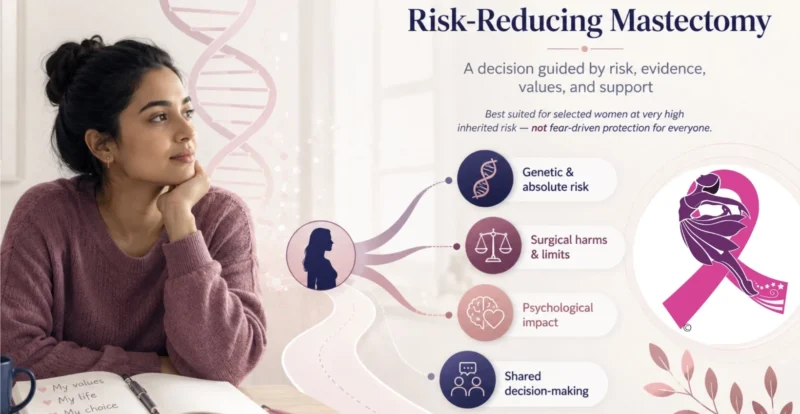
For women with a very high risk of developing breast cancer, bilateral risk-reducing mastectomy remains one of the most effective prevention strategies. The aim is to tailor interventions to match each person’s specific risk level.
Key principles for young women include:
- Risk stratification: Accurate evaluation considering genetics, family history, and clinical factors.
- Genetic counseling and testing: Focused, evidence-based approach rather than universal screening.
- Tailored surveillance: Using annual mammography and or MRI.
- Shared decision-making: Encourage open conversations about advantages, disadvantages, and unknowns.
Reframing the Conversation
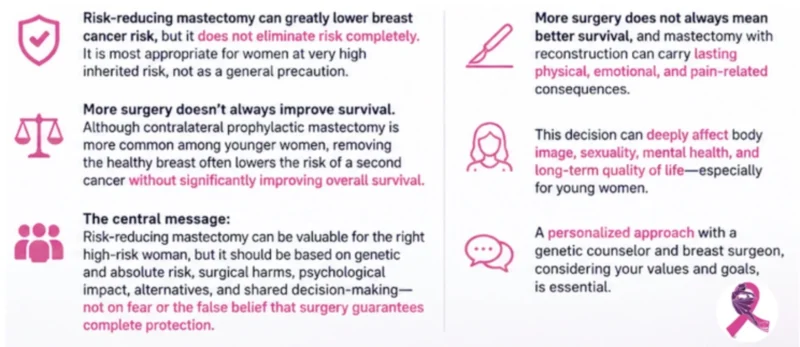
Risk-reducing mastectomy should not be portrayed as the final safeguard against breast cancer. Instead, a strong but targeted intervention might be beneficial for some and unnecessary for many. Discussions of bilateral risk-reducing mastectomy should cover:
- breast cancer risk estimates versus other health risks, such as smoking and obesity
- the procedure’s degree of risk reduction and impact on survival
- surgical techniques, including reconstruction options, potential surgical complications, and long-term sequelae and
- alternatives to surgery.
Preventive mastectomy, or rather risk-reducing mastectomy (with direct reconstruction), is precision medicine, it’s benefits should outweigh the potential harms on an individual level.
A Thought to Carry
Myths about risk-reducing mastectomy with reconstruction highlight a broader issue in cancer treatment: balancing certainty with complexity. While surgery can significantly reduce risk, it does not eliminate it entirely.
Risk-reducing mastectomy is rarely life-saving, but often it will prevent having to go through breast cancer and breast cancer treatment. Therefore, it is not a one-size-fits-all solution for every woman seeking reassurance.
Addressing these misconceptions is not merely an academic task it is crucial to:
- Prevent unnecessary surgery
- Promote evidence-based care
- Empower young women with accurate, nuanced information
Increasing intervention might not always be better, but more targeted, well-aligned interventions for the right risks are the most effective.

Other Articles About Breast Cancer on OncoDaily.