






Arpita Chauhan, Research Team Lead at Precision AQ, shared a post on LinkedIn:
“Natera recently announced that the National Comprehensive Cancer Network® (NCCN®) Bladder Cancer Guidelines now recommend consideration of tumor-informed ctDNA-MRD testing following cystectomy in appropriate patients with muscle-invasive bladder cancer.
Why is this important?
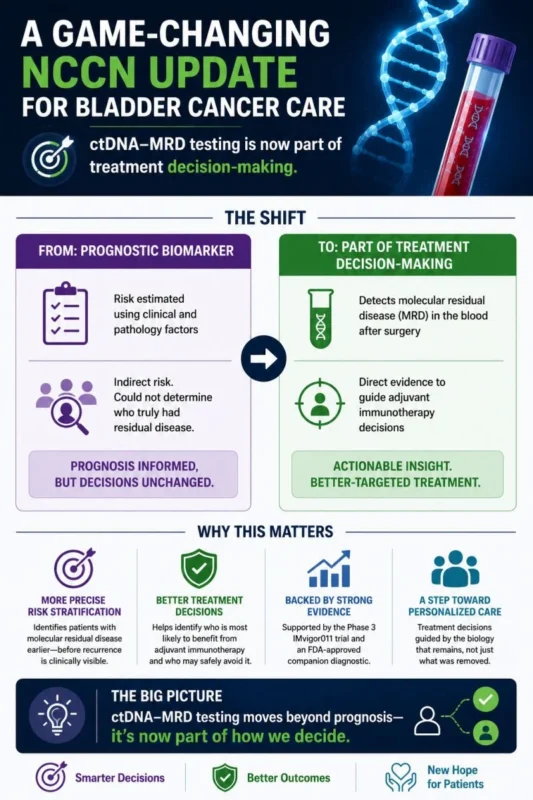
- Because ctDNA has crossed a critical threshold:
- From being a prognostic biomarker
- To becoming a tool that can inform treatment decisions
What changes in clinical practice?
Previously, adjuvant therapy decisions relied largely on clinicopathologic risk factors.
With ctDNA-MRD testing, clinicians can:
- Identify patients with molecular evidence of residual disease.
- Offer adjuvant immunotherapy to MRD-positive patients who are at higher risk of recurrence.
- Potentially spare MRD-negative patients from unnecessary treatment, toxicity, and cost.
Why does this matter?
This means care can become more personalized-treating the patients who are most likely to benefit while avoiding overtreatment in those who may not.
For oncology, it marks another step toward treating the biology of the disease, not just the pathology report.
This isn’t just another guideline update; it’s a signal that molecular residual disease testing is becoming an integral part of clinical decision-making.”
Other articles about Bladder Cancer on OncoDaily.