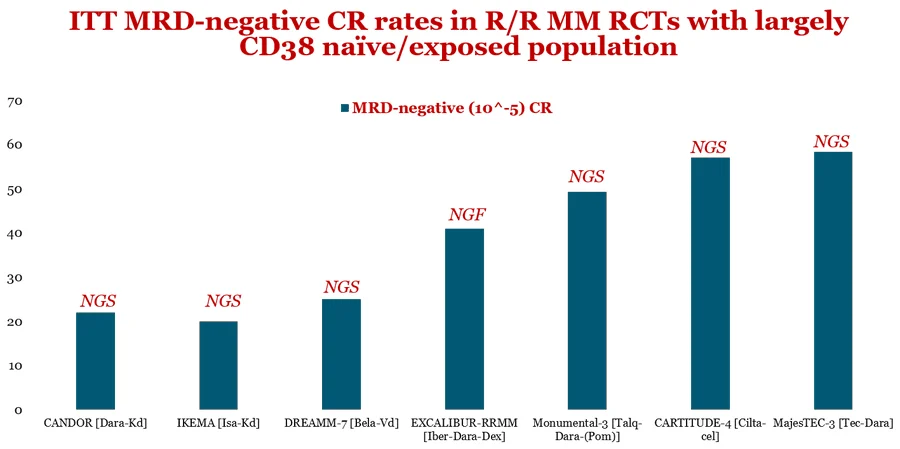
Ankit Kansagra, Medical Oncologist and Associate Vice President of Oncology Integration & Community Alignment at TGH Cancer Institute, shared Raj Chakraborty’s, Hematologist, Oncologist, Clinical Researcher at Herbert Irving Comprehensive Cancer Center, post on X, adding:
“Useful side-by-side. The iber-dara-dex MRD-negative CR rate is impressive given about half of patients were len-refractory and 90% were IMiD-exposed, and it puts an off-the-shelf option near what we see with BsAbs and CAR-T.
The caution is the usual one:
- cross-trial comparisons
- different MRD assays and timepoints
- MRD is a surrogate.
As you note, PFS has to follow.
The next question is sequencing in practice. With this many options in early relapse, the choice will depend as much on what a site can deliver (CAR-T access, step-up monitoring, infusion capacity) as on the depth of response.
We need a framework for that decision beyond MRD rates.”
Quoting Raj Chakraborty’s post:
“With a plethora of options now for early relapsed (1-3 prior LoT) Myeloma who are either naive or exposed/sensitive to anti-CD38-mAb (except CART-4 which had 25% CD38-refractory), how does the MRD-negative CR rates compare across regimens?
While BsAbs/CAR T remains at the top, impressive performance of Iber-Dara-Dex considering ~50% Len-refractory and 90% IMiD-exposed population.
Remains to be seen how this translates into PFS!”
Other articles featuring Ankit Kansagra on OncoDaily.