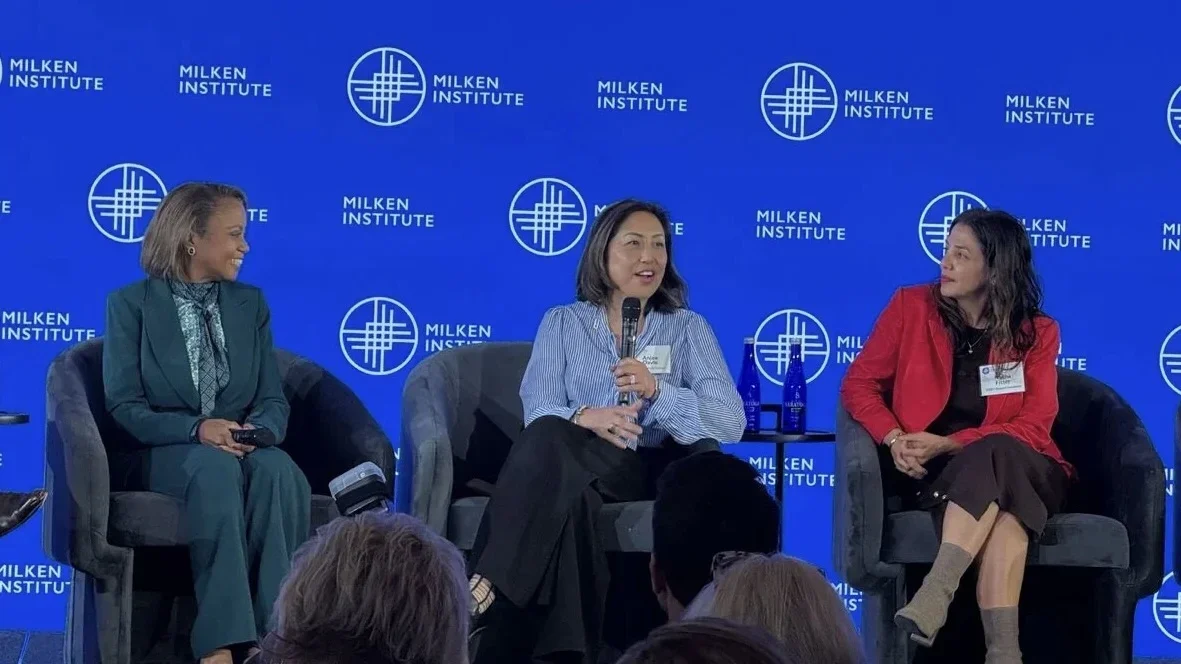
Anjee Davis, CEO of Fight Colorectal Cancer, shared on LinkedIn:
“I was in a meeting recently about AI in healthcare, and I kept noticing that we were talking about every AI tool as if it were the same thing. The chatbot that drafts our emails and the system that helps decide who gets screened, all folded into the same two letters.
When most people say ‘AI,’ they picture the productivity tool, generative AI, and it is useful. My team at Fight Colorectal Cancer uses it every day, and it has made us faster and sharper. I am glad we have it. But that doesn’t mean it’s been easy.
But the AI that drafts our emails is not the same AI that is reshaping how cancer is researched, diagnosed, and treated. There are three kinds worth knowing: generative AI creates content, predictive AI forecasts outcomes, and agentic AI acts on its own. The risks are progressivly higher as it become more autonomous and we can’t manage those risks if we lump them all together.
Our country has lived through big healthcare changes before. But in this case, the difference is speed, and the stakes: decisions about AI now reach beyond our own workflow and into what good care looks like. My worry is that if we keep calling it all ‘AI,’ we will miss where the real risks are in the systems deciding who gets screened, whose data counts, and whose care is shaped by a model no patient helped build.
Rolling up our sleeves
I have been drinking from a fire hose since 2023, policy nerd to tech nerd. Our first move was in 2024 we launched ChatCRC to keep up with what patients wanted and still ensuring reliable colorectal cancer information was accessible. In 2026 we partnered with Komodo Health, using its Marmot tool to analyze real-world data that informs policy and speeds our research.
In parallel, our operational team has had to be pretty deliberate about training our staff on how to use generative tools at work. (So we have been building the plan and flying it. Typical for a nonprofit our size.)
Has it been fast? Yes. Has it had challenges? Absolutely. Has it demanded real upskilling across our staff and research community? 100%. Getting an analysis to the point where you can replicate it, trust the numbers, and defend them before researchers and policymakers is painstaking. It should be.
The last two years have fundamentally changed how I think about my work, our strategy, and what it means to be a patient advocate in this decade. The word I keep returning to is discipline.
Discipline 1: If you don’t understand it, you can’t govern it
My first lesson was if everything is ‘AI,’ the email helper, the diagnostic engine, and the autonomous research agent flattened into the same two letters, we lose the precision we need to ask the right questions. If I cannot name what it is I am looking I cannot figure out how to govern it, or partner with it, or keep up with it.
I had to break it down into two buckets, the tools our staff use at their desks, and the systems being built into the larger healthcare system. For me this rule applies to both: know exactly which kind of AI you are dealing with before you decide how far to trust it.
I have done a lot of reading, but this has not been an academic exercise. This is about two different conversations, one about convenience and one about consequence. The generative tools we use for productivity are a world apart from the agentic systems being built to inform clinical and research decisions.
Agentic systems do not hand a human a draft to approve; they act with degrees of autonomy, which still amazes me and scares me.
The research describes this exact shift in clinical pharmacology, where agentic workflows already streamline analysis, modeling, and trial design, and are built to keep a human in the loop (Shahin et al., 2025). Are we keeping patients in the loop? I have yet to see this.
I have had to get in the weeds and break down every step. This is not my strength.
Discipline 2: Do the work to learn it
The second area I am really trying to be dicipined about is being commited to upskilling. Until I got in there and worked with a variety of AI tools, I couldn’t fully understand the nuances and the potential. Its like dating, you have to kiss a lot of frogs to figure out what is important to you.
The research in this space is blunt about the cost of our knowledge gap. Without adequate AI literacy, scholars are warning us that we risk eroding workforce competence and compromising patient safety, and that institutions have largely failed to keep pace with how fast these tools are moving (Rodger et al., 2025).
That warning was written for health professions education, but it lands just as hard on advocacy organizations like Fight Colorectal Cancer. The pace will not slow to wait for us.
The shift for me has been understanding that learning the tools does not make us subordinate to them. It’s so important to recognize this. It makes us more able to lead, and structure frameworks for building that literacy which are already emerging (Hoelscher & Pugh, 2025). It was such a light bulb moment for me.
You still have to bring ideas. You still have to know what you are talking about. And we still have to be the arbiter of trusted information. A tool does not change any of that. Don’t just take what it gives you. You might inadvertently hand your credibility, and the trust people place in us, over to a tool. I sound like a broken record, this is a whole new way of working, and it demands more rigor, not less.
I do struggle with where my idea starts and when it ends. The tool couldn’t come up with it with out me. Using these tools but taking credit for your ideas is part of our new work dynamics.
It’s awesome and scary
The use of AI is so seamlessly woven in that, as patients, we don’t even know when it’s helping guide imaging, biomarker discovery, liquid biopsies, treatment planning, drug discovery, and AI-facilitated trials. We don’t always see it happening, but it’s there.
To keep up, Fight CRC partnered with Komodo Health using their newest AI tool, Marmot, helping us to turn real-world data into insight for our advocates and for policymakers.
We are trying to look at underrepresentation, potential for prediction bias, risk omission in vulnerable populations, and misallocated resources. I read of one review of nearly 200 AI models for thyroid cancer that found socioeconomic status, race, and ethnicity often left out of the models entirely (Ramchandani et al., 2025).
That finding should stop us cold. If the patient experience is not in the corpus, it will not be in the cure. And there is no settled framework yet to catch these gaps: much of the healthcare AI technology already in use falls outside the FDA’s oversight, and regulators and clinical leaders alike say getting this right will require end users at the table from the start (Angus et al., 2025; Warraich et al., 2025).
Our founder, Nancy Roach, founded Fight CRC to give patients a voice at the table where research decisions are made. That charge has not changed, it has moved. The table is being built anew, and this time it’s where the AI models are made.
No technology will ever replace what sits at the center of our work: the patients and caregivers we equip with trusted information, the research advocates we train to sit on trial steering committees, the survivors whose experience shapes our work.
Our character, our lived experience, our passion for this cause: that is what we bring, and it is needed more now than ever.”

You can also read: Grounding AI in Lived Experience: The Next Frontier for Patient Advocacy – Fight Colorectal Cancer.